
By using this site, you agree to the Privacy Policy and Terms of Use.
Accept
India Times NowIndia Times NowIndia Times Now
Notification Show More
Font ResizerAa
  • India News
    India News
    Politics is the art of looking for trouble, finding it everywhere, diagnosing it incorrectly and applying the wrong remedies.
    Show More
    Top News
    The States Braces for Protests Over New COVID Rules
    August 29, 2021
    Proposal submitted for setting up 101 new polling stations in Karnataka’s Mandya
    October 12, 2025
    Watch: Government introduces bill in Lok Sabha to hike FDI in insurance sector to 100 per cent
    December 16, 2025
    Latest News
    Iran-Israel conflict: 84 MBA students from India’s Pune stuck in Dubai
    March 1, 2026
    NSUI holds fort in Patna University Students’ Union poll
    March 1, 2026
    Delhi Samaypur Badli Murders: Man arrested in Rajasthan for killing wife, three daughters
    March 1, 2026
    15 killed in blast at explosives factory in Nagpur
    March 1, 2026
  • Technology
    TechnologyShow More
    Strengthening the Team: Thryve PR Onboards Pranjal Patil as PR Executive & Project Manager
    October 1, 2025
    How to Take the Perfect Instagram Selfie: Dos & Don’ts
    October 1, 2021
    Apple iMac M1 Review: the All-In-One for Almost Everyone
    Hands-On With the iPhone 13, Pro, Max, and Mini
    September 4, 2021
    Apple VS Samsung– Can a Good Smartwatch Save Your Life?
    August 30, 2021
  • Posts
    • Post Layouts
      • Standard 1
      • Standard 2
      • Standard 3
      • Standard 4
      • Standard 5
      • Standard 6
      • Standard 7
      • Standard 8
      • No Featured
    • Gallery Layouts
      • Layout 1
      • Layout 2
      • layout 3
    • Video Layouts
      • Layout 1
      • Layout 2
      • Layout 3
      • Layout 4
    • Audio Layouts
      • Layout 1
      • Layout 2
      • Layout 3
      • Layout 4
    • Post Sidebar
      • Right Sidebar
      • Left Sidebar
      • No Sidebar
    • Review
      • Stars
      • Scores
      • User Rating
    • Content Features
      • Inline Mailchimp
      • Highlight Shares
      • Print Post
      • Inline Related
      • Source/Via Tag
      • Reading Indicator
      • Content Size Resizer
    • Break Page Selection
    • Table of Contents
      • Full Width
      • Left Side
    • Reaction Post
  • Pages
    • Blog Index
    • Contact US
    • Search Page
    • 404 Page
    • Customize Interests
    • My Bookmarks
  • Join Us
Reading: Lawyer’s vigilance is society’s early warning against democratic erosion, says A.M. Singhvi
Share
Font ResizerAa
India Times NowIndia Times Now
  • Finance ₹
  • India News
  • The Escapist
  • Entertainment
  • Science
  • Technology
  • Insider
Search
  • Home
    • India Times Now
    • Home 2
    • Home 3
    • Home 4
    • Home 5
  • Categories
    • Technology
    • Entertainment
    • The Escapist
    • Insider
    • Finance ₹
    • India News
    • Science
    • Health
  • Bookmarks
    • Customize Interests
    • My Bookmarks
  • More Foxiz
    • Blog Index
    • Sitemap
Have an existing account? Sign In
Follow US
Home » Blog » Lawyer’s vigilance is society’s early warning against democratic erosion, says A.M. Singhvi
India News

Lawyer’s vigilance is society’s early warning against democratic erosion, says A.M. Singhvi

Times Desk
Last updated: February 28, 2026 5:50 pm
Times Desk
Published: February 28, 2026
Share
SHARE


Contents
  • Law as a bulwark for the voiceless
  • ‘Selective’ corruption reference in NCERT textbook
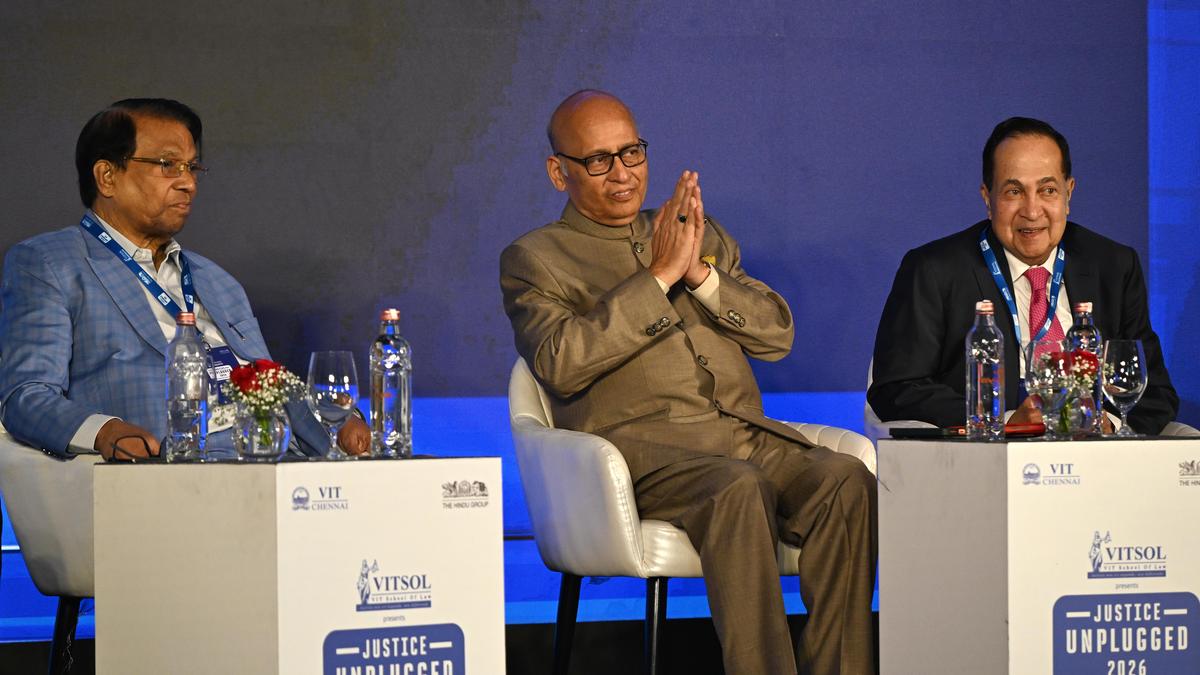
Supreme Court Senior Advocate Abhishek Manu Singhvi (center) with Founder and Chancellor of VIT G. Viswanathan and The Hindu Director N . Ram during The Hindu Justice Unplugged 2026 in New Delhi on February 28, 2026.

Supreme Court Senior Advocate Abhishek Manu Singhvi (center) with Founder and Chancellor of VIT G. Viswanathan and The Hindu Director N . Ram during The Hindu Justice Unplugged 2026 in New Delhi on February 28, 2026.
| Photo Credit: R.V. Moorthy

A lawyer’s vigilance serves as society’s early warning system against the gradual erosion of democratic values, senior advocate A.M. Singhvi said at Justice Unplugged: Shaping the Future of Law, a law conclave organised by VIT School of Law, VIT Chennai, in association with The Hindu, in New Delhi on Saturday (February 28, 2026).

“Democracies rarely collapse in a single dramatic moment. They erode gradually, through normalised excess, through institutional fatigue, through the slow corrosion of standards. It is the lawyer’s duty to recognise those early fissures,” he said, emphasising that a vigilant Bar constitutes the first line of constitutional defence.

Mr. Singhvi drew attention to what he described as a global phenomenon of constitutional backsliding, marked by deepening polarisation and the erosion of institutional norms. Lawyers, he said, must remain alert to such shifts.

“Around the world, we have seen democracies strained by polarisation, misinformation and erosion of institutional norms. Rarely do these crises begin with tanks on the streets. They begin with subtle distortions, normalising exceptional powers, questioning judicial legitimacy, weakening checks and balances,” he said.

Law as a bulwark for the voiceless

He also urged law students to steadfastly uphold constitutional values. Recalling stalwarts such as Nani Palkhivala, he pointed out that outstanding jurists are remembered not merely for their forensic brilliance in constitutional courts, but for their unwavering fidelity to constitutional principles.

“The courtroom is not a battlefield of egos; it is a sanctuary of reason. To enter it unprepared is disrespectful; to enter it without integrity is dangerous,” he said.

Mr. Singhvi further noted that the law must function as a shield for those without a voice. The true measure of a legal system, he said, lies not in how it treats the powerful when they are secure, but in how it protects the vulnerable when they are exposed. He pointed out that transformative change across jurisdictions has often been catalysed by young lawyers unwilling to accept inherited injustice as immutable.

“In India, public interest litigation expanded access to justice, bringing bonded labourers, under-trial prisoners, environmental degradation and gender discrimination within judicial scrutiny. That movement was not driven by corporate incentives; it was driven by moral imagination,” he said.

‘Selective’ corruption reference in NCERT textbook

Responding to a question from the audience, the senior counsel said a reference to “corruption” in the judiciary in a Class 8 textbook published by the National Council of Educational Research and Training (NCERT) was troubling because of its “selective” emphasis. While acknowledging that corruption exists across institutions, he said the chapter appeared to single out the judiciary without addressing similar concerns within the bureaucracy or the political class.

Earlier, the Supreme Court had registered a suo motu case over the “selective reference” and said it was a “tentatively calculated, deep-rooted attempt” to denigrate the judicial institution.

“…There can be no two views about the fact that there are black sheep in the judiciary, as in every other sector,” he said. “The problem lies in the selectivity of a two-page chapter that, out of the blue, isolates the judiciary without institutionally addressing corruption, which is rampant in the bureaucracy and the political class. It is presented out of context, as if targeting one institution alone. That is a matter of concern,” he said.

He added that the inclusion of the chapter appeared to have been undertaken without due scrutiny and could be construed as an “agenda” to “intimidate” the judiciary.

The chapter titled ‘The Role of the Judiciary in Our Society’ in a Class 8 Social Science book prescribed by NCERT identifies corruption, a mounting backlog of cases, and an inadequate judicial strength as among the “challenges” confronting the justice system. The section on “corruption in the judiciary” in the book states that judges were bound by a code of conduct that governed not only their behaviour in court but also how they conducted themselves outside of it.

Published – February 28, 2026 11:20 pm IST


Source link

Anbumani urges T.N. government to consider demands of noon-meal workers
Russia-Ukraine war, volatile coal markets driving up electricity costs in India: study
Waste treatment factory to resume operations
Goa nightclub fire: MEA considering Goa govt’s request to revoke passports of co-owners
India could withstand external shocks due to strong domestic demand and economic policies: Shaktikanta Das
TAGGED:India judiciaryIndia Lawyer’s vigilancesenior advocate A.M. Singhvithe hindu justice unplugged
Share This Article
Facebook Email Print
Leave a Comment

Leave a Reply Cancel reply

Your email address will not be published. Required fields are marked *

Follow US

Find US on Social Medias
FacebookLike
XFollow
YoutubeSubscribe
TelegramFollow

Weekly Newsletter

Subscribe to our newsletter to get our newest articles instantly!
[mc4wp_form]
Popular News

Bombay HC directs Maharashtra govt to pay ₹50 lakh benefit to COVID duty staff’s family

Times Desk
Times Desk
December 23, 2025
NSE SME Stock gains nearly 9% after company announces quarterly results: Check details here
Karnataka High Court directs government to develop unified and technology-driven platform for Bengaluru’s sold waste management
Manipur BJP MLA’s family refuses burial till demands are met
Central drug regulator releases guidelines to compound minor drug violations
- Advertisement -
Ad imageAd image
Global Coronavirus Cases

Confirmed

0

Death

0

More Information:Covid-19 Statistics
© INDIA TIMES NOW 2026 . All Rights Reserved.
Welcome Back!

Sign in to your account

Username or Email Address
Password

Lost your password?

