


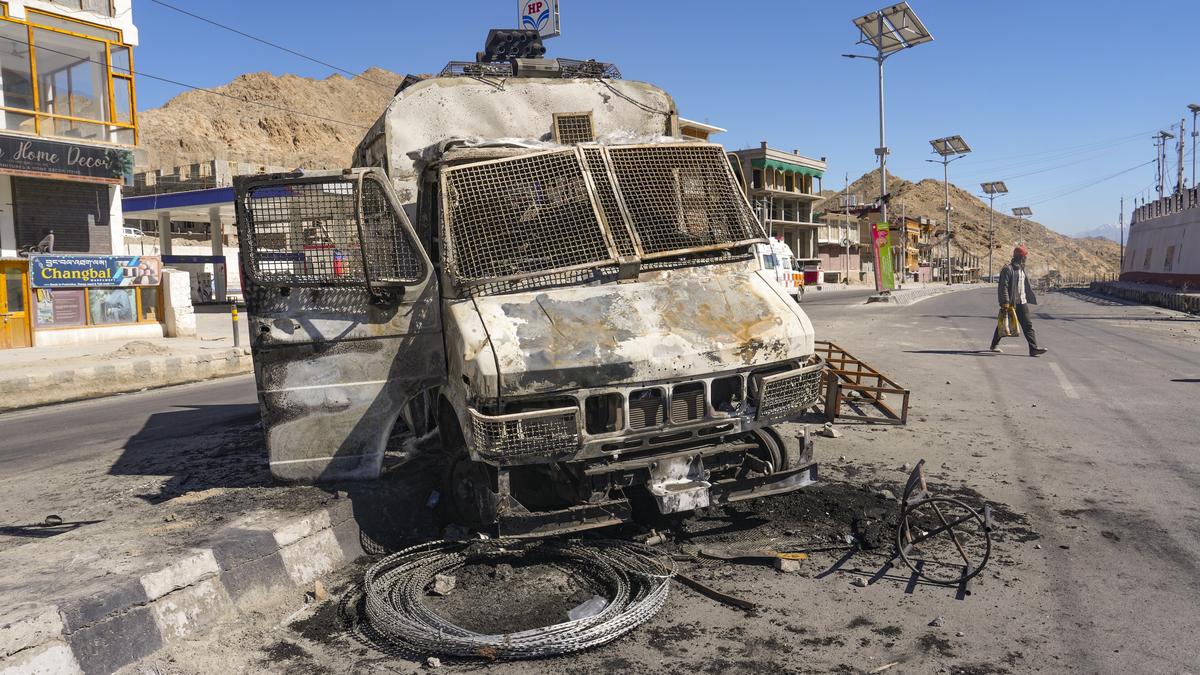
Charred remains of a vehicle lies in the aftermath of violent clashes between demonstrators and police during a protest demanding statehood for Ladakh, outside BJP headquarters building, in Leh, on September 25, 2025.
| Photo Credit: PTI
Tensions in Leh boiled over on September 24 as youth-led protests over statehood and constitutional protections spiralled into clashes with security forces. At least four people were killed and dozens injured, prompting the imposition of curfews and prohibitory orders across Leh and parts of Kargil. The unrest has thrust demands for deep structural change in Ladakh into the national spotlight.
Also Read: Mistrust in Ladakh: On the violence, legitimate aspirations
Why are people protesting in Ladakh?
For several years, residents of Ladakh have pressed the Centre for stronger constitutional safeguards, local control over land and jobs, and greater political representation. Protesters’ principal demands include full Statehood for Ladakh, the extension of constitutional protections under the Sixth Schedule (which grants certain autonomous powers to tribal areas), separate Lok Sabha seats for Leh and Kargil, and job reservations for local communities. These demands have been voiced through local bodies, including the Leh Apex Body and the Kargil Democratic Alliance.

A hunger strike led by civic groups in Leh, including the Leh Apex Body, pressed the Union Government to grant Ladakh Statehood and include the region under the Sixth Schedule. The unrest began as large, youth-led demonstrations in Leh calling for the elevation of Ladakh’s status and special constitutional protections.
On September 24, clashes between protesters and security personnel escalated: vehicles and offices were torched, stones were pelted in several parts of the town, and police used tear gas and baton charges to disperse crowds. Authorities said live rounds were fired during attempts to control the situation; by nightfall, at least four civilians were reported dead and many more injured. Curfew and prohibitory orders were imposed in Leh and parts of Kargil as officials sought to re-establish normalcy.
Also Read: What special status is Ladakh seeking? | Explained
Youth aggregations departed from the strike venue, marching toward official buildings and a BJP office, marking a move from peaceful protest to confrontation. Leaders have described this shift as a “Gen Z revolution,” a younger demographic breaking away from traditional protest methods.
Who is leading the protests in Ladakh?
The recent wave of mobilisation has been led in large part by younger activists and student groups, often described as “Gen Z” participants. Climate activist and educator Sonam Wangchuk, who began a hunger strike in early September, has been a prominent public figure associated with the movement’s demands for Sixth Schedule protections and statehood. The Centre has stated that it has been engaging with regional groups on these issues. The Press Information Bureau issued a statement noting these exchanges and also recording Mr Wangchuk’s fast.
What are the demands of the protesters in Ladakh?
Protesters’ core demands have centred on four items: full Statehood for Ladakh; inclusion of the Union Territory in the Sixth Schedule of the Constitution; separate parliamentary representation for Leh and Kargil; and job and land safeguards for residents. These issues date to Ladakh’s 2019 reorganisation, when it was separated from Jammu & Kashmir and placed under direct central administration, a change that many residents say left key questions over governance and local rights unresolved.
The Union Home Ministry and the Ladakh administration described the unrest as seriously disruptive. The Ministry subsequently revoked the Foreign Contribution (Regulation) Act (FCRA) registration of an organisation founded by Mr Wangchuk, citing alleged regulatory violations.
What lies ahead for Ladakh?
Officials have indicated fresh talks with the Leh Apex Body and the Kargil Democratic Alliance to address grievances. However, curfew restrictions remain in place, schools are closed, and public gatherings are prohibited as the administration seeks to prevent further escalation.
Published – September 26, 2025 01:02 pm IST



