


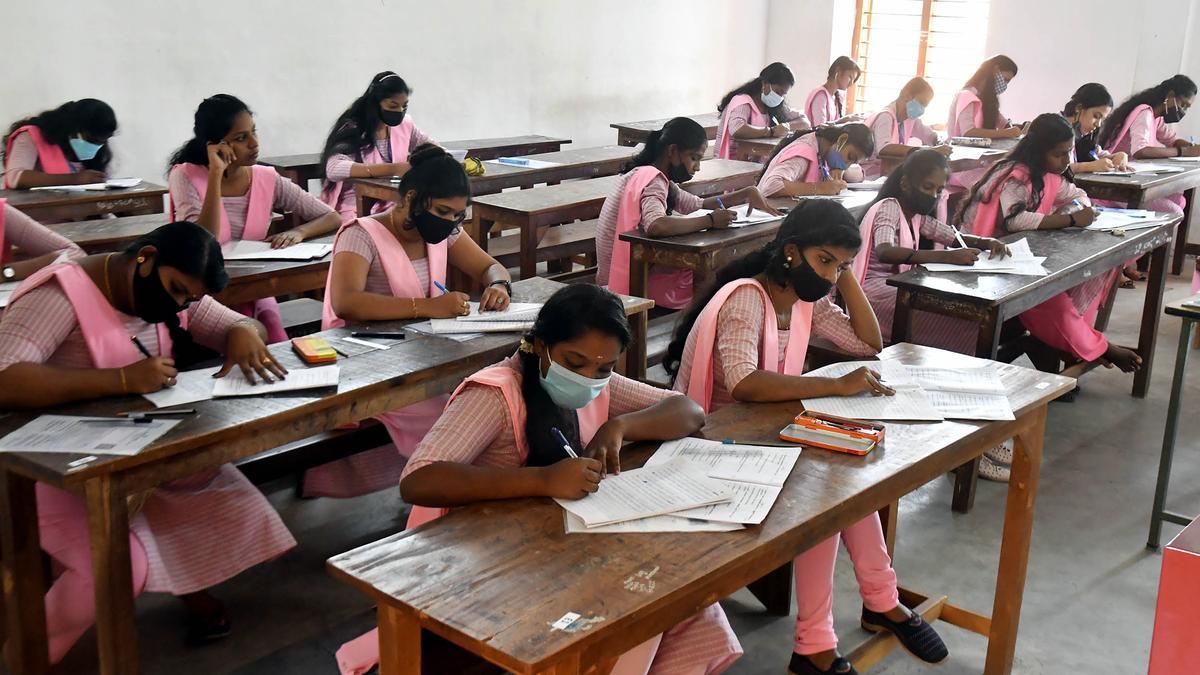
image for representation
| Photo Credit: special arrangement
The KEAM engineering examinations in Kerala this year (2026) will be conducted using a revised normalisation formula, modelled on the system followed in Tamil Nadu.
The reform is being reintroduced after it had faced strong opposition last year, as it was implemented after the entrance examinations had already been conducted. Subsequently, the Kerala High Court directed the State government to revert to the previous formula after observing that the sudden change could adversely affect students from CBSE and ISCE streams.
Under the new framework, equal weightage (50:50) will be assigned to the normalised entrance examination score and the marks secured in the final year of the qualifying examination.
Government sources point out that normalisation of entrance scores is essential to ensure that candidates do not gain undue advantage or suffer disadvantage due to differences in question paper difficulty levels across sessions. Besides, it is estimated that the marks secured by State Board students used to decrease by as much as 35 marks during the normalisation process as per the previous formula, even in the case of those who scored full marks.
The move comes in the backdrop of computer-based tests being conducted in multiple sessions over different days since 2024 for engineering and pharmacy courses, leading to minor variations among question paper patterns of various sessions.
An internal committee observed that the existing standardisation policy did not adequately justify mark variations among students who had studied similar syllabi.
It is also pointed out that the syllabi followed by CBSE, State boards and other recognised boards are largely based on NCERT textbooks, and significant disparities in academic preparation among students are generally absent. In such a context, the present standardisation procedures were found to create unnecessary mark differentials, and could potentially affect the principles of educational equity.
Cabinet approval
Accepting the committee’s recommendations, the State Cabinet had approved the revised normalisation model.
Admission will be regulated on the basis of merit calculated as an index mark out of 600 with equal weightage given to the normalised entrance examination score and the marks obtained in the final qualifying examination (both out of 300).
For the qualifying examination component, the marks in Mathematics, Physics and Chemistry will be combined in the ratio 5:3:2 (translating to a distribution of Mathematics: 150 marks, Physics: 90 marks and Chemistry: 60 marks).
In cases where a candidate has not studied Chemistry, marks in Computer Science will be considered. If both Chemistry and Computer Science were not studied, Biotechnology marks will be taken into account, and in their absence, Biology marks will be considered.
The relevant clauses in the KEAM 2026 prospectus will be amended accordingly to incorporate the revised methodology.
Published – February 18, 2026 02:30 pm IST



