


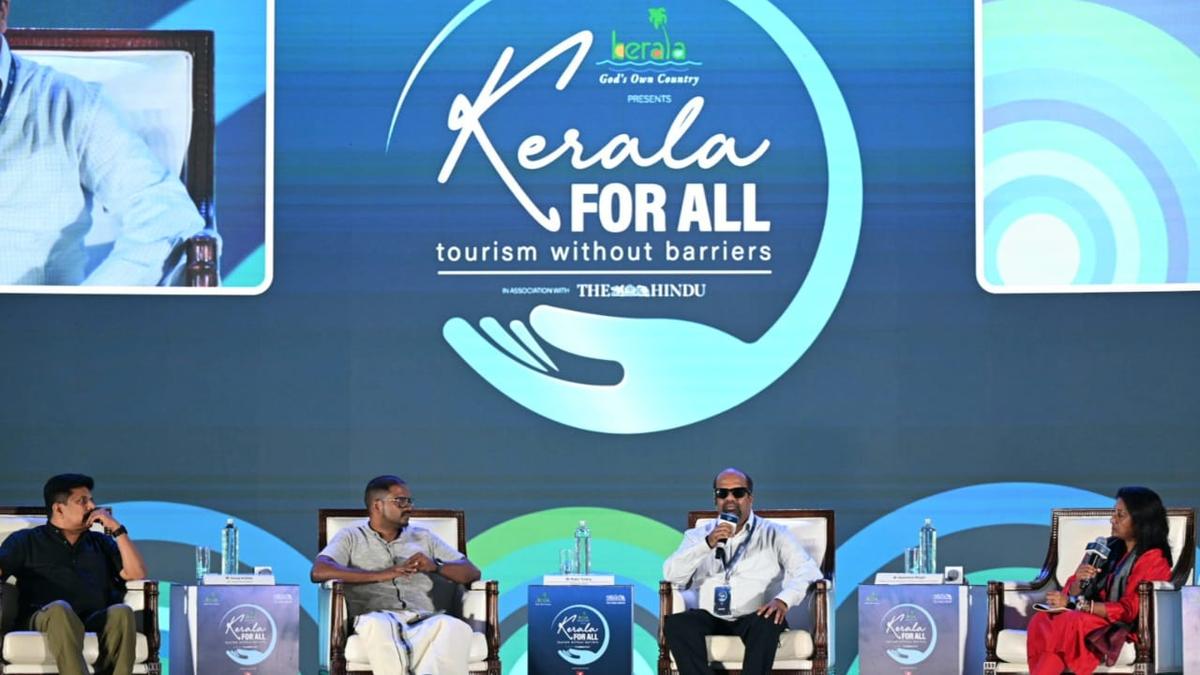
Anoop P. Ambika, CEO, Kerala Startup Mission (KSUM); Robin Tommy, Executive Director, Kerala Development and Innovation Strategic Council; Saidarshan Bhagat, Scientist D, Centre for Development of Advanced Computing, Mumbai, and moderator Soma Basu, Senior Deputy Editor, The Hindu, at a session at Kerala for All conclave in Kochi on Sunday.
| Photo Credit: H. Vibhu
Accessibility should not be reduced to a mere checklist, compliance factor, part of a regulatory mechanism, or simply an afterthought. It must be placed at the core of designing and developing every possible solution, observed experts at the session on Digital and Technology Innovation in Inclusive and Accessible Tourism at Kerala For All, a conclave on accessible and inclusive tourism jointly organised by Kerala Tourism and The Hindu.
Anoop P. Ambika, CEO, Kerala Startup Mission (KSUM); Robin Tommy, Executive Director, Kerala Development and Innovation Strategic Council; and Saidarshan Bhagat, Scientist D, Centre for Development of Advanced Computing, Mumbai, participated in the session. Soma Basu, Senior Deputy Editor, The Hindu, moderated the discussion.
Mr. Ambika said technology solutions should intuitively cater to the person using them by combining technologies like AI, Augmented Reality, Virtual Reality, voice, and brain-computer interfaces. “The development and adoption of technology, and the infusion of design into this process, remain very poor. Instead of fragmented solutions to address accessibility, what is needed are end-to-end solutions that can be integrated into a single workflow,” he said.
‘Incentivise firms’
He also called for developing empathy towards the differently abled from the school level by making it part of the curriculum, so that future innovators design solutions accessible to all. He added that the government should incentivise large corporate firms to make their systems fully accessible, either through taxation benefits or by utilising corporate social responsibility funds.
Mr. Tommy said accessibility should not be seen merely as a checklist, compliance requirement, or regulatory mechanism, but as a lived experience. “It is not that we lack technology or are unwilling to adopt it; rather, we don’t know where to use what. The design aspect presents the biggest challenge. Today, many designers have not even studied universal design principles in terms of accessibility. Accessibility and inclusive solutions should be approached from the perspective of environment, experience, and design,” he said.
Struggles recounted
Mr. Bhagat highlighted that lack of awareness, poor sensitisation, and faulty design of assistive technologies make accessibility a major challenge for differently abled travellers. He recounted his own struggle with self check-in counters at airports, which he said are not designed for the differently abled community. He added that digital products present similar challenges, often making differently abled individuals dependent on others.
“The Bureau of Indian Standards has developed an excellent set of standards for ICT products that comply with global norms. Policymakers and manufacturers must adopt these standards while designing their products,” he urged.
Published – February 01, 2026 06:46 pm IST



