


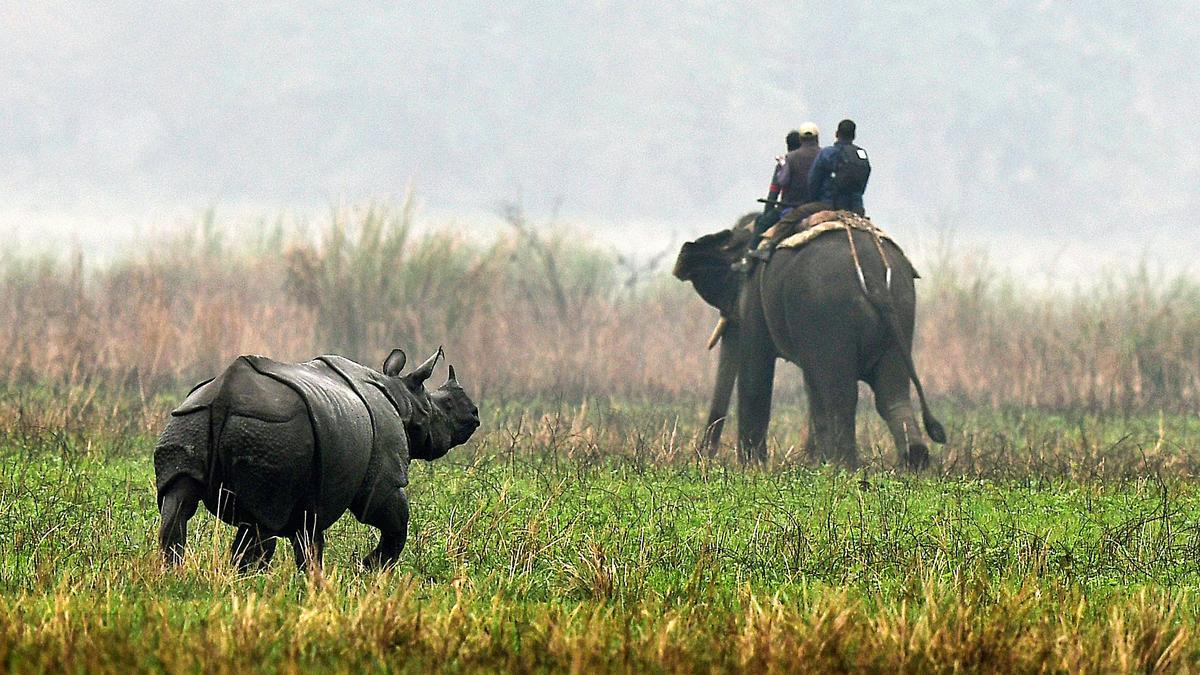
A one horned rhino looks at the tourists on elephant back in the Kohora range of Kaziranga National Park, Assam. Image for the purpose of repre
| Photo Credit: Ritu Raj Konwar
GUWAHATI
Simultaneous surveys have revealed that the 1,307.49 sq. km Kaziranga National Park and Tiger Reserve houses almost 40% of the 274 species of amphibians and reptiles, and more than 18% of the 422 species of freshwater fish recorded across the northeast.
The surveys were conducted between July and September by a team of Kaziranga officials in collaboration with scientists and researchers from the Wildlife Institute of India.
According to the surveys, the Kaziranga landscape supports 108 species of amphibians and reptiles, accounting for 39.41% of at least 274 herpetofauna species known from India’s northeastern region, comprising eight States.
Numerous wetlands of the tiger reserve also support 77 species of freshwater fish, which is more than 35% of Assam’s ichthyofauna, comprising 216 species.
“The richness of native species of fish and herpetofauna indicates that Kaziranga provides a pristine habitat to wild fauna. The diversity of amphibians and reptiles, in turn, serves as key indicators of the ecosystem health that play vital roles in maintaining ecological balance,” an official statement read.
Assam’s Environment, Forest, and Climate Change Minister Chandra Mohan Patowary released the survey reports on November 2.
Chief Minister Himanta Biswa Sarma said the surveys “reflect the sustained conservation efforts of our government and the dedicated work of the Forest Department’s officers and frontline staff, who continue to safeguard this invaluable ecosystem.”
Report highlights
The ichthyofauna survey reveals that Kaziranga’s fishes belong to 18 families, with Cyprinidae and Danionidae emerging as the most dominant families. The survey reaffirms the status of the tiger reserve as a key refuge for freshwater biodiversity in the Brahmaputra basin.
The report also documents species of conservation concern such as Wallago attu, Cirrhinus cirrhosus, and Botia rostrata (vulnerable); Parambassis lala, Ompok pabda, and Chitala chitala (near threatened); and Clarias magur (endangered).
The report underscores the ecological significance of fish in sustaining nutrient cycles, food webs, and habitat connectivity, while supporting species such as otters, fishing cats, and waterbirds. It also highlights threats from climate change, siltation, hydrological changes, and unregulated fishing, calling for long-term monitoring and stronger conservation measures.
The herpetofauna recorded during the survey belong to 19 genera and 14 families. The species include threatened species such as king cobra (Ophiophagus hannah), Assam roofed turtle (Pangshura sylhetensis), and the Asian brown tortoise (Manouria emys). The others include Chiromantis assamensis (vulnerable), Nilssonia nigricans (critically endangered), Varanus flavescens (endangered), and the data-deficient Cyrtodactylus kazirangaensis, found only in Kaziranga.
Published – November 07, 2025 05:07 pm IST



