

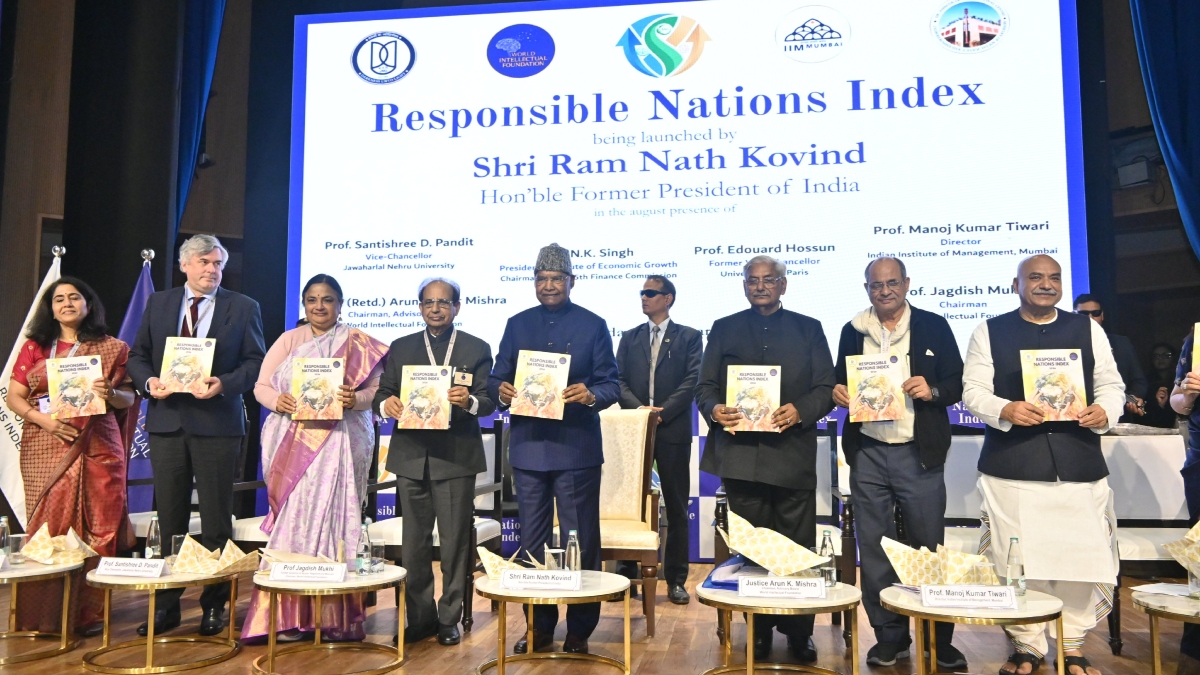

Responsible Nations’ Index (RNI) is a first-of-its-kind global index that evaluates countries based on how responsibly they exercise power towards their citizens, global community and the planet.
India is far ahead of nations like the United States, China and Pakistan in the Responsible Nations’ Index (RNI) launched by former President Ram Nath Kovind. While Singapore ranked first, Switzerland was second and Denmark third. The Central African Republic stood last on the 154-nation index. India’s neighbour, Pakistan, was in the 90th place. China was ranked 68th and the US 66th, according to the RNI.
What is the Responsible Nations’ Index?
Responsible Nations’ Index (RNI) is a first-of-its-kind global index that evaluates countries based on how responsibly they exercise power towards their citizens, the global community and the planet.
The RNI is a global evaluative framework developed by the think tank World Intellectual Foundation (WIF) in academic collaboration with Jawaharlal Nehru University (JNU) and methodological validation by the Indian Institute of Management (IIM), Mumbai.
The former President underlined the importance of ethical governance, inclusive development, and moral responsibility in shaping sustainable national and global futures.
“The index is not a scoreboard which increases competition, but a mirror of morality and responsibility which reflects if countries are doing justice to their citizens,” he said.
Index is anchored in three core dimensions
The index is anchored in three core dimensions — internal responsibility, environmental responsibility and external responsibility. The RNI has been operationalised through seven dimensions, 15 aspects and 58 indicators.
Sudhanshu Mittal, Founder and Secretary, WIF, said the RNI represents a shift from power-centric assessments to responsibility-centric evaluation of nations.
“The Responsible Nations Index asks a fundamental question — how responsibly does a nation exercise its power? Prosperity without responsibility is unsustainable. The RNI seeks to encourage ethical governance, humane development and global stewardship,” he said.



