


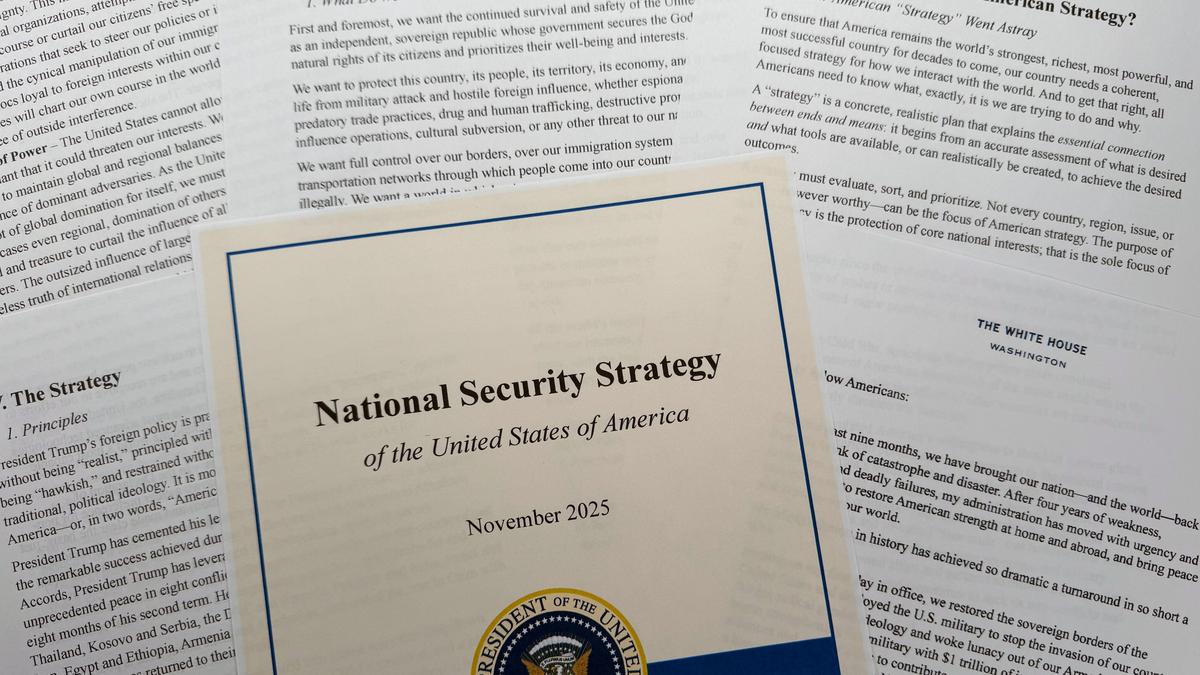
The National Security Strategy document, released in November 2025, is photographed on December 10, 2025.
| Photo Credit: AP
In 2005, when I served on the Prime Minister’s Task Force on Global Strategic Developments chaired by K. Subrahmanyam, India and the U.S. stood at the threshold of a historic transformation. Washington had declared that it wished to “help India become a major world power in the 21st century.” It was an extraordinary statement, not merely because of what it promised but because of the confidence it reflected. The U.S. then still believed that strengthening responsible rising powers would strengthen the world. That belief seemed to form, for many, the bedrock of the civil nuclear breakthrough and of a strategic partnership built on a shared sense of possibility.
The U.S.’s retreat
Reading the 2025 U.S. National Security Strategy (NSS) is therefore an unsettling experience. The document is saturated with self-praise. It claims to have “brought our nation — and the world — back from the brink of catastrophe and disaster” and asserts that “no administration in history has achieved so dramatic a turnaround in so short a time.” But this assertiveness feels defensive. It projects a nation unsure of its place in a world it no longer fully comprehends, yet unwilling to concede that uncertainty even to itself. The result is a strategy that is less a map for global action and more an exercise in national reassurance.
The contrast with the intellectual spirit of 2005 could not be sharper. Then, Washington spoke the language of partnership. Today, it speaks the language of burdens. “The days of the United States propping up the entire world order like Atlas are over,” the strategy declares. Global leadership, once embraced with ease, is now treated as a cost to be minimised. The overriding imperative is not to elevate the international system but to lighten America’s load.
Editorial | Notional security: On the U.S.’s National Security Strategy
Nowhere is this shift more stark than in the treatment of India. Cooperation is acknowledged but is instrumental. India is framed less as a civilisational actor and more as a component in America’s China calculus. The NSS states that the U.S. must “continue to improve commercial (and other) relations with India to encourage New Delhi to contribute to Indo-Pacific security, including through continued quadrilateral cooperation with… ‘the Quad’.” In this framing, India is not an end in itself but a means to a balance-of-power arrangement the U.S. seeks to preserve.
In 2005, India’s rise was an objective; now, it is a function. This narrowing is part of a broader retreat from internationalist confidence. The so-called Trump Corollary to the Monroe Doctrine, declaring an intent to “assert and enforce” hemispheric exclusivity, speaks to a nation turning inward. The irony is difficult to miss. In 2005, when India spoke of strategic autonomy, many in Washington bristled. In 2025, when America claims an expansive and unilateral autonomy, it calls it realism.
The document’s tone reinforces this inwardness. It catalogues a series of claimed diplomatic triumphs, resolving multiple global conflicts “from Cambodia and Thailand” to “Pakistan and India”. These read less like diplomatic achievements and more like political assertions crafted for domestic effect. Strategy becomes performance, and performance becomes a substitute for engagement with the world’s real fissures.
For India, the implications are clear. The U.S. that sought to create strategic space for India in 2005 is not the U.S. reflected in the NSS — it is preoccupied with its own vulnerabilities, identity, and hierarchy of burdens. It demands more from partners yet offers less in return. It speaks of shared interests while retreating from shared responsibilities. It calls for burden-sharing but often means burden-shifting.
This does not diminish the importance of India-U.S. cooperation. It simply changes its foundations. India cannot rely on the assumption that Washington will invest in India’s rise as a matter of strategic design. India’s rise will depend on India. Partnership will endure where interests converge and remain measured where they do not. As the NSS itself insists, partners must increasingly “assume primary responsibility for their regions,” a polite but unmistakable signal that U.S. support will be conditional and limited.
The path forward
The lesson of 2005 remains valuable because it reminds us of the conditions under which strategic transformations occur: confidence on both sides and a belief that the other’s ascent strengthens one’s own. The 2025 strategy lacks that confidence. It is shaped by grievance at past overreach, suspicion of institutions, and a preoccupation with restoring an earlier notion of American primacy.
India therefore must resist the temptation to interpret this document through the lens of earlier hopes. The era that produced the civil nuclear breakthrough was an era of widening horizons for both India and the U.S. The era that produced this strategy is one of contracting horizons for the U.S. and expanding responsibilities for India. If India is to be a major world power in the 21st century, it will not be because any external actor wills it. It will be because India possesses the strategic confidence and material capacity to act independently within a fragmented global order.
Paradoxically, the 2025 strategy makes that reality clearer than its authors intend. By reducing the scope of American commitments, it widens the space for others. For India, the challenge is not to fill a vacuum but to craft a role suited to its scale, interests, and civilisational temperament. The assumptions of 2005 cannot return, but the aspiration that animated them is ours to pursue.
Amitabh Mattoo, Dean and Professor, School of International Studies, JNU and former Member National Security Advisory Board
Published – December 17, 2025 12:39 am IST



