

By using this site, you agree to the Privacy Policy and Terms of Use.
Accept
India Times NowIndia Times NowIndia Times Now
Notification Show More
Font ResizerAa
  • Bharat Shreshtha Ratna Sanman
  • India News
  • Categories
    • Technology
    • Entertainment
    • The Escapist
    • Insider
    • Finance ₹
    • India News
    • Science
    • Health
Reading: In a first, migratory honey bees get ‘warm womb’ to stay back in winters in Kashmir
Share
India Times NowIndia Times Now
Font ResizerAa
  • Bharat Shreshtha Ratna Sanman
  • India News
  • Categories
Search
  • Bharat Shreshtha Ratna Sanman
  • India News
  • Categories
    • Technology
    • Entertainment
    • The Escapist
    • Insider
    • Finance ₹
    • India News
    • Science
    • Health
Have an existing account? Sign In
Follow US

Home » In a first, migratory honey bees get ‘warm womb’ to stay back in winters in Kashmir

India News

In a first, migratory honey bees get ‘warm womb’ to stay back in winters in Kashmir

Times Desk
Last updated: April 19, 2026 12:30 am
Times Desk
Published: April 19, 2026
Share
SHARE


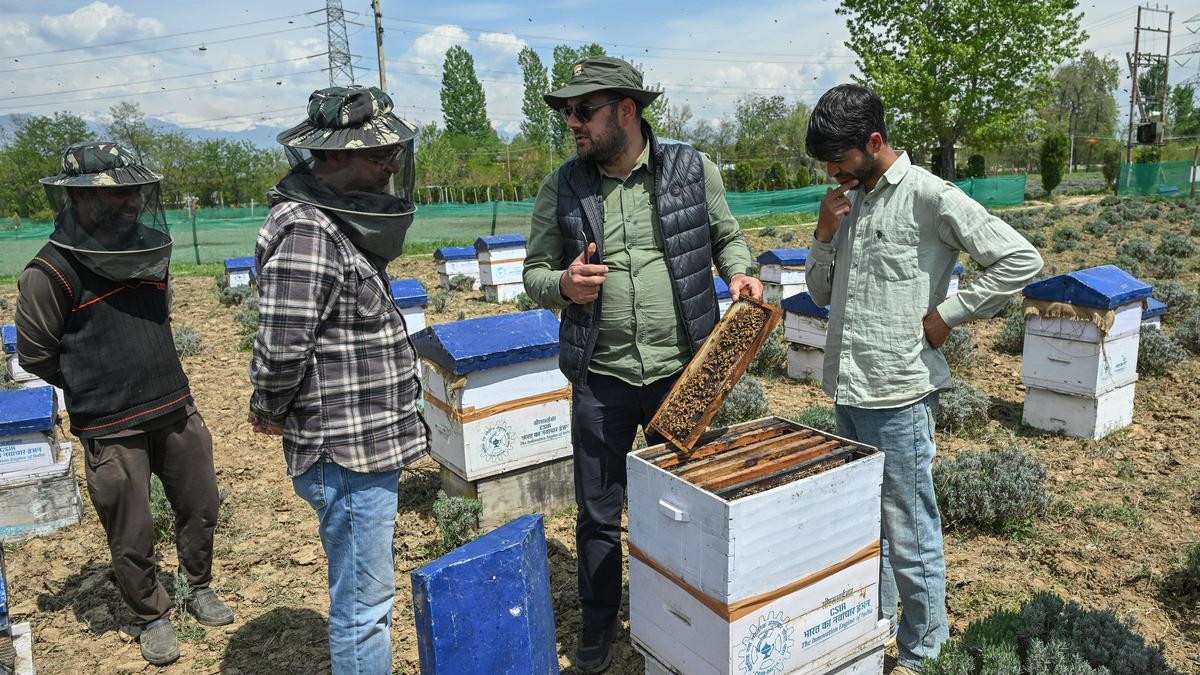
Scientists at the Council of Scientific and Industrial Research-Indian Institute of Integrative Medicine (CSIR-IIIM), Pulwama, have created a new protocol to raise honey bees in sub-zero temperatures in Kashmir for the first time

Scientists at the Council of Scientific and Industrial Research-Indian Institute of Integrative Medicine (CSIR-IIIM), Pulwama, have created a new protocol to raise honey bees in sub-zero temperatures in Kashmir for the first time
| Photo Credit: Imran Nissar

A new set of protocols and scientific intervention in honey bee farming in Jammu and Kashmir will finally allow beekeepers to rare colonies in sub-zero temperatures, instead of physically migrating hives to the plains for around six months with reported 30% mortality. As its spinoff, Kashmir has also recorded its first mono-floral apple honey. 

On January 29, when the Kashmir Valley was under a layer of snow, the Council of Scientific and Industrial Research-Indian Institute of Integrative Medicine (CSIR-IIIM), Pulwama, invited around 200 orchardists to the Bonera farm to demonstrate the first surviving bee colony of Apis mellifera, a migratory bee species at the core of the production of around 2,000 metric tonnes of honey annually worth ₹12.5 lakh.   

Published – April 19, 2026 06:00 am IST


Source link

Jaipur students develop AI-enabled platform for soldiers’ access to schemes
Rasmi Film Society, KUWJ to hold Palestine solidarity event
A month on, Assam mourns Zubeen’s death as family, fans await answers on his final moments
Congress MLC Pradnya Satav abandons party just before local polls to join BJP
Drop in KIA’s domestic passenger numbers in December 2025 due to IndiGo crisis
Share This Article
Facebook Email Print
Leave a Comment

Leave a Reply Cancel reply

Your email address will not be published. Required fields are marked *

Follow US

Find US on Social Medias
FacebookLike
XFollow
YoutubeSubscribe
TelegramFollow

Weekly Newsletter

Subscribe to our newsletter to get our newest articles instantly!
[mc4wp_form]
Popular News

Recruitment notification for 1,743 Telangana RTC drivers and shramiks

krutikadalvibiz
krutikadalvibiz
September 18, 2025
Once again, anger over Almatti
Campaign against sexual violence launched
Premier Energies commissions 5.6 GW solar module facility near Hyderabad
Gujarat High Court, after attire remarks in court, asks IIT Gandhinagar to ‘show sympathy’ to suspended student
- Advertisement -
Ad imageAd image
Global Coronavirus Cases

Confirmed

0

Death

0

More Information:Covid-19 Statistics
© INDIA TIMES NOW 2026 . All Rights Reserved.
Welcome Back!

Sign in to your account

Username or Email Address
Password

Lost your password?

