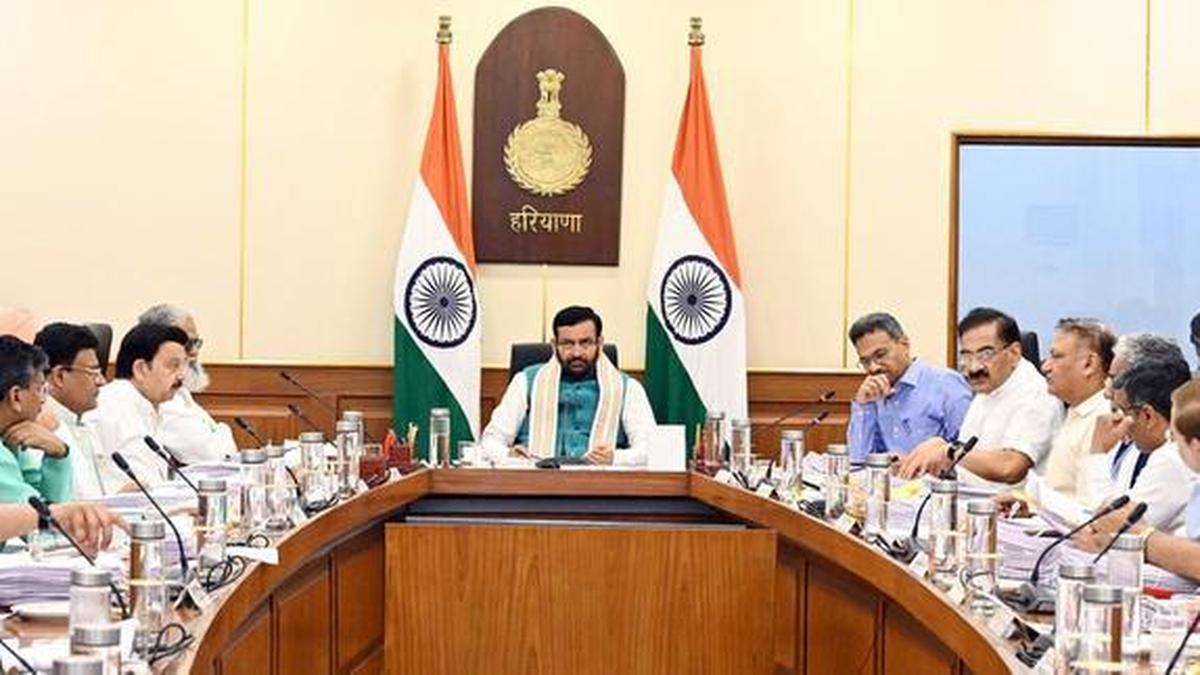
Haryana Chief Minister Nayab Singh Saini chairing the Cabinet meeting, in Chandigarh on Monday.
| Photo Credit: ANI
The Haryana Cabinet on Monday approved the Make in Haryana Industrial Policy 2026, which aims to draw fresh investments worth ₹5 lakh crore, create 10 lakh jobs, and boost the State’s export figures over the next five years.
The industrial policy provides for capital subsidy for new industrial investment, recruitment of youth registered on the Haryana Kaushal Rozgar Nigam portal, and incentives for research and development.
According to an official statement, the employment generation subsidy has been raised from ₹48,000 to up to ₹1 lakh per employee per year for 10 years to promote local employment.
The Cabinet meeting, chaired by Chief Minister Nayab Singh Saini, also approved the rules for granting aggregator licences under the Haryana Motor Vehicles Rules, 1993. The rules align with guidelines issued by the Ministry of Road Transport and Highways and directions of the Commission for Air Quality Management.
The statement added that the move aims to promote clean mobility, curb vehicular pollution, and improve air quality in the State’s National Capital Region (NCR) areas.
Under the amended rules, all new vehicles added to the fleets of aggregators, delivery service providers, and e-commerce entities in NCR areas from January 1, 2026 must run on CNG or other cleaner fuels, or should be electric or battery-operated.
In addition, only CNG or electric autorickshaws will be permitted for new inductions into existing fleets in NCR areas, it added.
The Cabinet also approved the substitution of Rule 86A of the Haryana Motor Vehicles Rules to establish a comprehensive regulatory framework for app-based passenger aggregators and delivery service providers in the State.
According to the statement, new provisions include mandatory licensing for aggregators and delivery service providers, norms for onboarding drivers and vehicles, passenger safety measures, grievance redressal mechanisms, induction and refresher training programmes, insurance for drivers and passengers, cybersecurity compliance for apps, and regulation of fares.
Published – May 19, 2026 01:00 am IST