


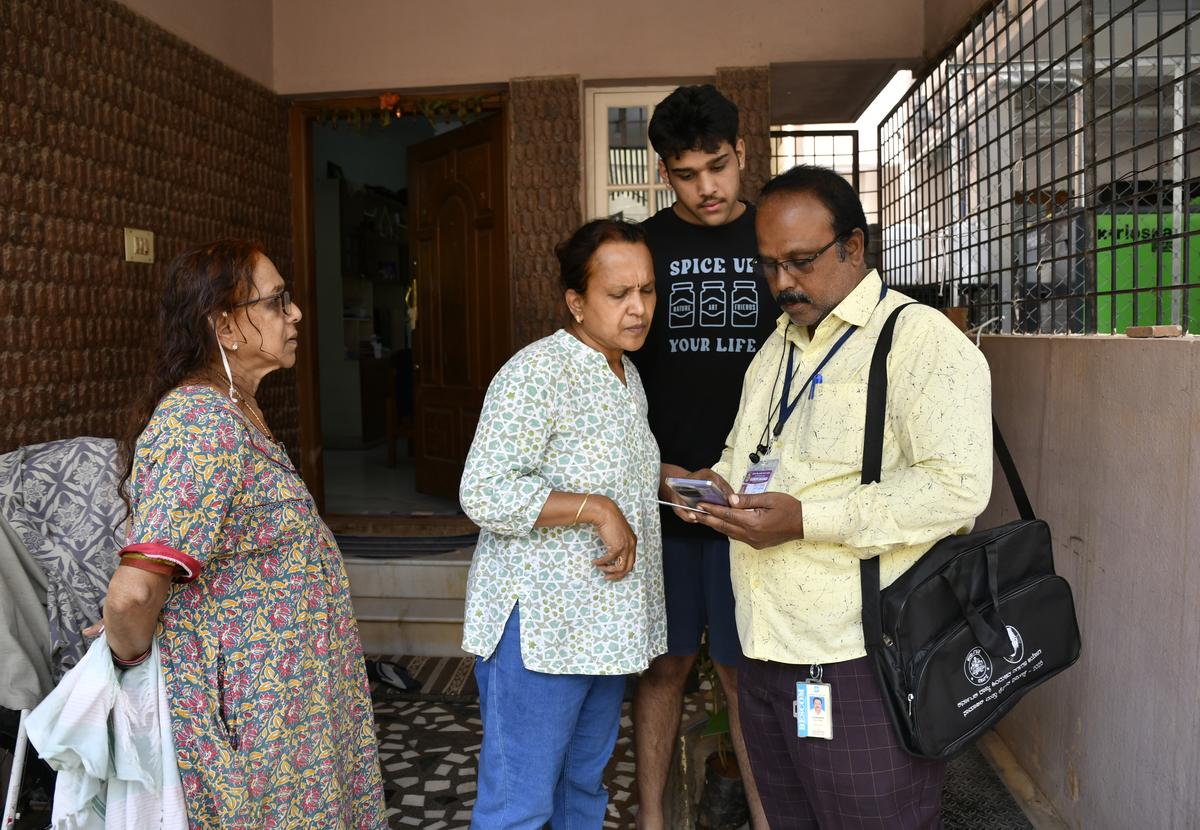
An enumerator interacting with residents during the ongoing Social and Educational Survey at Bhuvaneswari Nagar in Bengaluru on Sunday.
| Photo Credit:
ALLEN EGENUSE J.
On Sunday morning, Manappa P. (name changed) started his day at 11 a.m., going door-to-door to conduct the Social and Educational Survey at Bhuvaneshwari Nagar in Dasarahalli. Assigned as an enumerator, Mr. Manappa, a Bescom meter reader, had been out in the streets for over 90 minutes before one household finally agreed to answer and cooperate for the ongoing survey, which took nearly an hour to complete.
His experience was not unusual. Across Bengaluru’s five corporation limits, the survey, which began on October 4 in the Greater Bengaluru Authority (GBA) limits, is taking place slowly, due to public hesitation, reluctance, and technical glitches.
The enumerators said that while there’s no official target set for them, they have been clearly instructed to complete up to 15 surveys in a day. “The public are refusing to cooperate. Some are not even opening the door after seeing us. With this kind of cooperation, even completing three or four surveys is a big achievement,” Mr. Manappa said.
No training, no resources
For this survey, the State government roped in enumerators from multiple government departments, who argue that they had not received even half an hour of training before being sent out in the field, leaving them to figure out the process on their own.
Hemanth K., another enumerator, asked a household for their district and the option did not appear on the app. When he asked for caste, the same problem arose. The details had to be scrolled through and could not be searched directly.
“A booklet containing caste, sub-caste, district codes, and other details was supposed to be provided to all of us, but we have not received it. We noted down the codes as we found them so that when another household from the same caste or district appeared, we could enter directly instead of navigating through the app,” Mr. Hemanth lamented.
In some cases, residents themselves tried helping enumerators by checking on YouTube videos, while some were seen checking newspapers that had published some of these details like caste codes.
The enumerators also said that the survey app got crashed, and sometimes the device they own got crashed too. Each household required multiple verification steps, including entering Aadhaar numbers and generating OTPs for each member. Even when the app seemed to work, forms sometimes failed to get saved, compelling them to re-enter information.
Lack of cooperation
A lack of cooperation from residents was common, especially in apartment complexes. Many households said that since they are staying on rent, they would not provide the information themselves and that the owner should give it instead. Others said they had seen on social media that enumerators would ask for bank details or Aadhaar-linked information, which made them unwilling to share their data.
“There are no such questions which can give access to anyone’s personal or financial details. We only ask if people have a bank account and their Aadhaar number to verify other details,” Mr. Manappa said.
Lengthy survey
Even when residents participated, some of them wondered if there was any relevance of certain questions asked in the survey, such as whether a household member knew how to use a computer or had access to the internet. “Why do they need to know this? It feels unnecessary and generic.” A few people who were surveyed felt that such questions added to the length and made it harder for people to remain patient and cooperate.
However, others argued that these details were important to get an accurate picture of the city’s demographics. “Understanding access to technology and similar indicators helps plan educational and social programmes more effectively. If the survey is meant to guide progress, these details cannot be skipped,” Pawan Swamy, a resident of Vasanth Nagar said, adding that simplifying the survey too much would defeat its purpose.
The residents also believe the government should have informed them in advance about when enumerators would arrive. They said it would have saved time for both the residents and the enumerators and allowed everyone to have all necessary documents ready. Often, someone in the household was away, requiring repeated calls for Aadhaar OTPs, which made the process tedious. Many felt that sending bulk messages with schedules or letting residents choose convenient time slots would have made the survey much smoother for everyone.
Divided over location
Officials told The Hindu that some enumerators from the Education Department had raised concerns that could not be accommodated. One teacher, whose school is in Hegde Nagar, requested to be assigned to a nearby area instead of her allotted ward in Dasarahalli, just five km away.
The officials described this as an impractical request, noting that survey areas are assigned according to maps and cannot be changed. The teacher, however, described the allotment process as unfair, saying it did not take familiarity with the area into account and only made the work more difficult.
Published – October 05, 2025 09:02 pm IST



