


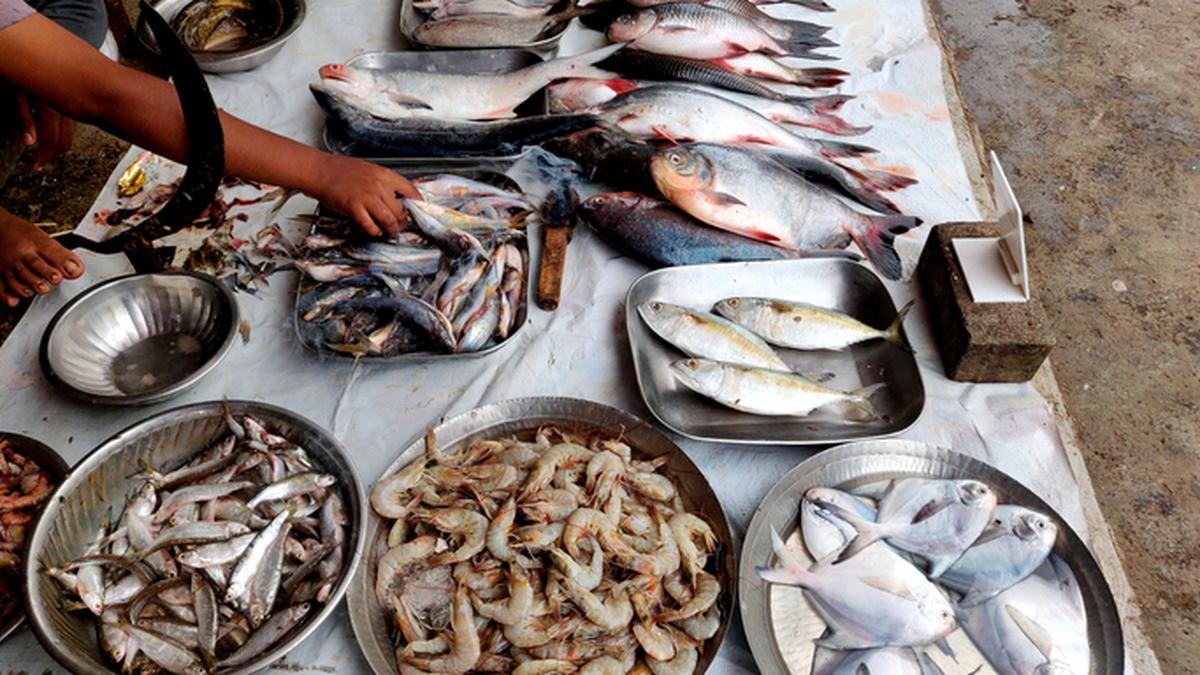
In a recent meeting with State fisheries departments, farmers, fish workers, processors and exporters, the Ministry urged them to cultivate a wider range of species and adopt the latest farming practices.
| Photo Credit: Getty Images/iStockphotos
Given recent challenges in seafood exports due to tariff uncertainty and the impact of climate change, the Union Fisheries Ministry is advising States and the fishing industry to diversify their markets and their produce, to reduce the risk of disease and appeal to global customers.

In a recent meeting with State fisheries departments, farmers, fish workers, processors and exporters, the Ministry urged them to cultivate a wider range of species and adopt the latest farming practices, such as the integrated multi-trophic aquaculture to cultivate more fish in the same space, in order to access new global markets.

In fact, Union Fisheries and Animal Husbandry Minister Rajiv Ranjan Singh recently chaired a meeting with envoys from countries seen as potential new markets. Though invited, the United States was absent from the meeting, which was attended by representatives from more than 40 countries, including China, Russia, Iran, Venezuela, Vietnam, and Saudi Arabia.
Reducing risk
A senior Ministry official told The Hindu that a farmer dependent on one species faces a huge risk. If infested by disease, seeds of that particular species could spread from State to State. In 2006-2007, for instance, the white spot syndrome virus destroyed the farming of black tiger shrimp, the popular brackish water species Penaeus monodon.
“We have been asking the farmers to diversify their species. We have a lot of species with us, which have both domestic and international demand,” the official said. “We have asked States to promote species diversification in inland aquaculture by promoting scampi, tilapia, pangasius in the place of varieties such as rohu (Labeo rohita) and Catla (Catla catla) which do not have a global market presence. We will help States to create production and processing clusters where production, processing, value addition, and export could be done for the benefit of farmers and can create jobs locally,” the official added.
To avoid farmers’ dependency on litopenaeus vannamei (whitleg shrimp) and to ensure disease-free species, government scientists are now working on improving two indigenous varieties — Penaeus indicus (Indian white prawn) and Penaeus monodon (giant tiger prawn). “Both have good export markets. We are exporting these species to more than 100 countries,” the official said.
Global demand
The official said that there is huge international demand for certain finfish like seabass as its meat quality is good. Kerala’s popular karimeen or pearl spot also has an international appeal. “Both can be cultivated in brackish waters. We are now trying to develop this variety particularly in States such as Punjab, Haryana, Uttar Pradesh and Rajasthan where in many parts, groundwater is saline. We want turn the waste land into wealth land,” the official added.
The Centre has also decided to help States in promoting sea weed marine cage culture, a common practice in China and Norway. “We are now using this as a model in Karnataka, Goa, and Andhra Pradesh. Indian pompano, silver pompano, cobia, grouper and seabass could be cultivated using this technology of mariculture,” the official said.
“We are creating a network and value chain to ensure that quality seeds reach to States. Each state has their own fish eating culture. We will cultivate fish according to these culinary traditions,” the official said.
Published – January 23, 2026 11:06 pm IST



