


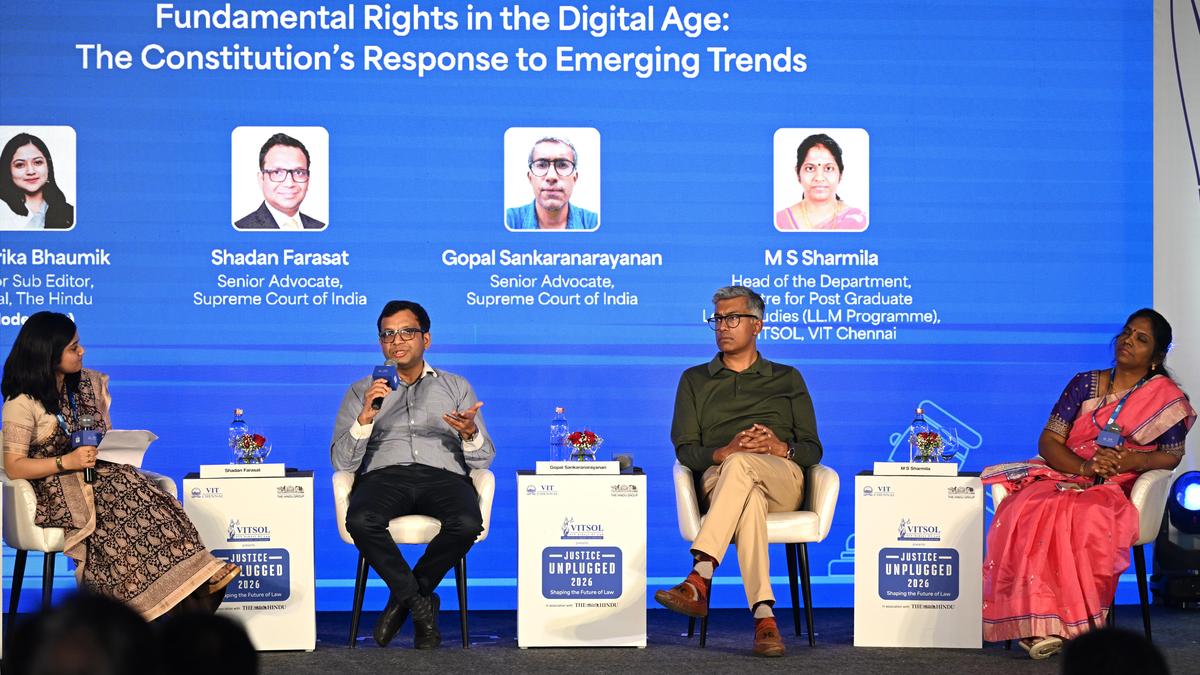
(L-R) Senior Advocates of the Supreme Court Shadan Farasat, Gopal Sankaranarayanan and M.S. Sharmila, HoD Centre for Post Graduate Legal Studies, VIT, at The Hindu Justice Unplugged 2026 in New Delhi on February 28, 2026.
| Photo Credit: R.V. Moorthy
There has been a steady dilution of the Right to Information (RTI) Act, 2005, which is significantly undermining Constitutional guarantees, legal experts said at the ‘Justice Unplugged: Shaping the Future’ of Law conclave organised by the VIT School of Law, VIT Chennai, in association with The Hindu, in Delhi on Saturday (February 28, 2026).
In a panel discussion on ‘Fundamental Rights in the Digital Age: The Constitution’s Response to Emerging Trends’, Gopal Sankaranarayanan, senior advocate, Supreme Court; Shadan Farasat, senior advocate, Supreme Court; M.S. Sharmila, Professor of Law, VIT School of Law, VIT Chennai, were in conversation with Aaratrika Bhaumik, Senior Sub Editor, The Hindu.
Also Read: Justice Unplugged 2026 Highlights
“Over the last decade, the RTI Act has become largely ineffectual. For all practical purposes, information that implicates Central agencies is rarely forthcoming. In the past 10 years, it has been in a ‘dead phase’. When it was enacted, it was a transformative piece of legislation for democratic accountability,” Mr. Farasat said.
The legal practitioners also observed that with greater access to court proceedings and the live-streaming of hearings, both the Bench and the Bar must exercise restraint in avoiding sensational remarks that could compromise the integrity of proceedings.
“Traditionally, it is the Bench that is quoted in media reports, not the Bar,” Mr. Sankaranarayanan said. “If comments are made in open court, the media will inevitably report them. Instead of making sensational observations, the Bench can incorporate its views in a formal order.”
Addressing recent concerns expressed by the Supreme Court over abusive and obscene content on digital platforms and the need to regulate such commercial speech, the senior counsel said there was no regulatory vacuum warranting fresh legislation. He pointed out that adequate provisions already exist under the Information Technology Act, 2000 and various criminal law statutes to address obscenity.
“There are sufficient statutory safeguards in place. No new regulations are required to deal with obscenity,” he said, adding that what is considered profane or obscene is inherently subjective, and that community standards evolve over time.

Responding to a question from Suresh Nambath, Editor of The Hindu, on whether the evolving legal doctrine of the right to be forgotten could be invoked to seek the deletion or de-indexing of past news reports after an accused has been discharged, Mr. Farasat said he did not subscribe to the view that individuals possess a right to a sanitised past. The principle enables a person to request the removal or de-indexing of information, such as news reports, videos, or photographs, from Internet archives, so that it no longer appears in search engine results, including on platforms such as Google.
“If someone is charged in a court of law and subsequently discharged, both developments form part of the public record,” Mr. Farasat said. “It cannot be that everything is sought to be erased in an effort to sanitise history.”
Highlighting the need to strengthen digital literacy and undertake reforms to dismantle barriers to access, Ms. Sharmila said citizens must be equipped to critically engage with emerging digital power structures. It was equally vital for individuals to be trained in AI systems and other transformative technologies so that they could engage with them responsibly and adapt to evolving societal needs, she said.
Published – February 28, 2026 11:58 pm IST




