


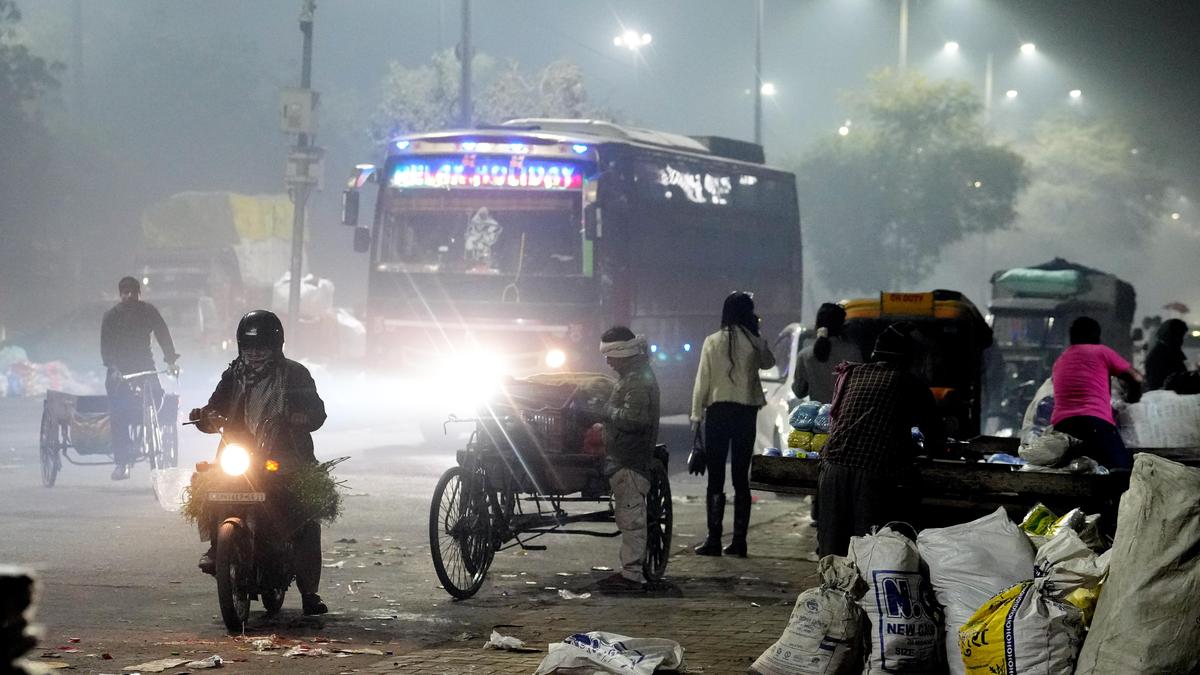
Commuters on a cold and smoggy winter morning, as air quality remains poor in the national capital, in New Delhi on November 27, 2025.
| Photo Credit: PTI
Chief Justice of India (CJI) Surya Kant on Thursday (November 27, 2025) struck a cautious note, saying the Supreme Court does not have a “magic wand” to disappear the smog choking Delhi-NCR.
But the Chief Justice assured the court would now go beyond the “ceremonial listing” of the air pollution case every year before Deepavali, and proceed to hear the issue on a continuous basis.

The Bench headed by the CJI accompanied by Justice Joymalya Bagchi listed the case on December 1 on an urgent basis.
The remarks from the Chief Justice was triggered by an oral mentioning made by Amicus Curiae, senior advocate Aparajita Singh, seeking an early hearing and urgent judicial orders as that air pollution in Delhi-NCR has become a public health emergency.
Also Read | Delhi’s air, a ‘wicked problem’ in need of bold solutions
Chief Justice Kant indicated his stance that pollution cannot be blamed on one source. The CJI said there would be multiple reasons for the health crisis. Previous hearings before a Bench headed by Chief Justice Kant’s immediate predecessor, Justice B.R. Gavai, had largely focussed on stubble-burning by farmers, particularly in Punjab.
“There is no such one reason for pollution. Be very clear about that. People are under a bona fide misconception that it [pollution] is due to a particular reason. There are multiple sources. Neither us nor you are experts… We are also like any other resident facing hardship, but neither we nor you are experts in this issue… Domain experts and scientists have to bring up the solutions to this problem,” Chief Justice Kant drew the boundaries for future hearings.
Ms. Singh pointed out that the court has been monitoring pollution cases for a quarter of a century, passing orders for a comprehensive action plan, the ongoing Graded Response Action Plan — an emergency air pollution control mechanism for the Delhi-NCR region, etc.
“Yes, this is an issue which not only concerns the Delhi-NCR but also other parts of the country. The problem is what magic wand do we have… Can you suggest something that can be passed an order and by that time there is clean air?” Chief Justice Kant emphasised on the limitations of judicial review in the case.
Chief Justice Kant said the problem of air pollution required long-term plans crafted by domain experts. Ms. Singh said solutions were galore on paper, but their implementation has translated into zero.
“We will take up this case on a continuous basis now. This case has a ceremonial listing. It will come up before Deepavali and disappear after winter,” Chief Justice Kant said.
The previous Bench headed by Justice Gavai (now retired) had given the Commission for Air Quality Management (CAQM) a free hand to take “any proactive measure” to curb air pollution throttling Delhi-NCR after the statutory body proposed advancing choice GRAP IV restrictions like work-from-home and 50% office attendance to the ongoing GRAP III stage itself.
“Any proactive measure of CAQM to reduce air pollution is always welcome,” the Supreme Court had observed in a November 19 order.
The Commission had also suggested exempting BS-III emission vehicles from the protection of an August 12, 2025 apex court order, which had barred authorities from taking any coercive steps against the owners of 10-year-old diesel and 15-year-old petrol vehicles.
The CAQM proposed including the GRAP III restriction of staggered office timings in GRAP II. The Commission has recommended differential rates and augmentation of public transport fleet and metro services, more deployment at traffic congestion spots and synchronisation of traffic movements to be put in place as part of the GRAP I stage.
As long-term measures, the CAQM has proposed a review of the electric vehicle policies and imposition of higher environmental protection charges in luxury diesel cars and SUVs of 2000 cc capacity and above. Currently the environmental cess charged is a paltry 1%.
Published – November 27, 2025 01:07 pm IST



