


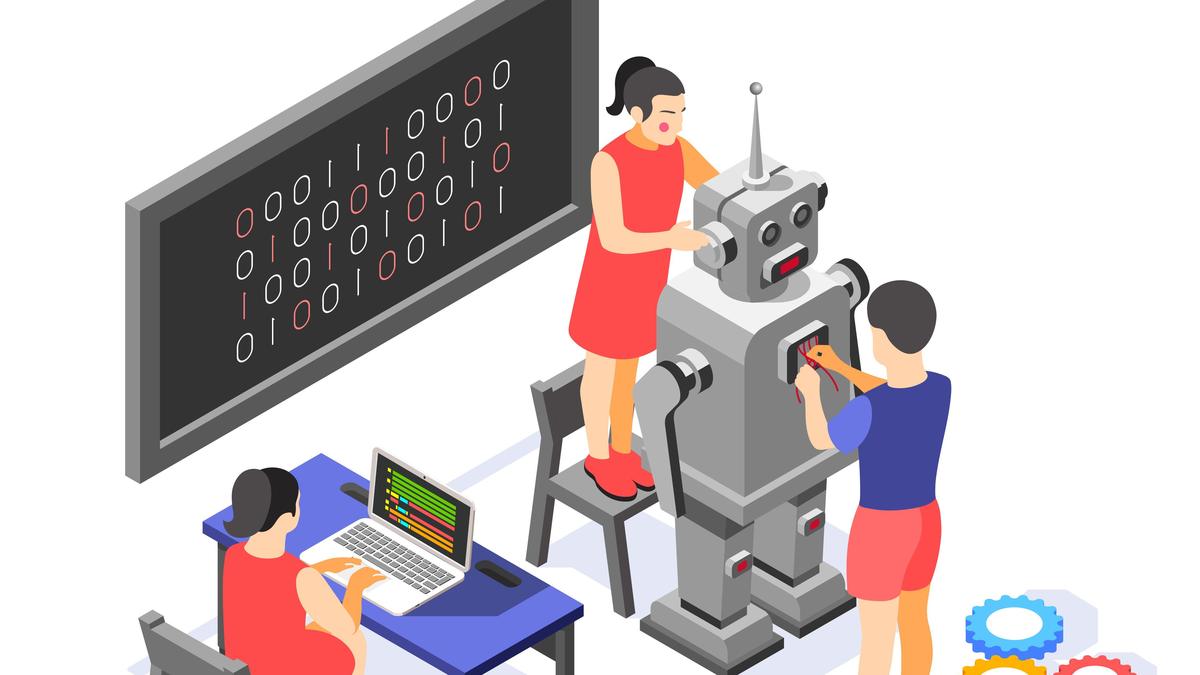
The rote memory model often leads to mental exhaustion and boredom to the learner, and mostly deals with memorisation of facts. Critical thinkers, innovators and inventors usually emerge from a system that encourages inquiry, reflection and problem solving.
| Photo Credit: Madhuvanti S. Krishnan
Every child has tons of curiosity. Curiosity is the precursor to learning. While the nourishment for physical growth happens at home, the intellectual and emotional growth happens in school. In the early stage of learning, the child’s curiosity is met in the school through interaction with peers and in the classroom.
The early method
One of the many forms of learning is rote learning, which is also one of the earliest methods. This is based on repetition. This has also been the preferred method of learning in most civilisations since ancient times. Since this method involves repetition of facts, it helps fast recall. This also works well to improve memory, attention span and mental endurance, particularly in younger learners.
In the Indian subcontinent, recitals of tables, hymns, and verses from traditional texts was a regular exercise to Indian children. Traditional knowledge was passed through generations by this method.
This was further a need because of the absence of learning material. A recent study from the Universities of Harvard and Columbia by Dr. James Hertzel and others has shown that the intensive memorisation of Sanskrit texts enhances brain structure and cognitive function.
However, the rote memory model often leads to mental exhaustion and boredom to the learner, and mostly deals with memorisation of facts. Critical thinkers, innovators and inventors usually emerge from a system that encourages inquiry, reflection and problem solving. Over-reliance on rote memory often hinders the development of creative capabilities. Models of inquiry-driven learning have also been part of ancient texts.
In a changed world
With the advent of the Internet, memoisable facts are available at a single click and are no longer a very valuable skill. It is, therefore, important to realise that while keeping a certain degree of rote memory is necessary, it is very important to add a sizeable component of inquiry-based learning to process new information. Learning, unlearning, and relearning are a need.
One of the methods of inquiry-based learning is experiential learning. This is highly personalised to meet the pace and style of learning of the individual child. This is also a child-centric model for learning. Instead of a teacher talking about the three laws Newton discovered, the child in this model discovers the same three laws by the scientific method of observation, hypothesising, exploration, data collection, organisation, and conclusions. This not only enables a scientific process of pursuing knowledge but gives the joy of discovering what the great scientists once did. Knowing the process of science is as important, or even more important, as knowing the facts of science.
Some experiments done in this direction have led to improved attendance in classrooms, joyful participation, and excitement and comfort in learning.
“Experience is the only source of knowledge, and everything else is mere information,” said Albert Einstein.
The best gift to our children is to help their curiosity grow, let them explore for themselves, and enjoy learning.
(The author is founder and chief mentor, Prayoga Institute of Education Research
Published – November 14, 2025 08:09 am IST



