


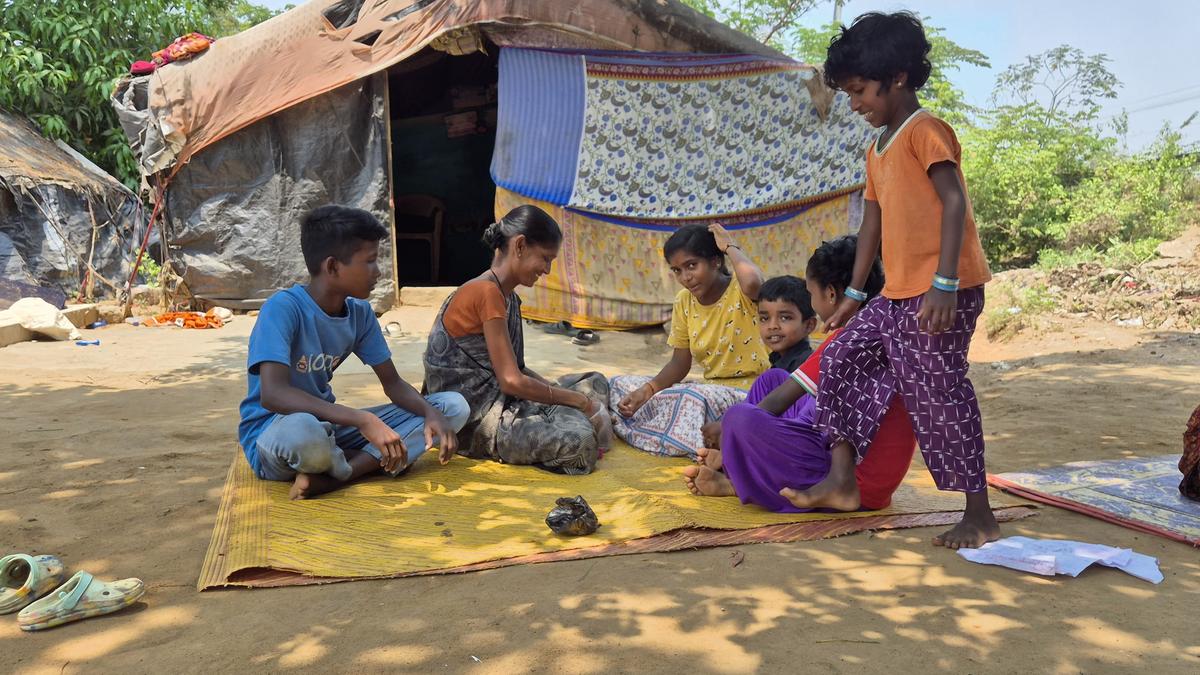
A view of migrants camp on the outskirts of Shivamogga.
| Photo Credit: SPECIAL ARRANGEMENT
Off the Shivamogga bypass, one can see a clutch of tenements built with wooden poles and plastic sheets. These are dwellings of microscopic, nomadic communities that have settled here for decades. Nearly 150 people, belonging to Sindhollu, Sudagadu Sidda and Shillekyatha communities have been residing at the place, with no electricity supply and toilets.
As children get ready to leave for the schools, elders leave the camp to earn their livelihood. While some of them, particularly women, collect plastic waste material thrown in public places, others go around selling stationery items, ornaments, utensils and so on. Only a few of continue to seek alms wearing traditional attire as they would traditionally do. In this settlement, only two have stepped into degree colleges in recent years. Nobody has a job with a regular income.
The school children of the camp study under the streetlights in the neighbouring locality. When it is dark, they light lamps or switch on battery-operated lights. They are dependent on a shopkeeper in the neighbouring locality to charge their mobile phones and batteries. The shopkeeper charges ₹5 to charge a mobile phone for some time.
No toilets
“The major problem is the absence of toilets. All of us, particularly women, are facing great difficulty. All these years, we have been demanding toilets,” said Saritha, a resident.
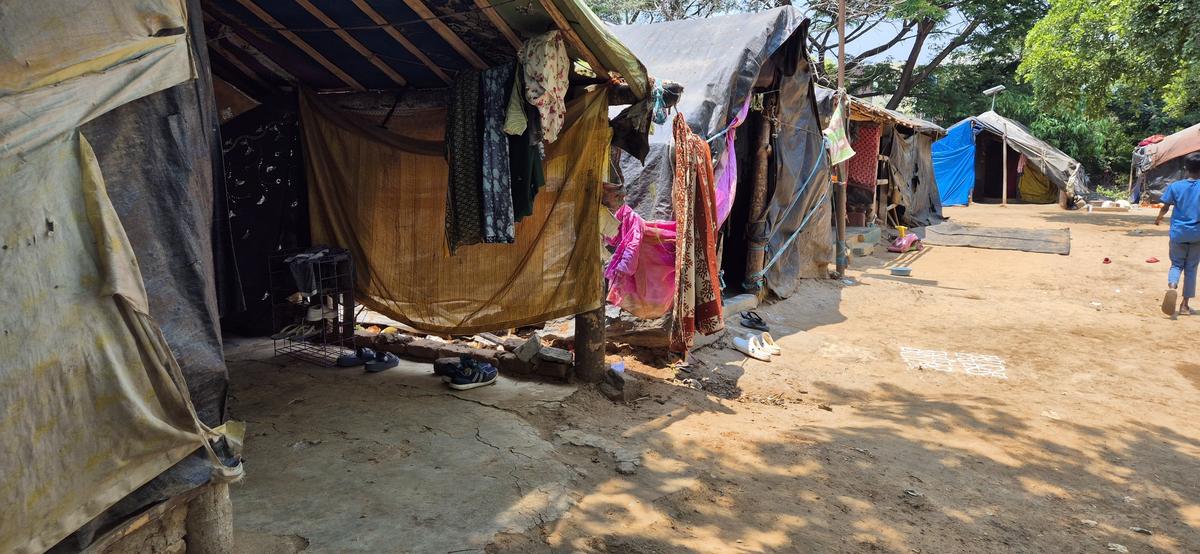
A view of migrants camp on the outskirts of Shivamogga.
| Photo Credit:
SPECIAL ARRANGEMENT
Four residents from the camp were recently in Bengaluru to take part in the protest of nomadic communities against the manner in which internal reservation has been implemented. The residents are upset that the government has not considered their plight while taking a decision on the recommendations of the Justice H.N. Nagamohan Das commission on internal reservation.
As per the Justice Nagamohan Das commission report, there are 36,431 Sudagadu Sidda, 45,989 Shillekyathas and 5,337 Sindhollu (Chindollu) in the State. There are hardly any government servants from these communities, as per the commission’s report. None from Sindhollu Chindollu community has made it into government offices. Among Sudagadu Sidda, there are 246 and among Shillekyathas, 291 are in the government services. Nearly all of them are in either Group C or D jobs.
59 communities
The commission considered 59 such communities, with a total population of 5.22 lakh, the most-backward, and placed them under Category A. It recommended 1% reservation for them. The members of the community were hoping that the government would implement the commission’s recommendation.
However, the government decided to merge the 59 microscopic communities with “less backward” communities — Bhovis, Lambanis, Korama, Koracha — and allocated 5% reservation. As a result, the “most backward” communities have to fight with the “less backward” communities to claim benefits of the reservation, they say.
“It is like newly literate people competing with university professors,” opined Hussainappa, a resident of the camp. “Many people of the Lambani, Bhovi, Korama, and Koracha have become senior officers and university professors. However, our children have just begun to attend school and study under streetlights. How can we compete with them? This is a grave injustice done to the community,” he added.
Continued protests
Starting Monday, Karnataka Asprushya Alemari Samudayagala Maha Okkoota (a federation of nomadic communities) has announced an indefinite dharna, in New Delhi, in protest against the manner in which internal reservation has been implemented. Protests are also continuing in Bengaluru. Some activists tried to lay siege to the house of Social Welfare Minister H.C. Mahadevappa on Friday.
Published – October 11, 2025 07:30 pm IST



