

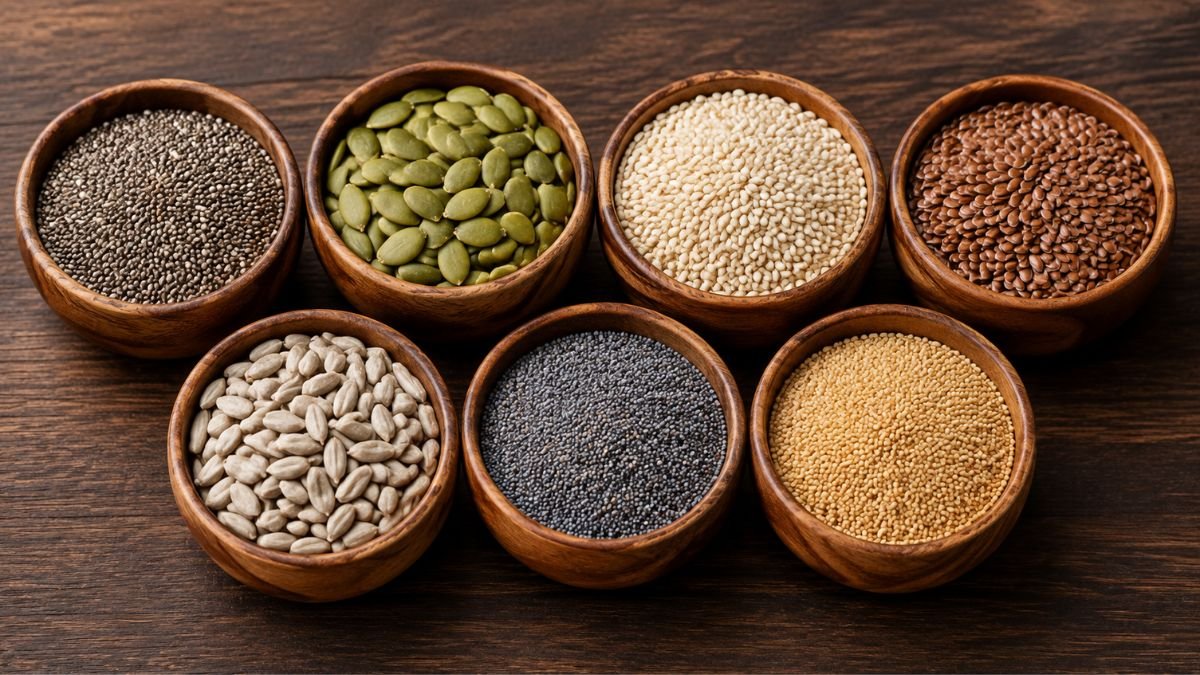

Seeds may be small, but the way they are prepared and eaten can make a difference to how they fit into your diet. From soaking some varieties to roasting and grinding others, there are a few simple distinctions to keep in mind before adding them to meals.
Dr. Vartika Vishwani, Surgical Oncologist, Artemis Hospitals, Gurugram, has shared guidance on seven commonly eaten seeds, covering how to prepare them, how much to have, when to eat them and the key benefit associated with each. Her advice also stresses that eating all seven every day is not necessary.
How to eat these 7 seeds
Dr. Vishwani’s recommendations vary considerably from one seed to another. Here is what she suggests:
1. Chia seeds
- How to eat: Soak in water or milk for at least 20 minutes
- How much: 1 tablespoon a day
- Best time: With breakfast or as an evening snack
- Best benefit: Rich in fibre, which supports digestion and gut health
The surgical oncologist recommends soaking chia seeds in water or milk for at least 20 minutes before consuming them.
2. Pumpkin seeds
- How to eat: Eat raw or roast on a low flame for 3 to 4 minutes
- How much: A small handful, approximately 28g
- Best time: As a snack or sprinkled over salads and curd
- Best benefit: One small handful provides around 37% of the daily value for magnesium
Dr. Vishwani suggests keeping pumpkin seeds either raw or lightly roasted, with a small handful being the suggested quantity.
3. Halim seeds
- How to eat: Soak for approximately 2 hours, then add to water, curd or smoothies
- How much: 1 to 2 teaspoons a day
- Best time: With any meal
- Best benefit: A plant-based source of iron
The doctor also recommends pairing halim seeds with lemon to support iron absorption.
4. Sesame seeds
- How to eat: Lightly roast, then crush or grind before adding to food
- How much: 1 tablespoon a day
- Best time: Add to chutney, salads, vegetables or roti dough
- Best benefit: A source of calcium, along with healthy fats and minerals
Her advice is to lightly roast sesame seeds and then crush or grind them before adding them to food.
5. Flaxseeds
- How to eat: Lightly roast and grind them
- How much: 1 tablespoon a day
- Best time: Add to breakfast, curd, smoothies or atta
- Best benefit: Rich in ALA, a plant-based omega-3 fatty acid
Dr. Vishwani points out that whole raw flaxseeds may pass through the digestive system without being fully broken down, making grinding an important part of her suggested preparation.
6. Sunflower seeds
- How to eat: Eat raw or lightly roasted without too much salt
- How much: 1 to 2 tablespoons a day
- Best time: As a snack or added to oats, salads and curd
- Best benefit: Rich in vitamin E, an antioxidant that helps protect cells from oxidative damage
She recommends choosing raw or lightly roasted sunflower seeds and avoiding excessive salt.
7. Poppy seeds or khus khus
- How to eat: Lightly roast, then grind before adding to food
- How much: 1 tablespoon a day
- Best time: Add to curries, gravies or homemade chutneys
- Best benefit: A source of calcium and manganese
Poppy seeds, according to the doctor, are best lightly roasted and then ground before being added to food.
Do you need all 7 seeds every day?
Not necessarily. Dr. Vishwani’s advice is to choose one or two varieties and rotate them through the week rather than trying to include every type daily.
“Choose one or two varieties and rotate them throughout the week,” she says.
She also stresses that seeds are nutrient-dense, so eating more is not always better. For people whose diets are currently low in fibre, she advises starting with a small quantity.
The key takeaway from her guidance is that there is no need to focus on finding one perfect time to eat seeds. As the doctor puts it, “There is no magical time to eat seeds. Preparation, portion and consistency matter more.”
For a quick reference, her recommendations are:
- Chia: Soak
- Pumpkin: Raw or lightly roast
- Halim: Soak and pair with vitamin C
- Sesame: Roast and crush
- Flax: Grind
- Sunflower: Raw or lightly roast
- Poppy: Roast and grind
The focus, therefore, is not on eating all seven varieties every day, but on choosing suitable options, preparing them as recommended and keeping portions in check.
ALSO READ:
15 minutes or overnight? The right soaking time for different dals and pulses



