



Heera Manjhi is a worried man. He cannot find his name in his native Bihar’s draft electoral roll, which was published on August 1.
Mr. Manjhi has recently returned to his home in Bihar’s Gopalganj district from Faridabad, on the outskirts of the national capital, where he had worked various odd jobs. As he was not able to furnish a permanent residency certificate along with his enumeration form within the deadline for the special intensive revision (SIR) of the electoral roll, his name was left out of the draft list, he says.
Though he furnished a Voter ID card which showed he had registered as a voter in 2004, Mr. Manjhi, who is more than 50 years old, said that he had not voted for the last five years as he was mostly away at work.
Missing documents
As per the SIR rules of June 24, voters must furnish one of 11 documents, such as a permanent residency certificate, to prove their identity and address if their names were not included in the 2003 voter list, when the last SIR took place. On September 9, however, the ECI directed the Bihar Chief Electoral Officer to add Aadhaar as the twelfth indicative document, following a Supreme Court order the previous day.
Many booth-level officers (BLOs) told The Hindu that initially, the ECI’s directives had been to accept enumeration forms only with the requisite documents. Later, they were told to accept the forms first and collect documents afterwards.
Mr Manjhi, a resident of Chaturbagaha village, may still make it to the final list after submitting a claims form, but the same cannot be said about hundreds of other excluded voters who migrate temporarily to cities like Delhi, Hyderabad, Surat and even the Persian Gulf countries to eke out a living. Some take along their immediate family members like wives and children, while others migrate for five to six months and are back in their home villages for the rest of the year.
Migrants register at home
Harinder Mahato, who hails from Mangolpuri village under the Baikunthpur Assembly seat, has been working in Surat in Gujarat as a foreman. Luckily, he returned home two months ago for a family function, just in time to fill in the enumeration forms given by the BLO, thus prevnting his name from being marked as “absent” or “permanently shifted”, the most common reasons given in the deleted lists pasted outside every booth in the district.
Similarly, Dhruv Mahato of Vishunpur village, whose entire family live and work in Hyderabad, rushed back to Bihar just in time to submit his form. Mr. Mahato even speaks Hindi with a Hyderabadi accent, but insists that no member of his family has been registered as a voter in Hyderabad.
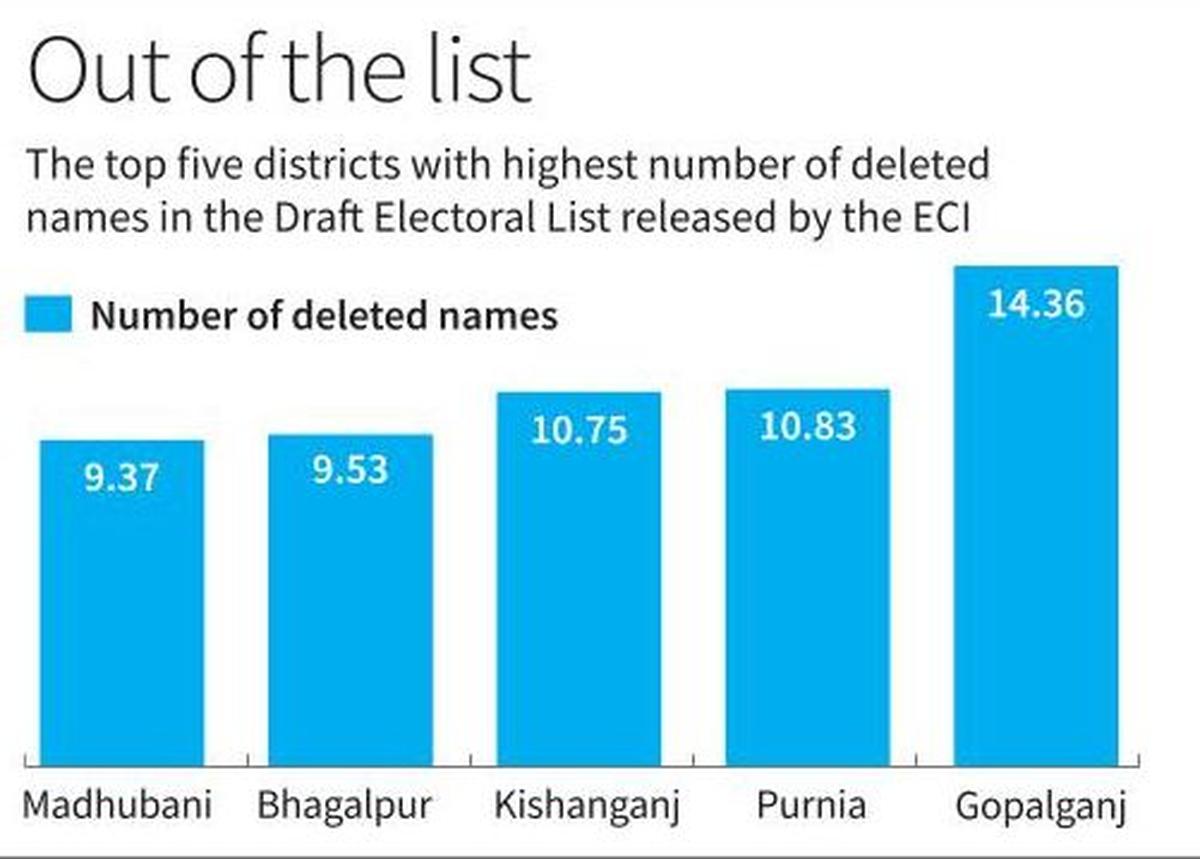
The Gopalganj district has the highest number of names deleted from the draft electoral list. A visit to the various Assembly constituencies in the district shows that the ECI’s list of deleted voters had only a few anomalies in terms of electors who live in the area and were excluded from the list. However, the adherence to the rule that only those “ordinarily resident” in a particular place are allowed to vote there may rob many temporary migrants of their right to vote, as it was not clear whether they are enrolled as voters in their current places of residence.
The ECI has already announced a country-wide SIR, with January 1, 2026 as the likely cut-off date. This could mean that migrants whose names were deleted in their native places will get added as voters in their current places of residence and work.
Illiteracy sparks fears
In the villages of Gopalganj, the problem gets acute when one moves into the ‘Dalit Tolas’, areas where the Scheduled Castes reside. High levels of illiteracy, especially among women, ensures that villagers look towards the BLOs, who are almost always the local “master” or school teacher, for hand-holding while filling any form or submitting a required document.
When this reporter visited the Chaturbagaha village, worry was writ large on the faces of a group of Dalit women who had been told by the BLO to submit the requisite documents quickly lest their names be struck off the list.
Dewanti Devi was convinced her name was not on the voter list, and worried that this would result in her losing her ration card as well. When told that her name was not there in the deleted list, a relieved Ms. Dewanti said the ration card is critically important for her as she is a landless labourer who does did not own any farm land.
Booth-level confusion
In one of its directives, the Supreme Court had asked the BLOs as well as the 1.6 lakh booth-level agents appointed by political parties to assist and clear the doubts of voters.
Deepak Chowdhary, the BLO of the Ramratan Shahi Ucchatar Madhmik Vidhaylaya Vishunpur booth, said that voters unable to get permanent residency certificates or any of the other 11 documents had been asked to get an identity and residence certificate from the village headman. Regarding Aadhaar, he said that since all forms had these accompanying documents, no need had arisen for submission with Aadhaar.
What has added to the confusion is the reorganisation of polling stations, with a new limit of 1,200 voters per booth. This means that while one set of BLOs handed out the enumeration forms, another set seems to have collected them and the requisite documents.
For example, in Mr. Manjhi’s case, the BLOs of Chaturbagaha Daya (Right) and Chaturbagaha Baya (Left) — two sides of the same village — each pointed at the other booth as the one where he was supposed to register.
Married, not migrated
Apart from migrant voters, women are the next most affected group. Almost all women who have been listed as “not present” or “migrated” have in fact married and moved to their matrimonial homes in villages just five to 10 km away, according to their neighbours and kinsmen. Again, it was not clear if these women have been added to the voter lists in their new homes.
Aarti Devi of Mangolpuri village said that the names of two of her daughters were struck off the list after the door-to-door survey by the BLO, but they are yet to register in their new homes as their in-laws have not helped them. Both had been married to men in nearby villages but their names were still on the electoral rolls of their native village.
A village resident who did not wish to be named said many families thought that adding the names of women in the voter lists would make them eligible to claim property rights, whether they were daughters or daughters-in-law.
One of the most poignant cases is that of Raj Keshari Devi of Vishunpur village, who is nearly 80 years old, and whose name was deleted from the voter list as she was supposedly “absent”. She points to her broken right knee, due to which she is immobile. She anyway cannot go to vote, her family says.
Published – September 12, 2025 05:35 am IST



