


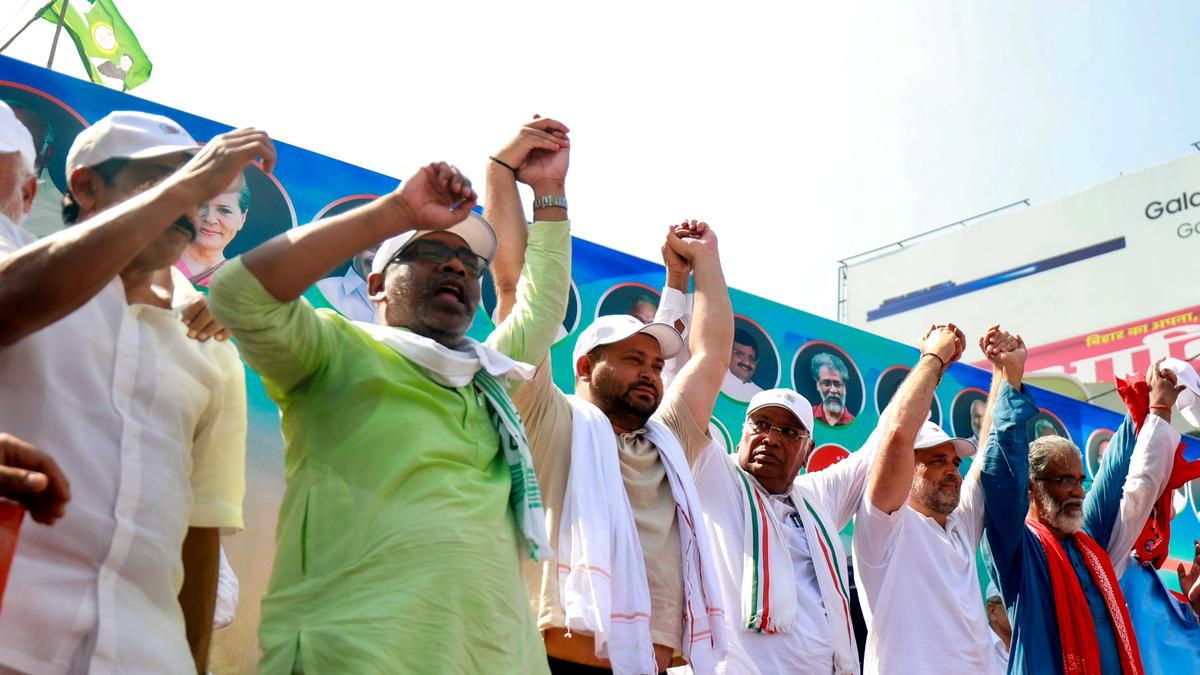
Leaders of INDIA bloc hold hands during the conclusion of the ‘Voter Adhikar Yatra’, in Patna. File. Photo: AICC via ANI
Kicking off the campaign for the Bihar Assembly polls, the INDIA bloc is scheduled to release a dedicated manifesto for the Extremely Backward Classes (EBC), a politically crucial segment. The manifesto release will coincide with the Congress Working Committee meeting in Patna on Wednesday (September 24, 2025).
Sources said that the manifesto will include a promise to bring a law for the EBCs on similar lines as the Scheduled Castes and the Scheduled Tribes (Prevention of Atrocities) Act. This idea has been in the works now for several months and was first mooted by the CPI(ML). The INDIA bloc’s campaign against the Special Intensive Revision (SIR) of electoral rolls had delayed its launch.

All INDIA bloc leaders will be present during the release of the manifesto.
As per the caste-based survey released by the Bihar government in October 2023, 36% of the State’s total population belongs to the EBC category, comprising a total of 112 castes. Among these, only four castes — Teli, Mallah, Kanu, and Dhanuk — each have a population of more than 2% of the State’s population.
The Congress’s Bihar in-charge Krishna Allavaru told The Hindu, “We will have manifestos for each segment of the society. This is the first in that series.”
In 1951, the Bihar government took the first step to classify its population based on social and economic backwardness. It composed two lists of Backward Classes comprising Hindu and Muslim caste groups that were not Scheduled Castes or Adivasis but were economically and socially backward. The two lists came to be known as Annexure I and Annexure II, which could be presently seen as categorising the Extremely Backward Classes (EBC) and the Other Backward Classes (OBC), respectively.
The first list (EBC) included around 78 Hindu and Muslim castes such as Dhanuk, Hajjam, Kahar, and Mallah. The second list had 30 castes, including Barhi, Kandu, and Kumhar, as well as Muslim castes like Momin and Rayeen. It also included relatively more advanced groups such as Bania, Koeri, Kurmi, and Yadav.

Socialist leader Karpoori Thakur was the first to extend 12% reservation for the EBCs. Bihar Chief Minister Nitish Kumar introduced several social welfare schemes for this segment. He also added more caste groups, building himself a constituency to be electorally loyal to him.
The Congress too has been making an effort to reach out to this segment. In May this year, Leader of Opposition in the Lok Sabha Rahul Gandhi visited Darbhanga to attend the ‘Shiksha aur Nyay Samvad’ (Education and Justice Dialogue). There, he addressed the Backward Classes, EBCs, Dalits-Mahadalits, and the minority communities, advocating for reservations in private institutions. Rashtriya Janata Dal, which is part of the INDIA bloc, is planning to field several EBC candidates in the upcoming polls.
CWC meet
The CWC is expected to send a strong message against the alleged “vote theft” and against the Election Commission’s SIR.
Ahead of its meeting in Patna, the Congress announced the names of CWC members and senior leaders who would address press conferences on vote chori and Har Ghar Adhikar (rights for every household) campaign in as many as 20 districts of Bihar.

In post on X, Mr. Gandhi also linked unemployment to “vote theft”.
“The biggest problem for youth in India is unemployment — and it is directly linked to vote theft. When any government comes to power by winning the trust of the people, its first duty is to provide employment and opportunities to the youth. But the BJP does not win elections honestly — they stay in power by stealing votes and holding institutions captive,” Mr. Gandhi said. “That’s why unemployment has reached its highest level in 45 years. That’s why jobs are declining, recruitment processes have collapsed, and the youth’s future is being pushed into darkness,” he added.
Published – September 23, 2025 10:03 pm IST



