


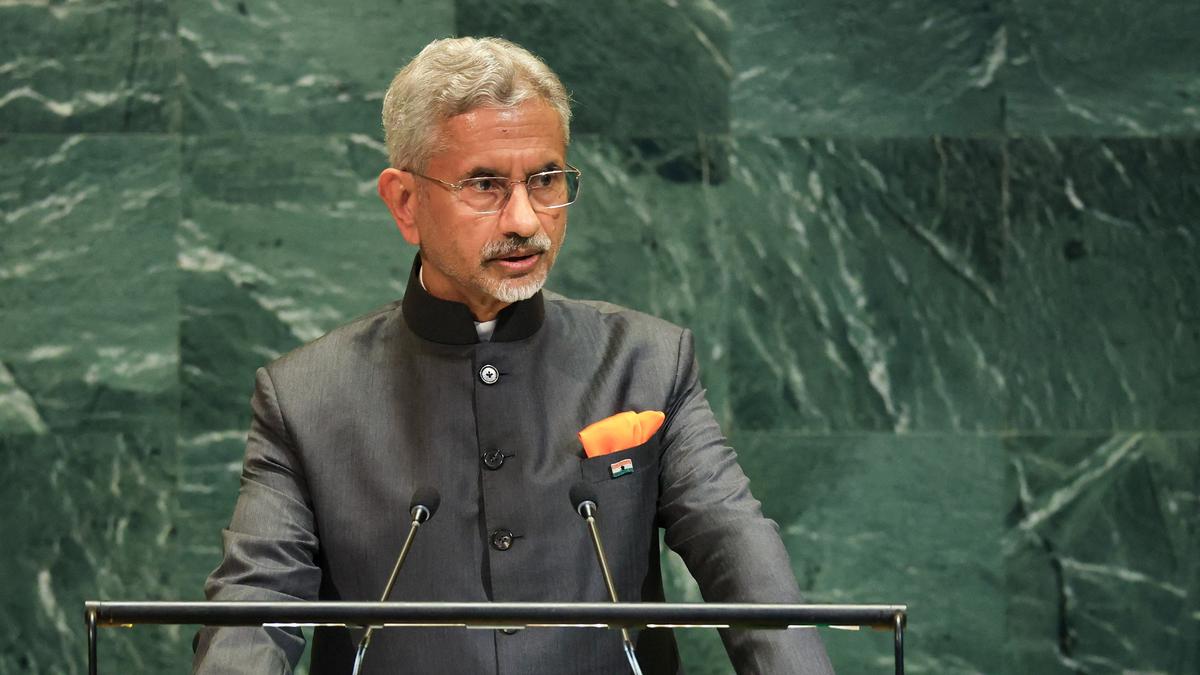
External Affairs Minister Jaishankar addresses the 80th United Nations General Assembly, at the U.N. headquarters in New York City, U.S., on September 27, 2025.
| Photo Credit: Reuters
India stepped up its engagement with the Global South quite visibly during External Affairs Minister S. Jaishankar’s hectic consultations at the United Nation’s 80th high-level week, with strong criticism of Israel’s war on Gaza, U.S.-led trade turmoil, and the lack of UN reform in focus in statements.
More than half of his approximately 30 one-on-one bilateral meetings with Foreign Ministers were with countries of the developing nations, while nearly all the multilateral meetings India hosted or Mr. Jaishankar hosted focused on the Global South’s issues, and non-western groupings.
The multilateral meetings included the BRICS, IBSA (India-Brazil- South Africa), India-CELAC (South American countries), India-SICA (Central American Integration System), FIPIC (with Pacific Island countries), the L-69 (developing countries from the Global South) and C-10 (African Union representatives) and the “High-Level Like-Minded countries of the Global South”.

Pharma tariffs
Some of the focus on the Global South may have come, suggested analysts, from disappointment with the U.S.’s actions this week. Mr. Jaishankar held a meeting with U.S. Secretary of State Marco Rubio at the beginning of the week, but there was no let-up in the U.S.’s rhetoric and actions against India. A day after the meeting, President Donald Trump called India, along with China the “primary funders of the war” in Ukraine, and repeated his claim that he ended the India-Pakistan conflict. In addition to 50% tariffs on Indian goods, and visa and immigration cuts that affect Indian professionals, the U.S. administration also slapped new tariffs on pharma industries this week. Commerce Secretary Howard Lutnick said the U.S. would “fix India” to ensure it opens its markets and cut trade actions against the U.S., indicating Indian and U.S. negotiators still have a hard road ahead in FTA talks.
Meanwhile, Mr. Jaishankar also met with Australian Foreign Minister Penny Wong and his Japanese counterpart on the sidelines of other groupings, but there was no Quad Foreign Ministers’ meeting, raising questions about whether a date can still be agreed on for the Quad Summit India is due to host this year. Washington also ruffled feathers in Delhi with its intense engagement with the South Asian neighbourhood. Mr. Trump held 80-minute talks with Pakistan Prime Minister Shehbaz Sharif and Army Chief Field Marshall Asim Munir, even as U.S. Ambassador-designate and Special Envoy for the region Sergio Gor met leaders from Bangladesh, Sri Lanka and Bhutan in New York. In contrast, Mr. Jaishankar met only counterparts from Sri Lanka and Maldives during the week, even as India and Pakistan sparred at the General Debate.

Gaza situation
A significant shift at the UNGA week was indicated by India’s position on the Israel war on Gaza. New Delhi, that has been an outlier from other Global South countries thus far and abstained on resolutions calling for a ceasefire, was instead seen backing a number of statements sharply critical of Israel during the UNGA. These included statements by the BRICS Foreign Ministers and the IBSA Trilateral Commission, which said the “Ministers expressed grave concern about the situation in the occupied Palestinian territory and strongly condemned the Israeli attacks against Gaza, which, after almost two years, continue to cause unprecedented suffering to the civilian population of the territory, ravaged by deaths, destruction, forced displacement, and famine”. The statements are much tougher than previous statements that India has agreed to being a part of, indicating a greater alignment with Global South priorities on the issue. Even so, India did not join about 80 countries whose diplomats walked out in protest during Israeli Prime Minister Benjamin Netanyahu’s speech at the General Assembly.
Referring to India’s commitment to dealing with the “especially acute” “predicament of the Global South” during India’s statement at the General Debate, Mr. Jaishankar listed a number of issues they faced: from the conflicts in Ukraine and Gaza, to energy and food security, “non-market trade practices”, tariff volatility and uncertain market access.
“The resource-stressed ones scrambled to survive, only to hear sanctimonious lectures thereafter,” he said, in a sharp dig at global superpowers for not doing more for the Global South.
In its 48-point “priority paper”, put out on its website, the Permanent Mission of India (PMI) expressed its disappointment over the lack of movement on UN Security Council reform in the previous session. It also stressed maintaining “India’s active engagement as a leading voice of the Global South”, emphasising different areas such as climate finance, development financing, etc, and strengthening coordination with important groups like the Landlocked Developing Countries (LLDCs), Least Developed Countries (LDCs) and Small Island Developing States (SIDs) as well.
Published – September 28, 2025 10:34 pm IST



