


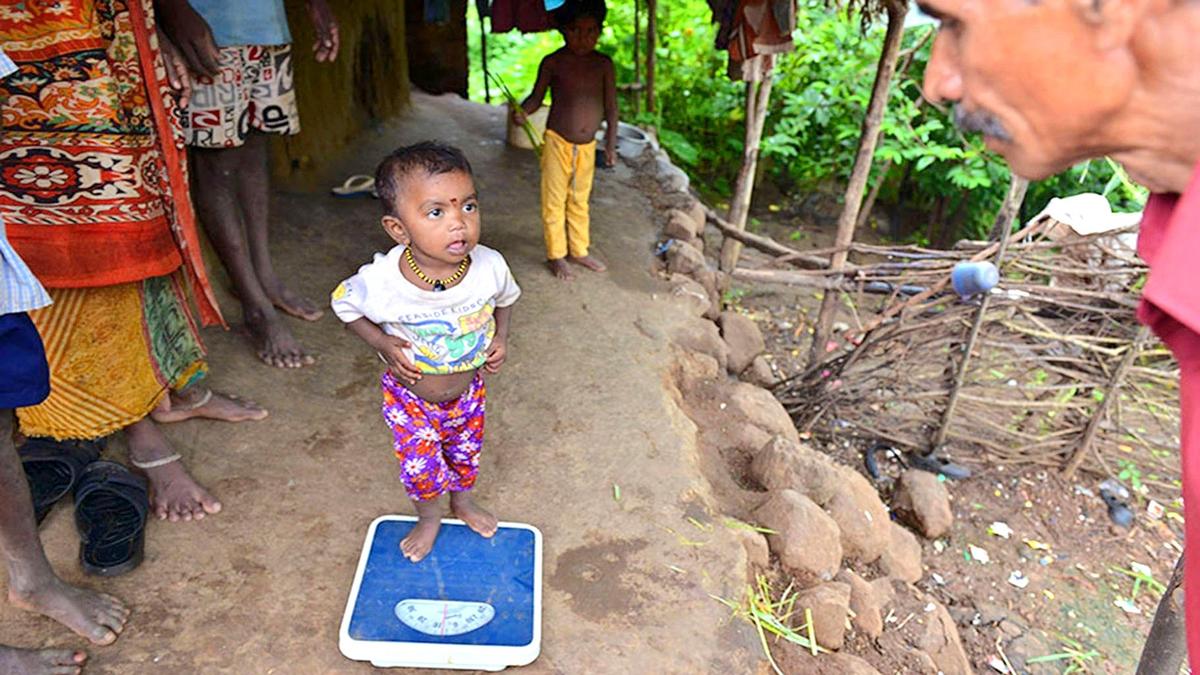
Bombay High Court has asked the Maharashtra government to explain its conduct when it is able to allocate crores of rupees to schemes such as ‘Ladki Bahin’ but malnutrition-related deaths among children, pregnant women, and lactating mothers persist in tribal regions such as Melghat Image used for representation purpose only.
| Photo Credit: The Hindu
The Bombay High Court has asked the Maharashtra government to explain its conduct when it is able to allocate crores of rupees to schemes such as ‘Ladki Bahin’ but malnutrition-related deaths among children, pregnant women, and lactating mothers persist in tribal regions such as Melghat. The court was hearing a public interest litigation that has been pending since 2007.
A Division Bench of Justice Ravindra Ghuge and Justice Abhay Mantri noted that despite orders passed by the High Court since 2007, the State had done “too little” for the welfare of tribal communities and had not succeeded in preventing deaths caused by malnutrition in the region.
“In a progressive State like Maharashtra, after 78 years of independence, we are still talking about babies dying of malnutrition,” Justice Ghuge said. “This discussion about malnutrition itself is a defeat of the policies. People are dying, babies are dying. From 2007 onwards orders have been passed, yet babies continue to die. You cannot say that no earlier 20 babies were dying and today only 15 are dying. Not at all. This is not acceptable. You need to stop the deaths itself. No baby should die.”

The judge added that the fact that the issue of deaths of babies, pregnant women, and lactating mothers was being argued in 2026, after continuous orders and after 25 years, “speaks louder than words”. He said it was a tragedy that the court had to hear submissions on deaths occurring due to malnutrition, lack of medication, and absence of appropriate support for malnourished patients, pregnant women, and lactating mothers.
The Bench was informed earlier that 38,000 children had died in the region. On Wednesday evening, senior advocate Jugalkishore Gilda, appearing as Amicus Curiae, told the court that the State was spending crores under the ‘Ladki Bahin’ scheme, under which women receive a monthly amount as a “gift package”. He argued that at the same time, the budget allocated for tribal welfare was being reduced.

Mr. Gilda also pointed out that more than Rs. 148 crore in pending payments by the government had led to disruption in electricity and potable water supply in tribal areas of Amravati and Nandurbar districts.
When the hearing resumed on Thursday evening, Poornima Upadhyay, a party-in-person and activist, informed the Bench that around Rs. 7 crore in wages under the Mahatma Gandhi National Rural Employment Guarantee Act (MGNREGA) remained unpaid to tribal people in Melghat.
Dr. Ashish Satav, who runs a non-governmental organisation in Melghat and has worked there for two decades, told the judges that medical personnel in the region contributed from their own resources to pay for blood bags procured from State-run blood banks. He emphasised that the State, instead of spending crores on ‘Ladki Bahin’ by giving “gift packages” to people not engaged in work, should focus on the welfare of tribal citizens.

Responding to these submissions, Justice Ghuge said the State owed an explanation to the tribal communities. “Listen to them, Mr. Counsel,” he said. “What they say is you have funds for schemes like Ladki Bahin but you are not paying the daily wage of tribals under the MGNREGA. Rightly Mr. Gilda has been agitating that you are spending money on such schemes but not for the welfare of the tribal people. You owe an explanation to them. The State must explain this to them.”
The judges also questioned why the State was unable to specify a timeline for laying the foundation stone of a 300-bed hospital in Melghat’s Dharni area, a project that had been announced at least two decades ago. The State submitted that steps were being taken for approvals and that the hospital, initially planned as a 100-bed facility, had now been “upgraded” to 300 beds.
Justice Ghuge observed that the upgrade appeared to exist only on paper. “It is strange that the announcement was done before I enrolled as an advocate,” he said. “Now I have practiced for so many years, my judgeship is about to be completed in a year or two, but the hospital is yet to come up.”
The Bench directed the State to present a plan detailing how it intended to proceed with the hospital project and how it proposed to implement the recommendations made by Dr. Satav regarding the supply of nutritious food and the provision of medical facilities for tribal communities. The matter has been adjourned to April 15.
Published – March 27, 2026 09:36 am IST



