


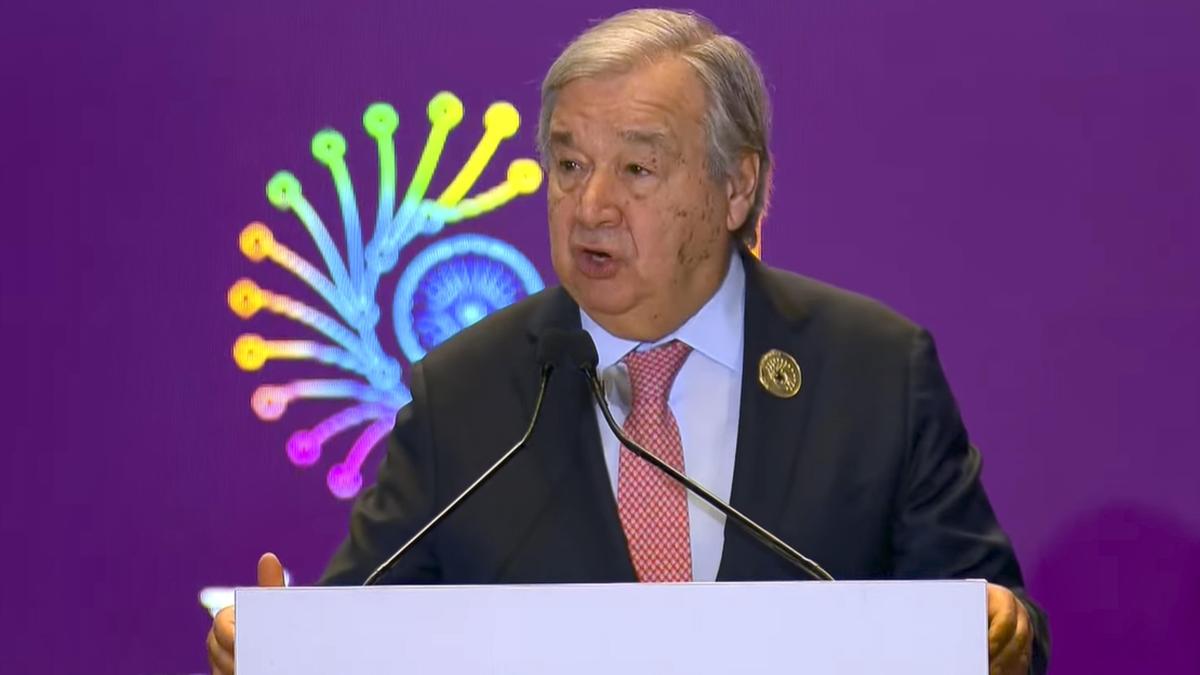
United Nations Secretary-General Antonio Guterres addresses the gathering during the India AI Impact Summit 2026, in New Delhi. Photo Credit: X/@NarendraModi via PTI
| Photo Credit:
United Nations (U.N.) chief Antonio Guterres warned technology leaders on Thursday (February 19, 2026) of the risks of Artificial Intelligence (AI), saying its future cannot be left to “the whims of a few billionaires”.
Speaking at a global AI summit in India, the U.N. chief called on tech tycoons to support a $3 billion global fund to ensure open access to the fast-advancing technology for all. “AI must belong to everyone,” he said.
“The future of AI cannot be decided by a handful of countries — or left to the whims of a few billionaires,” he added, warning the world risked deepening inequality unless urgent steps were taken.
“Done right, AI can… accelerate breakthroughs in medicine, expand learning opportunities, strengthen food security, bolster climate action and disaster preparedness and improve access to vital public services,” he said. “But it can also deepen inequality, amplify bias and fuel harm.”
The U.N. has set up an AI scientific advisory body to help countries make decisions about the revolutionary technology. Mr. Guterres warned that people must be protected from exploitation, and that “no child should be a test subject for unregulated AI”.
He pressed for global guardrails to ensure oversight and accountability, and the creation of “Global Fund on AI” to build basic capacity.
“Our target is $3 billion,” he told the conference, which includes national leaders as well as tech CEOs, including Sam Altman of OpenAI and Google’s Sundar Pichai.

“That’s less than one per cent of the annual revenue of a single tech company. A small price for AI diffusion that benefits all, including the businesses building AI.” Without investment, “many countries will be logged out of the AI age”, exacerbating global divides,” he said.
He also cautioned that as AI’s energy and water demands soar, data centres must switch to clean power, rather than “shift costs to vulnerable communities”.

Published – February 19, 2026 11:00 am IST



