


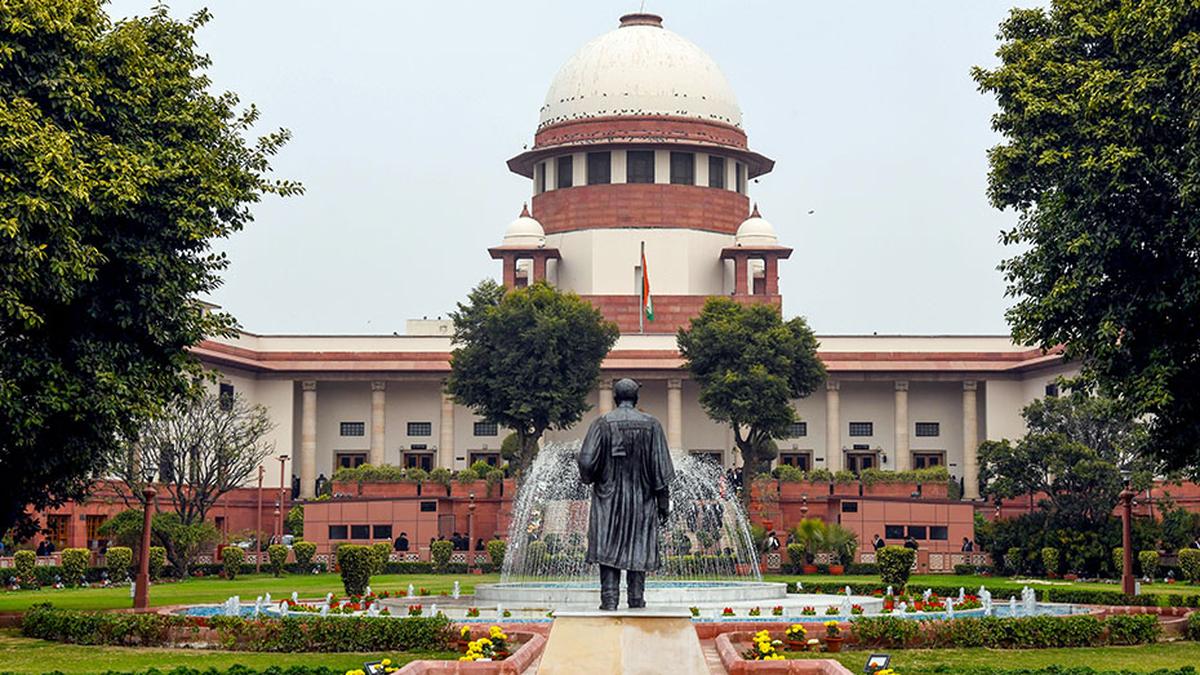
Supreme Court of India. File
| Photo Credit: ANI
Over a year before a civil court imposed an ex-parte injunction on journalists from publishing or circulating allegedly unverified and defamatory material against Adani Enterprises, the Supreme Court had been worried about courts recognising ‘SLAPP’ suits across jurisdictions.
‘SLAPP’ stands for ‘Strategic Litigation against Public Participation’, a three-judge Bench headed by then Chief Justice of India D.Y. Chandrachud had written in a May 2024 judgment.

“It is an umbrella term used to refer to litigation predominantly initiated by entities that wield immense economic power against members of the media or civil society, to prevent the public from knowing about or participating in important affairs in the public interest. We must be cognisant of the realities of prolonged trials… While granting ad-interim injunctions in defamation suits, the potential of using prolonged litigation to prevent free speech and public participation must also be kept in mind by courts,” the Bench had cautioned in the verdict in Bloomberg Television Production Services India Private Limited and others versus Zee Entertainment Enterprises Limited case.
The apex court underscored that pre-trial, ex-parte injunctions by courts spelt the “death sentence to material sought to be published, well before the allegations have been proven”.
Staying the civil court’s ex-parte injunction order of September 6, District Judge Ashish Aggarwal on Thursday (September 18, 2025) said the journalists were not given a reasonable opportunity to be heard.
The Supreme Court has made it clear in numerous judicial precedents that the protection of journalistic expression was a “constitutional mandate” and “courts must tread cautiously while granting pre-trial interim injunctions”.
Chief Justice Chandrachud, who authored the Bloomberg judgment, invoked the ‘Bonnard standard’ laid down by the Court of Appeal (England and Wales), which mandated that interim injunctions in defamation suits should be given only in “exceptional situations”. A gag order affects not only the journalists but also the right of the public to know.

“In essence, the grant of a pre-trial injunction against the publication of an article may have severe ramifications on the right to freedom of speech of the author and the public’s right to know. An injunction, particularly ex-parte, should not be granted without establishing that the content sought to be restricted is ‘malicious’ or ‘palpably false’. Granting interim injunctions, before the trial commences, in a cavalier manner results in the stifling of public debate,” the Supreme Court has held in 2024.
The top court had set down a three-fold test trial judges ought to follow before granting the interim relief of an injunction. They include establishing a prima facie case of defamation, balance of convenience and irreparable loss or harm that would be caused by publication. The 2024 judgment had warned courts from applying the three-fold test mechanically, especially against journalistic pieces.
Published – September 18, 2025 11:17 pm IST



