


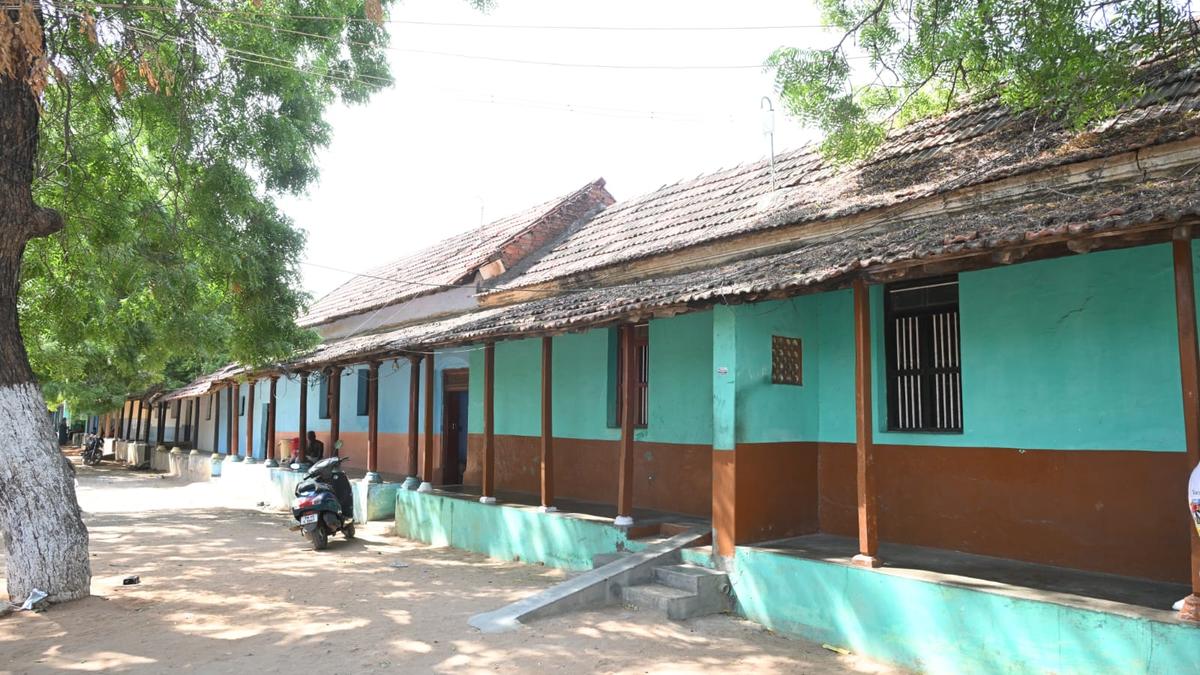
A house on Chidambara Street in Udangudi with palm wood trusses and a tiled roof
| Photo Credit: N. Rajesh
Two-and-a-half-year-old Mahadiya is playing in the sandy muttram (courtyard) of her ancestral house on Chidambara Theru (Street) in Udangudi, in Thoothukudi district. The house, with palm wood trusses and a tiled roof, was built by her great-great-great-grandfather. Ms. Mahadiya and her mother, who now live in Chennai, have come to Udangudi to spend their Pooja holidays. Her mother says that playing in the sand will boost her immunity and improve her hand-eye coordination.
Nazar, the present owner of the house, says he preserves it without modern alterations, honouring his grandfather’s insistence on retaining the open courtyard and sandy floor for environmental and climatic reasons. While many houses, though retaining their old structures, have covered the courtyards with roofs, Mr. Nazar has not.
“It is environmentally friendly and will be very cool at night,” says Mr. Nazar, who has brought masons from Chennai to repair the plastering that has peeled off in some places. The house once had a pathayam (storage structure) and a separate room that functioned as a labour ward. Mr. Nazar’s niece said the verandahs were also made of clay and have only recently been replaced with concrete.
Anyone who visits Udangudi will come across rows of old tiled-roof houses with palm wood trusses on all sixteen streets with Muslim inhabitants, including Periya Theru, Mohideen Puthu Theru, Puthumanai Mela Theru, Puthumanai Vadakku Theru, and Santhaikadai Theru. Giant neem trees flank both sides of the streets, offering protection from heat and direct sunlight. A few houses, which were beyond repair, have been replaced with concrete structures.
Preserving old structures
“The houses were demolished because we could not find masons skilled in repairing old houses. Even if you find them, the raw materials — lime, sand, gallnut (kadukkai), and other ingredients for making the paste — are costly and hard to come by. Still, 90% of the houses continue to survive against all odds,” says M. Shaik Mohideen, explaining the community’s commitment to the preservation of old structures.
Such houses were possible because Udangudi, a hub of palm sugar manufacturing and other palm-based products, offered palm wood for house construction. M.H. Nijamudeen, now 78 years old, says he remembers seeing 90-year-old men living in these old houses when he was a small boy. “It means the houses are more than 200 years old. They are environmentally friendly, and the one-and-a-half-foot-thick clay walls provide heat resistance,” he says.
Tamil Nadu Muslim Munnetra Kazhagam (TMMK) leader M.H. Jawahirualla, a native of Udangudi, says the houses kindle memories of his childhood. “My father’s ancient house in Puthumanai Mela Theru and my mother’s house in Kalankudiyiruppu Periya Theru are still retained with their old structure. The straight, well-planned streets boast a mosque and a burial ground at one end. After lunch, the wind flowing through the branches of the neem trees would lull you to sleep. Unforgettable days,” he said.
Published – October 06, 2025 02:29 pm IST



