


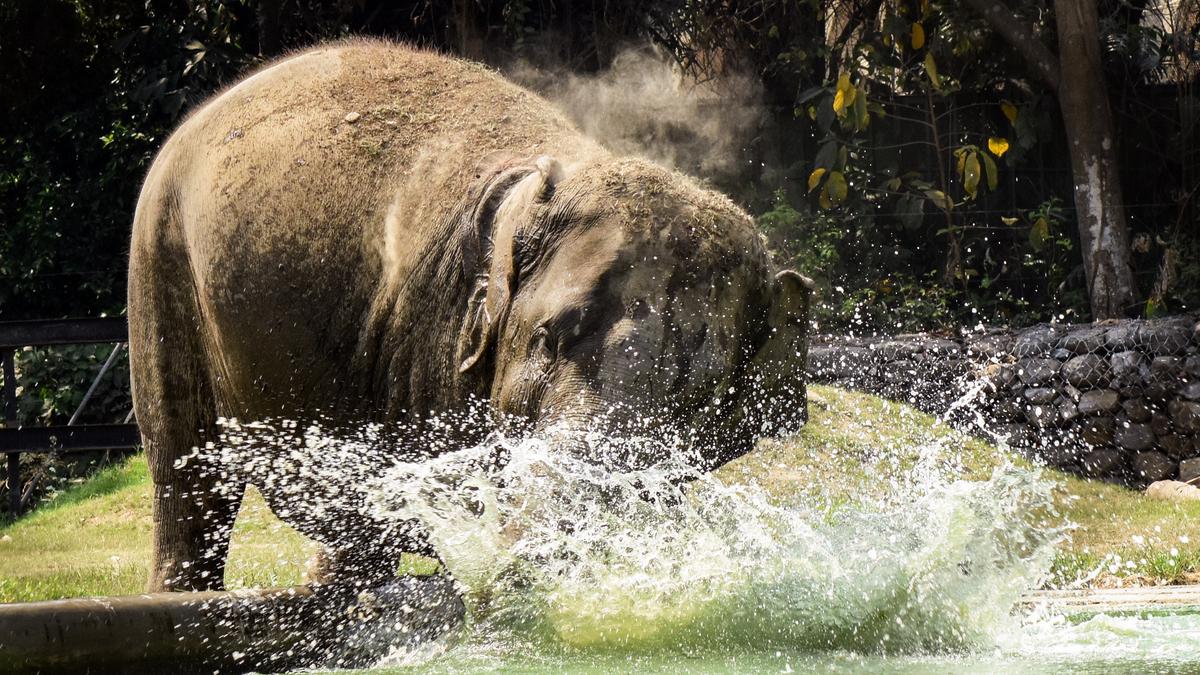
Representative image. File
| Photo Credit: ANI
A recent study by scientists have pointed out that elephants in highly fragmented landscapes which are experiencing significant anthropogenic disturbances have recorded higher adrenal activity to cope with the stress and reduced metabolic rates to conserve energy in emerging challenging contexts.
The details of the study were published in a paper titled ‘Physiological responses in free ranging Asian elephant populations living across human-production landscapes’ published in Scientific Reports, a Nature group journal.
As a part of the study, a team of scientists and researchers assessed physiological stress by measuring faecal glucocorticoid metabolite (fGCM) levels and metabolic states using faecal triiodothyronine (fT3) across three free-ranging Asian elephant populations (one in Central India and two in Northeastern India) whose home ranges encompass varying extents of disturbance in human-production landscapes.
In Central Indian landscape the scientists studied elephant populations in Paschim Medinipur and Kharagpur forest division of West Bengal and in north-eastern India landscape the elephant population in Gorumara, Jalpaiguri, Jaldapara and Buxa regions of the state were studied.
“Elephants living in more fragmented habitats in Central India had higher fGCM and lower fT3 levels compared to the Northeastern populations, as well as when compared (only fGCM levels) with a previously-studied Southern Indian elephant population,” the study pointed out.
Sanjeeta Sharma Pokharel, the lead author of the publication points out that while elephants may adapt to living in human-modified landscapes to some extent, they may experience high stress levels beyond a threshold of disturbance which can be physiologically costly.
The publication also suggested that aggressive human responses to elephant depredation of crops were clearly the highest in the Central population where people aggressively used ‘hula parties’ to chase elephants. Hula party comprising local residents are deployed to steer jumbos away from human settlements in South Bengal. They are often accused of using fireballs and torches to scare the animals which somethings results in deaths of elephants.
Levels of elephant-human negative interactions including unnatural elephant deaths and human fatalities due to elephant attacks, were relatively lowest in the country’s Southern landscape when compared to central India landscape of South Bengal.
“We found that elephants from the Central Indian population had higher fGCM and lower fT3, as compared to populations elsewhere, potentially indicating a compromised health status for elephants living in highly fragmented habitats and experiencing much higher levels of anthropogenic stress,” the publication stated.
The other people who contributed to the paper included well known elephant ecologist Raman Sukumar, Amir Kumar Chettri, Sunipa Chatterjee and Polani B. Seshagiri. Scientists behind the publication indicated that their earlier research in a southern population showed that lower fGCM levels were linked to superior dietary quality in crop-foraging elephants; a pattern they observed similar relationship in the NE-1 and NE-2 populations, but the Central population deviated from this pattern.
“This implies that severe anthropogenic disturbance, rather than dietary quality, may have a stronger influence in stress physiological responses among elephants,” Dr. Sharma Pokharel said.
India’s estimated free-ranging elephant population of 27,000 to 30,000 individuals, is distributed across four major geographical regions – Northeastern, Northwestern, Central and Southern – with varying degrees of habitat fragmentation and elephant-human negative interactions.
Southern West Bengal is part of the highly fragmented Central Indian elephant habitat with very high levels of elephant-human negative interactions. With the numbers of elephants growing over time and several elephants now becoming “resident” in South Bengal.
Published – September 28, 2025 04:57 am IST



