


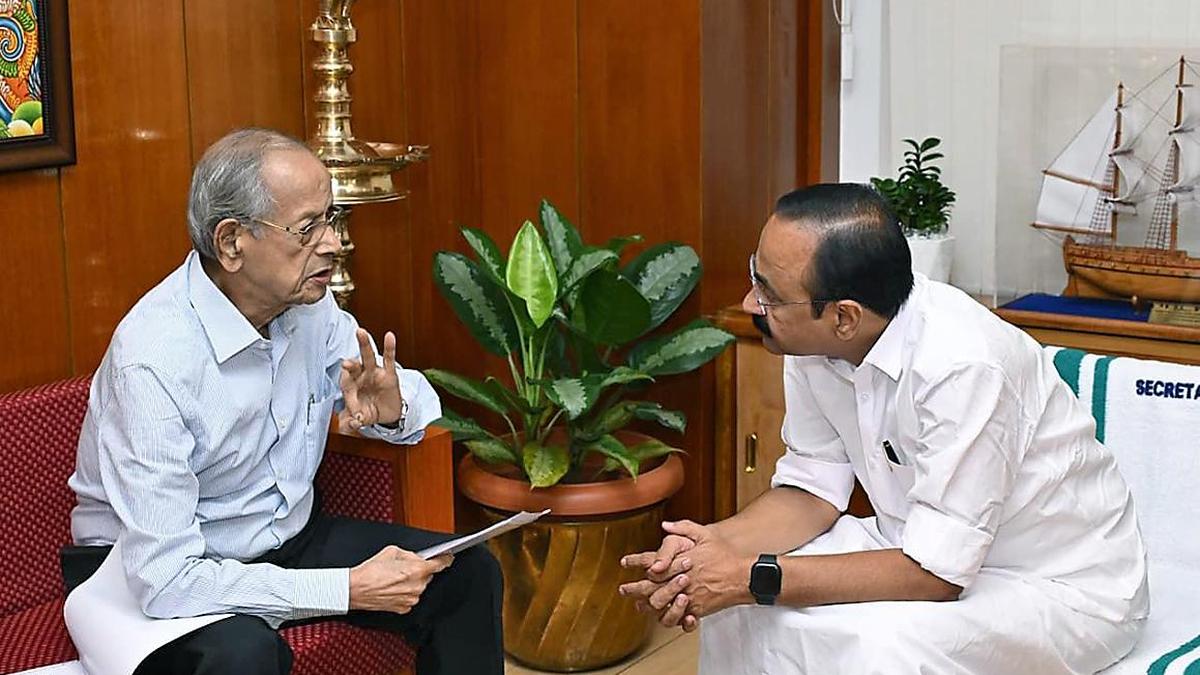
Technocrat E. Sreedharan meets Chief Minister V.D. Satheeshan in Thiruvananthapuram on Friday.
The new interim report on the high-speed rail project, submitted by technocrat E. Sreedharan to the Kerala government on Friday, envisions connecting Thiruvananthapuram with Kannur in just three hours and 30 minutes, envisaging the project as the world’s first green rail corridor.
The proposed Kerala High-Speed Railway (KHSR) line will start from Poojapura in the capital city and terminate at Mundayad in Kannur. The report has been submitted by the Delhi Metro Rail Corporation (DMRC) to both the Union Ministry of Railways and the State government.
The 473.20-km double line from Poojapura to Mundayad will have 23 stations. Unlike the earlier proposal, the line will be fully elevated except for a 6.5-km tunnel in Thiruvananthapuram city. The line will also connect three airports in Kerala, excluding the Kannur International Airport, which will be served through an exclusive 10-km road link.
Standard gauge
The new line, proposed on standard gauge with the axle load reduced to 15 tonnes as against 25 tonnes in broad gauge, will substantially reduce both investment and operational costs. According to the interim report, all advanced countries use standard gauge for high-speed rail operations, and most technical upgrades and innovations are developed for standard-gauge systems. This will help India keep pace with global technological advancements and become self-sufficient, the report says.
The average inter-station distance will be 21.5 km. The maximum design speed of the trains will be 200 kmph, while the maximum operational speed will be 180 kmph and the average commercial speed, 140 kmph. The trains will consist of 12 coaches with a total seating capacity of 800 passengers. The train length can later be increased to 16 coaches, as the platforms are being designed to accommodate 16-coach trains, the report said.
Initially, trains are planned to operate every 20 minutes during peak hours (6 a.m. to 11 a.m. and 4 p.m. to 8 p.m.) and every 40 minutes during non-peak hours. The total carrying capacity will be 54,400 passengers per day. The train frequency can be increased to one service every five minutes during peak hours and every 10 minutes during non-peak hours, raising the carrying capacity to 2.28 lakh passengers per day.
The land requirement will be minimal, as only a 20-metre-wide corridor is needed for construction. After completion of the project, the land could be leased back to the original owners, subject to certain conditions for cultivation or grazing, the report says. The entire energy requirement of the system will be met through a captive solar power system, which will also sell surplus electricity to the Kerala State Electricity Board (KSEB), making the project the world’s first green rail corridor, according to the report.
The total project cost is estimated at ₹60,000 crore, of which ₹36,000 crore will be contributed as equity by the Central and State governments in a 51:49 ratio. The remaining ₹24,000 crore is proposed to be raised through crowdfunding. The average construction cost works out to ₹127 crore per kilometre. The project can be completed within five years of receiving approval, says the report.
Published – May 30, 2026 04:46 pm IST



