

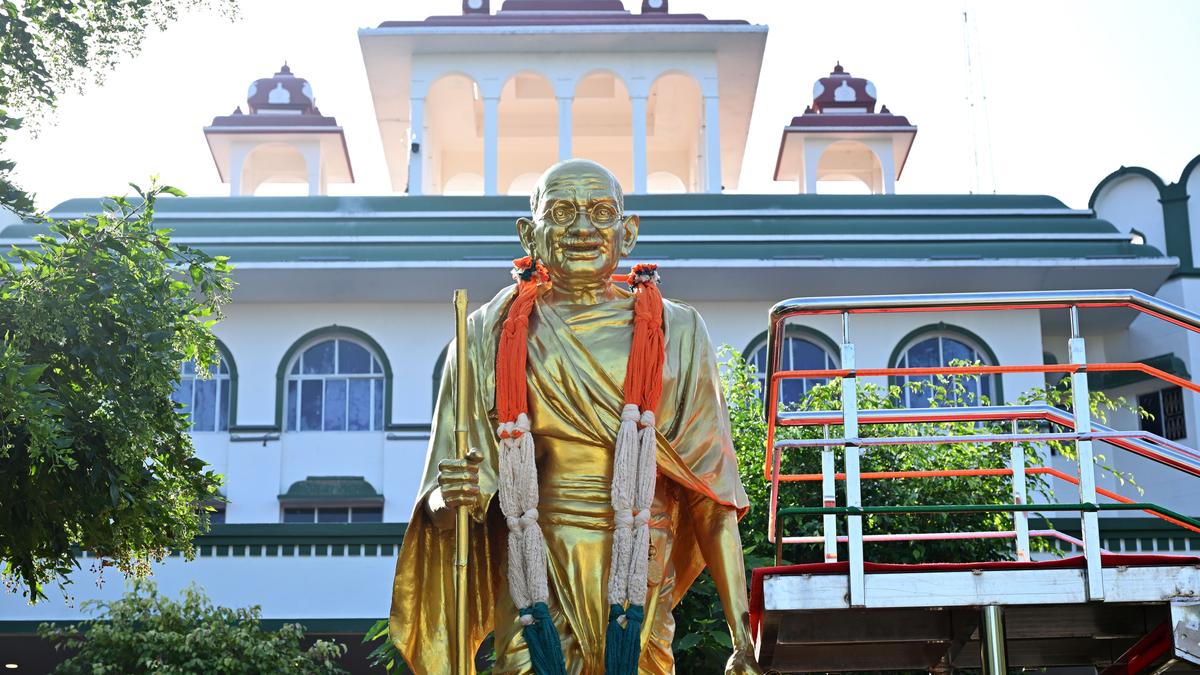

Madurai Bench of Madras High Court. File
| Photo Credit: R. Ashok
“Equality in worship is non-negotiable. The law must speak firmly so that no person or group ever again dares to deny temple entry on grounds of caste,” the Madurai Bench of the Madras High Court has said.
Referring to Vaikom Satyagraha of 1924-25 in Travancore, Guruvayur Satyagraha of 1931-32 in Malabar, and the Temple Entry Proclamation of 1936 issued by the Maharaja of Travancore, Justice B. Pugalendhi said the struggle for equality in worship had a long and painful history.
These struggles reached a defining moment in Madurai in 1939. The Madras Temple Entry Authorisation and Indemnity Act, 1939, enacted by the then government, gave trustees the legal power to admit Scheduled Caste devotees into temples. It was under this Act that in 1939, a group led by A. Vaidyanatha Iyer and L.N. Gopalaswami, along with Scheduled Caste devotees including P. Kakkan, first entered the Meenakshi Amman Temple in Madurai, the court said.
Mahatma Gandhi regarded this moment as a spiritual triumph. He later visited the temple in 1946 with Harijan (Scheduled Caste) devotees, recording it as one of the most satisfying experiences of his life. The message from Madurai in 1939 was unambiguous — that the walls of caste had no place in the precincts of God. The entry of Scheduled Caste devotees into the Meenakshi Amman Temple was celebrated across the nation as proof that social reform and constitutional morality could triumph over centuries of oppression, the court added.
Yet, in 2025, the very land where Gandhi rejoiced the breaking of caste barriers to worship presented the spectacle of Scheduled Caste devotees being excluded from Mariamman Temple in Chinna Dharapuram in Karur district, the court said, while hearing petitions filed by Vanniyakulachathiriyar Nala Arakattalai (Trust), represented by its president Murugan, and Marimuthu, who alleged that Scheduled Caste devotees were being denied entry into the temple. The Trust sought the removal of a 2018 prohibitory order, and permission to resume festivals and worship. It said no caste discrimination took place in the temple, which they had the right to manage. Mr. Marimuthu alleged that Scheduled Caste devotees were denied entry into the temple, and officials had failed to protect their rights to equality and religion.
Pursuant to the orders of the court, Scheduled Caste devotees were permitted to enter the temple and offer prayers. The fact that such entry had been secured only by an order of the court was not a matter of pride, but of shame. What was achieved in 1939 in Madurai through the moral conviction of reformers and the courage of leaders was, in 2025, possible only through a judicial mandate, the judge said.
The court said that had the Collector acted with firmness, and had the Superintendent of Police fulfilled the legal obligations, the temple would never have been closed since 2018, and the devotees would have enjoyed their rights without recourse to litigation.
The court took note that at the time of entry, some persons attempted to obstruct worship, leading to a commotion and registering of a case. The court directed that the criminal case be pursued and brought to its logical conclusion at the earliest.
Published – September 18, 2025 12:22 pm IST



