


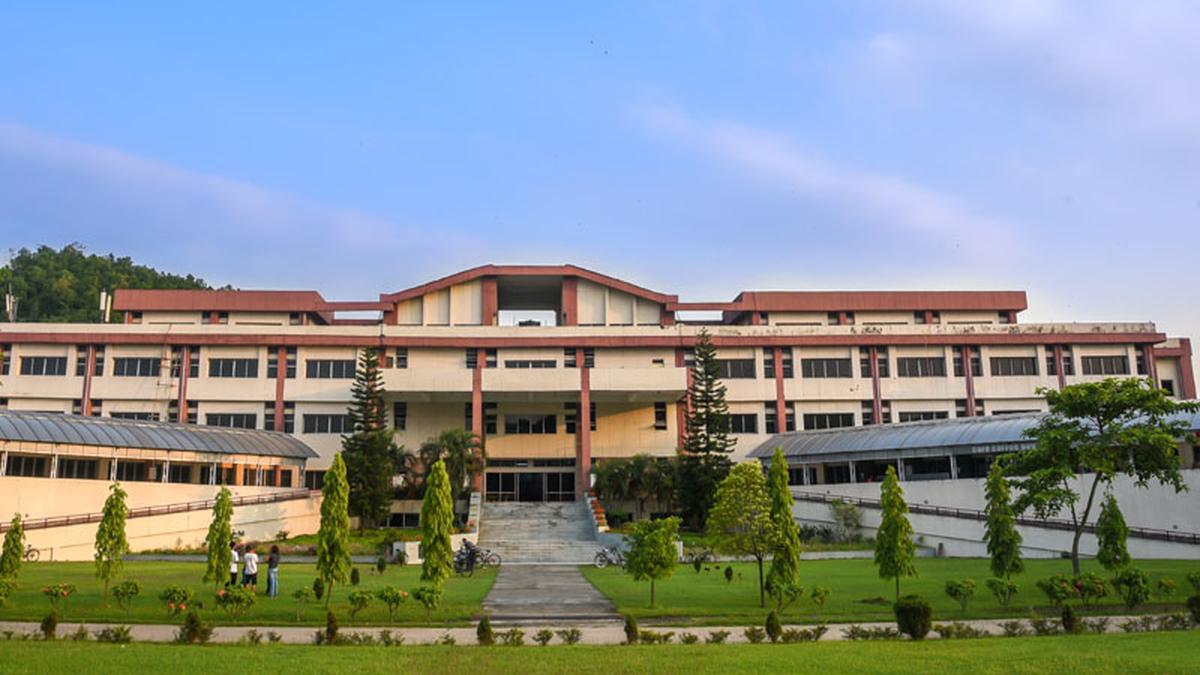
A team of researchers from the Indian Institute of Technology Guwahati (IIT-G) have developed energy-efficient bricks.
| Photo Credit: The Hindu
GUWAHATI A team of researchers from the Indian Institute of Technology Guwahati (IIT-G) have developed energy-efficient bricks designed to keep buildings naturally cool, offering a solution for sustainable construction.
The researchers are Bitupan Das, Urbashi Bordoloi, Pushpendra Singh, and Pankaj Kalita of the IIT-G’s School of Energy Science and Engineering and the School of Agro and Rural Technology. Their study has been published in the latest issue of the Journal of Energy Storage.
“In modern architecture, most infrastructures rely on air conditioning systems to maintain indoor temperatures, especially during the summer. While these systems are effective, they consume substantial electricity and contribute significantly to carbon emissions and environmental degradation,” an IIT-G statement read.
The IIT-G researchers focused on addressing the challenge of heat entering building interiors through the roof and walls, thus increasing the usage of air conditioners. They redesigned conventional bricks to minimise heat gain.
The team applied Phase Change Materials (PCMs), a type of substance that can absorb and release heat during phase transitions. An example of such substances is wax, which absorbs heat as it melts and releases it upon solidification.
“Similarly, when embedded in building components, the PCMs absorb excess heat during the day and release it when the temperature drops. This way, the indoor temperature remains stable throughout the day,” the researchers explained.
The team found OM35 to be the most suitable PCM for the research. This material melts at around 35 degrees Celsius, making it particularly suitable for hot, humid regions where temperatures range from 28 to 38 degrees Celsius.
Prof Kalita underlined the use of PCM in developing climate-responsive infrastructure. “The developed bio-composite-filled Autoclaved Aerated Concrete brick is highly stable in shape and offers adequate mechanical strength in hot and humid conditions, making it suitable for infrastructure development,” he said.
Leaking challenge
The researchers addressed the challenge of PCMs leaking during the melting phase by integrating the PCM with biochar to develop a composite material. Biochar is a carbon-rich material that serves as a supporting matrix, holding the molten PCM in place and preventing leakage while enhancing thermal conductivity.
“PCM-embedded bricks are capable of better thermal management in terms of temperature reduction than conventional bricks, as they can absorb and store heat during the day and release it gradually when the temperature drops, helping maintain more stable indoor conditions compared to conventional bricks,” Prof Kalita said.
However, the team said that innovative technologies like PCM-based thermal bricks often fail to reach the market. “This is not due to poor performance, but because of practical barriers such as high initial cost, difficulty in large-scale manufacturing, lack of standardisation, and low awareness among builders and developers. Additionally, the absence of real-world demonstration projects reduces industry confidence,” the team said.
“For successful lab-to-consumer transition, it is essential to reduce costs, validate performance through pilot projects, obtain certifications, and collaborate with industry stakeholders. Policy support and awareness programmes can further accelerate adoption,” they added. EOM
Published – March 28, 2026 01:18 am IST



