


On February 24, 2026 the BJP-led government at the Centre approved the proposal of the CPI(M)-led regime in Kerala to change the State’s name to ‘Keralam’, the name used in the Malayalam language. Nearly 50 years ago, the Congress government did this for Tamil Nadu when the DMK regime, which came to office dislodging the national party from power, had wanted the title of the State to be changed from ‘Madras’ to Tamil Nadu.
It is common knowledge that the “moment of frisson,” as described by diplomat-turned-writer R. Kannan in his perceptive book, The DMK Years, came on July 18, 1967, about four months after the Dravidian major captured power in a sensational manner, unseating the Congress that ruled the State for 20 years. On that day, the State Assembly adopted a resolution unanimously, calling for the change in the name of the State.
But, as early as in March 1961, the Congress government informed the Legislative Council and the Assembly that it would hereafter limit, in official communication in Tamil, the usage of the name ‘Chennai’ to the capital of the State and that of ‘Tamil Nadu’ to the State. R. Venkataraman, who was the then Industries Minister in the Congress regime, had called the State “Tamizh Nadu.

However, there are many unknown or less known facets of the chapter regarding the change of the name. It was on Tamil New Year Day (April 14, 1967) that the then Chief Minister C.N. Annadurai formally initiated the process of the name change when he switched on the new neon-light name board of the State Government over the Secretariat that read: ‘Tamizhagha Arasu – Thalaimai Cheyalagam’ (Tamil Nadu Government Chief Secretariat).
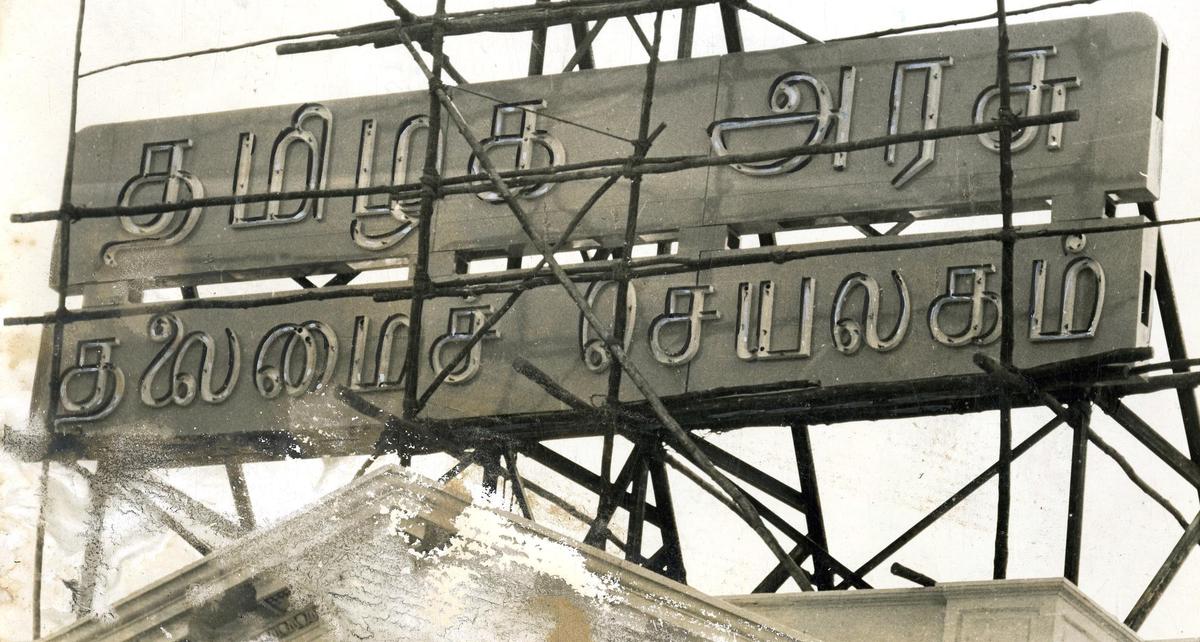
The Tamil name in neon lights of Madras Government Secretariat (Fort St. George), above the Chief Minister’s chamber, seen in 1967.
| Photo Credit:
The Hindu Archives
The then Education Minister V.R. Nedunchezhian called for giving second place in name boards to English for the benefit of non-Tamils. The latter went to the extent of saying that the change-over was a “fruition of the longings” of poet Subramania Bharati who had dreamt of a great and glorious future for Tamil and Tamil Nadu. Then Public Works (PWD) Minister M. Karunanidhi said some critics had contended the word ‘Tamizhagham’ did not find a place in ancient grammar texts. But, the epic, Silappadikaram, made mention of the word, The Hindu’s report, published on April 16, 1967, quoted him as having said.
It was only a year later that the Union government sent a draft Bill on the name change to the DMK government for feedback. Originally, the State was to be called in Tamil ‘Tamil Nad.’ But, the spelling was changed to ‘Tamil Nadu’ on the suggestion of the country’s former Governor-General C. Rajagopalachari (Rajaji or CR), said another report of this newspaper on April 24, 1968. This time, the daily had quoted the then Law Minister S. Madhavan.
Enough drama was in store seven months later when the Bill was to be taken up by the Lok Sabha for consideration and adoption. At 3:18 p.m. on November 21, Deputy Speaker Raghunath Keshav Khadilkar, called Union Home Minister Y.B. Chavan to move the Bill to alter the name of Madras State but the Minister was “absent.” So were his junior Ministers. The Deputy Speaker observed that Chavan was “not here,” states the transcript of the debate of the House for the day. Immediately, K. Rajaram, who was the Salem MP, representing the DMK, suggested that the Congress MP of Tenkasi (SC) R.S. Arumugam introduce the Bill. Another parliamentarian from the DMK, V. Krishnamoorthi, later popularly known as Nellikuppam Krishnamoorthi, complained that “the Ministers must be here at least to move the bill.”
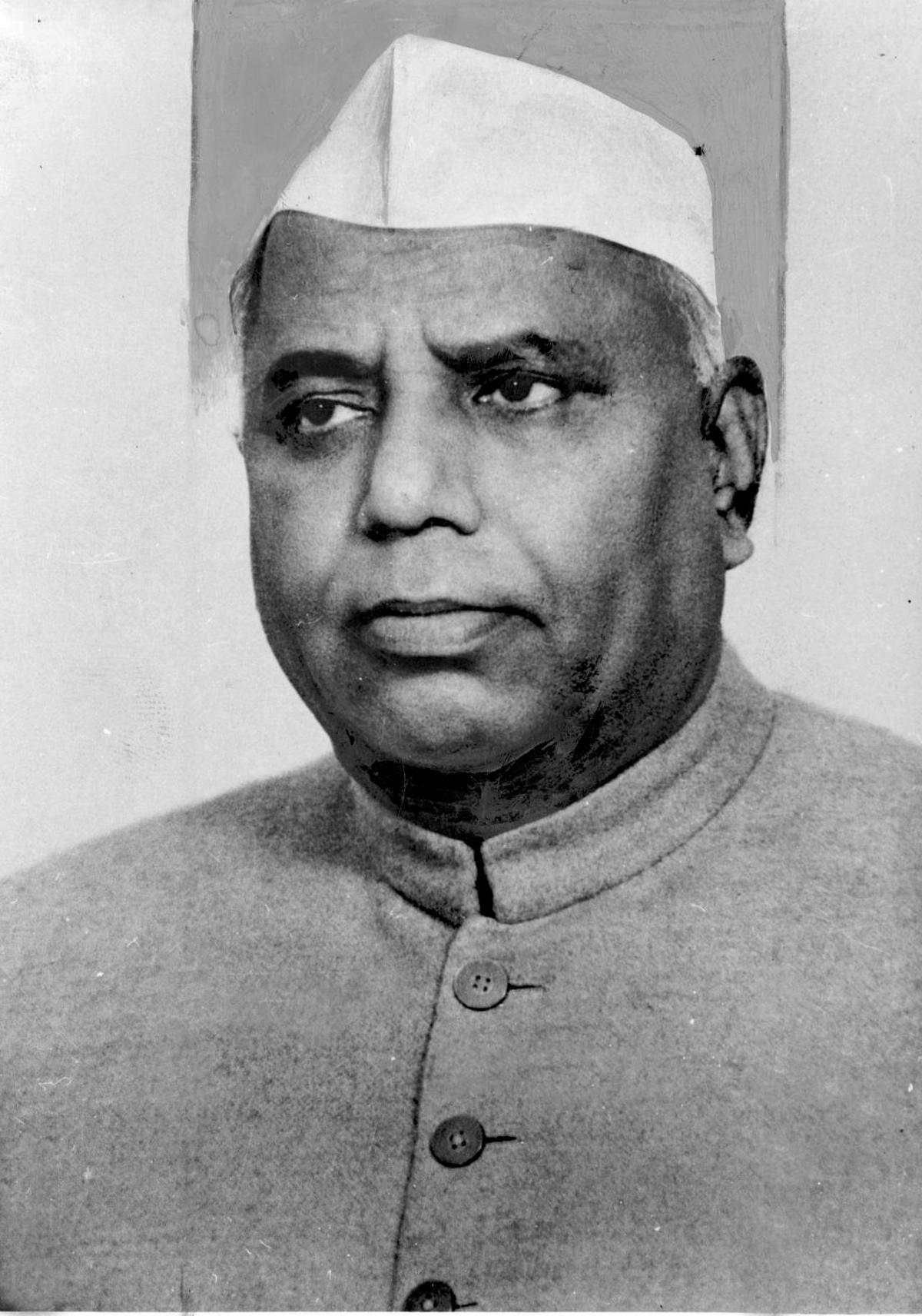
Y.B. Chavan. File.
| Photo Credit:
The Hindu Archives
The Congress MP from Bombay-Central, R.D. Bhandare, also an advocate and professor of law, sought to find a way out, by stating Law Minister [P. Govinda Menon, an alumnus of the Madras Law College and Chief Minister of Travancore-Cochin during 1955-56] could table the Bill. But, the reply from the Deputy Speaker was: “Unless he [Law Minister] writes to me that he would like to act in the place of someone else, I cannot permit it. If he writes, I will permit him.” When Krishnamoorthi volunteered to move the Bill, Khadilkar adjourned the House.
When the House met again after about an hour, Praja Socialist Party’s MP from Balasore (Odisha) Samarendra Kundu, who later became Minister of State for External Affairs during the Janata regime (1977-79), came down heavily on the Ministers. “It is a disgrace to the House that [the] Ministers do not come prepared, they do not take the House seriously,” Kundu said. When he wanted the Ministers to be dismissed, there were interruptions in the Lok Sabha.
Subsequently, a veteran Communist leader Hirendranath Mukherjee (Calcutta – North East), better known as Hiren Mukherjee, rose to speak, and he too did not spare the government. Pointing out he had been a member of the House since 1952, Mukherjee said “something has happened which is without precedent.” He had also consulted a person “who was associated with the Central Legislature [Central Legislative Assembly, a precursor to Parliament post-Independence]” and he was told there was no such precedent.

Referring to the Deputy Speaker’s decision to adjourn the House, the veteran Communist called it “an expression of censure on the working of the government, not on the politics of the government.” The DMK’s MP from Mettur, S. Kandappan, stated not a single Minister from the Home Ministry was present, when the House had to transact business on the Bill. Though Deputy Ministers for Defence and Law were present along with other Ministers, the Bill’s introduction was not done. “I had a feeling whether they were not at all interested in passing this Bill. If that is not so, what prevented them to take it up?”
Kundu was again allowed to speak, holding all the Union Ministers responsible for their treatment of the House “in a casual and cavalier manner.” Expressing his shock, he added the Ministers “care a hoot for this Parliament.” The Ministers, “this Congress Government, have completely usurped the privilege of this House,” he added.
The lively parliamentarian of Swatantra Party and Godhra’s representative, Piloo Mody, known for sarcasm and bitter criticism of Indira Gandhi, made scathing remarks on the Congress government: “Over a period of years, we have found an authoritarian tendency developing in this country which, more and more, has begun to treat Parliament merely as a function of Government instead of the essence of it. We have found, over the years, that whatever is discussed in Parliament is not adequately considered by the Government, and the Government has begun to consider itself as an entity apart from Parliament, not deriving its just powers from Parliament.” The Samyukta Socialist Party (SSP)’s MP from Bombay South, George Fernandes, who earned the sobriquet of “giant killer” by defeating former Union Minister S.K. Patil in 1967, had even given a notice for the breach of privilege, which was disallowed by the Chair.
Chavan clarified to the House he was in the Rajya Sabha when the Bill had to be moved for the first time. Parliamentary Affairs Minister Ram Subhag Singh and Minister of State for Home, V.C. Shukla expressed apology over the absence of the Ministers concerned. Both called the episode of absence a “lapse.” Singh assured the House “we will do our best to see that it never recurs.”
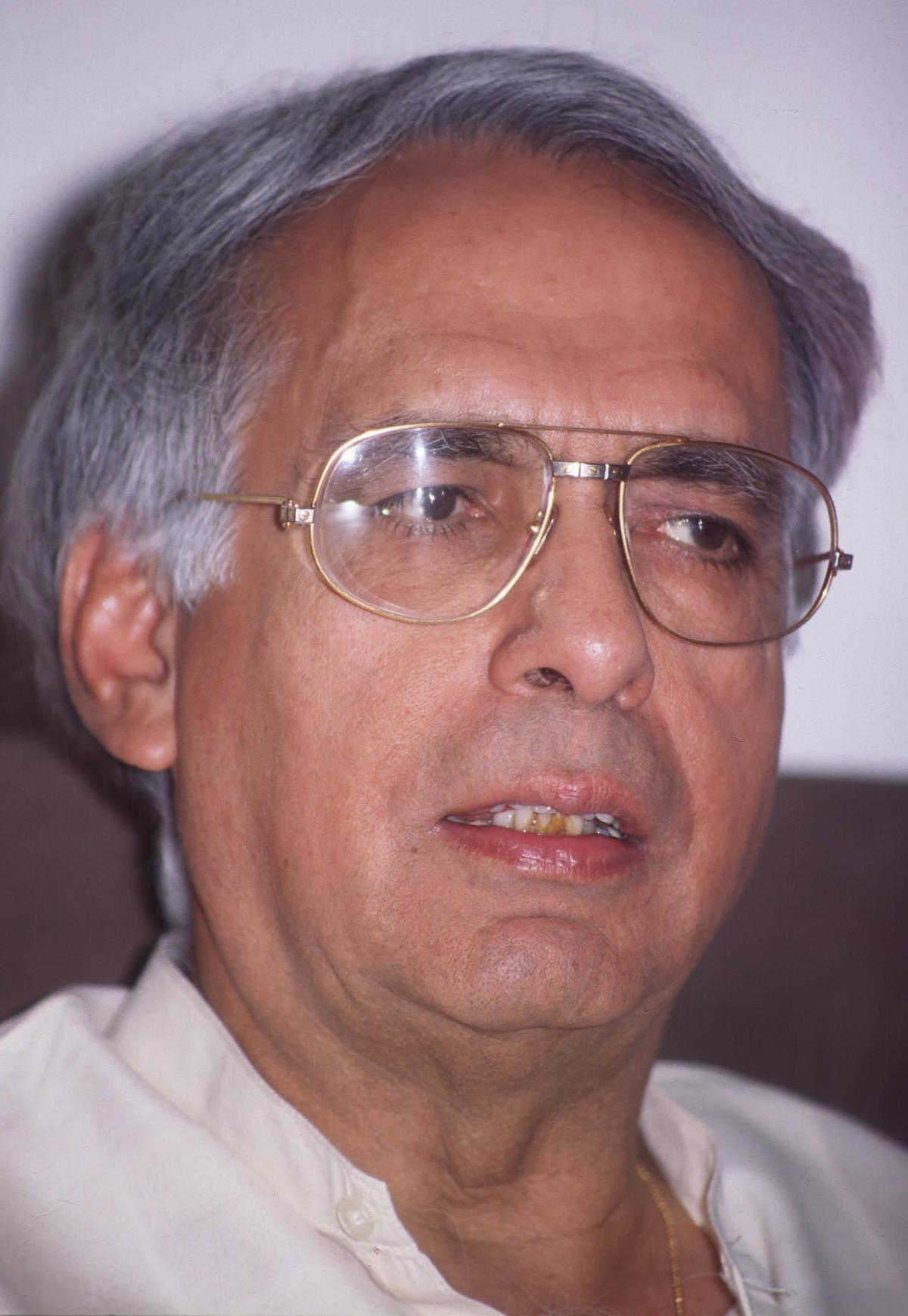
Vidya Charan Shukla. File.
| Photo Credit:
Sandeep Saxena.
Shukla recalled that in 1956, the State legislature, which had considered the issue of name change, decided not to recommend any change. On April 4, 1961, the State government issued an order, directing their officers that Tamil Nadu should be used as the name of Madras State in all future official correspondence, in Tamil. Tracing the brief history of the Bill, Shukla explained the government was guided by the wishes of the legislature. He described as “unfortunate” the observations of Kandappan.
Menon clarified why the name change was being made through a mere piece of legislation and not through an amendment to the Constitution. Quoting the essence of the Supreme Court’s 1967 ruling in the I.C. Golak Nath & Ors. vs. The State of Punjab & Ors. case, the Law Minster said that only the name change – from ‘Madras’ to ‘Tamil Nadu’ – had been proposed and “there is no abridgement of fundamental rights as guaranteed by Article 31A [which comes under Part III titled Fundamental Rights].”
Murasoli Maran (DMK), thanking the government for the Bill, said for the past 15 years, the people of his State had been wanting a name “hallowed by their long history and the rich legacy of their language to be given to their State.”
On November 22, Chavan, while participating in the debate on the Bill, apologised for his absence the previous day. He disclosed to the House that when he had a discussion on the subject, the Chief Minister Annadurai had thought of some other “musical name.” But Annadurai was prevailed upon by him to have a “name which would be understood by all.” During his speech, Chavan recounted a visit by a Tamil scholar, who spoke in Tamil for about 15 minutes at an event on his [Chavan’s] request and told the House that “it is a very musical language.” Describing the measure as a general expression of national pride, the Home Minster hoped the new name would bring the State one step nearer to integration of the country.
The Hindu reported next day that “new ground was broken when a Union Minister [for Transport and Shipping] Dr. V.K.R.V. Rao, also participated in the debate, supporting the measure. He appealed to the ruling party in Madras to see that Hindi acquired an honoured place in Tami Nadu.”
This newspaper, in its editorial on November 25, 1968, cited the unanimous support in the Lok Sabha for the legislation and stated that “no one outside grudges Tamil Nadu the name of its choice.” On December 1, at what was then called Children’s Theatre and later renamed as Kalaivanar Arangam [which stood at the present site of the recently-built structure having the identical name] on the Government Estate in Chennai, the renaming of the State was celebrated with Chief Minister Annadurai making his first public appearance after the illness of cancer in the gullet. He was given a standing ovation when he rose to speak, this newspaper reported on December 2, 1968. He called for steps to facilitate “Tamilians to live as Tamilians” and secure the much-needed changes in the political sphere for the State within the framework of the country’s constitutional framework.
On December 5, the Rajya Sabha adopted the Bill. The new name came into force on January 14, 1969, the day of ‘Thai Pongal.’



