


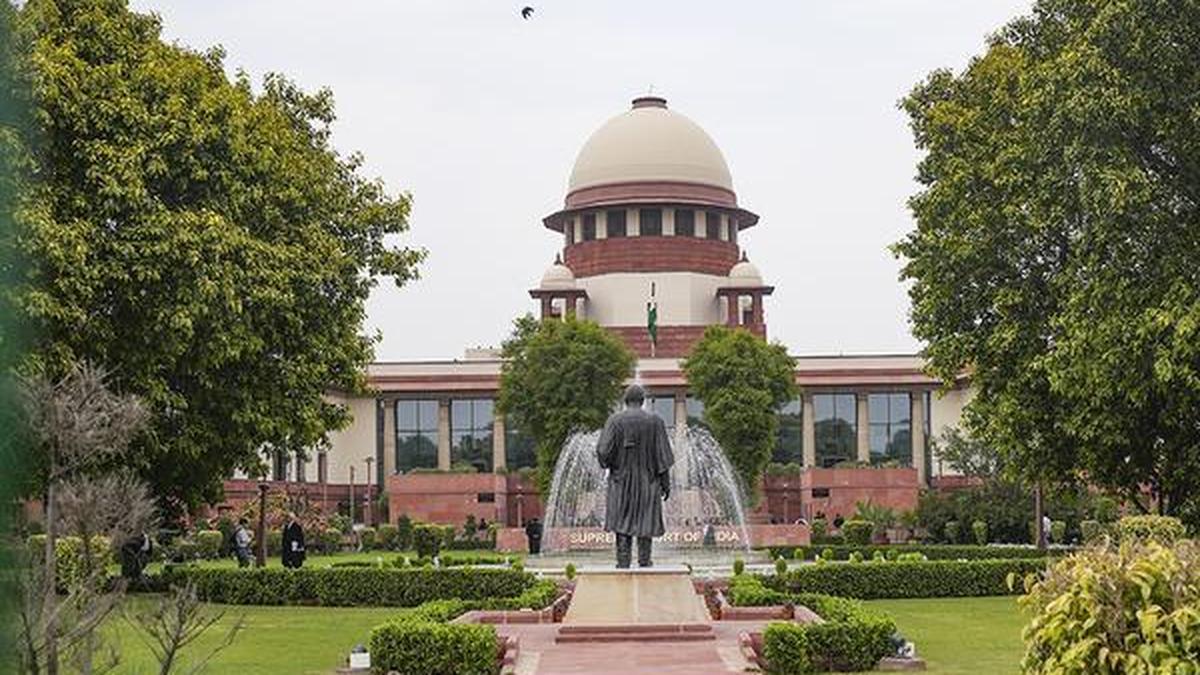
A file image of the Supreme Court of India.
| Photo Credit: PTI
The Supreme Court on Monday (March 16, 2026) expressed reluctance to endorse any change in the duration of five-year integrated LL.B. programmes across the country. The court said that such policy matters do not warrant judicial intervention, even as it acknowledged the need for reforms to strengthen the quality of legal education.
A Bench comprising Chief Justice of India (CJI) Surya Kant and Justice Joymalya Bagchi observed that while reforming legal education was necessary, decisions concerning the structure and duration of professional programmes require broader consultation with academic institutions, regulatory bodies and other stakeholders.

“On the issue of legal education, the judiciary is just one stakeholder. There are many others who also have a say in it. Academicians, jurists, the Bar, social and policy researchers are there. There should be deliberation with them. We cannot thrust our views,” the Bench said.
The top court was hearing a Public Interest Litigation (PIL) petition filed by advocate Ashwini Upadhyay seeking the establishment of a Legal Education Commission comprising jurists and legal experts to examine the regulatory framework governing legal education in India, including the syllabi and duration of law programmes. Challenging the existing five-year integrated law courses, the petition argued that most professional programmes in India are structured for four years and that the longer duration may discourage meritorious students from pursuing a career in law.
While mentioning the plea for urgent listing, Mr. Upadhyay told the Bench that the existing law degree programmes were failing to attract the best talent. “This is a PIL seeking the constitution of a Legal Education Commission of eminent jurists to frame the syllabus. Most professional courses like CA and B.Tech are for four years, whereas law is five years. It is failing to attract the best talent,” he submitted.
While acknowledging that reforms in legal education are a necessity, the Chief Justice remarked that it may not be appropriate for courts to determine the duration of professional courses. He also referred to the origins of the five-year law programme in India, noting that the model existed even before the National Law School system was established.
“The pioneer of the five-year course was not National Law School Bangalore but Maharshi Dayanand University, Rohtak. The first batch was around 1982 or 1983”, he said.
At this point, Mr. Upadhyay submitted that several university chancellors were not supportive of the five-year law course. The Bench, however, questioned why those institutions could not initiate such changes on their own. “Then why can’t they reduce the term? Why is a court order needed?” the Bench asked.
Mr. Upadhyay responded that any modification in the duration of law programmes would require a decision by the Bar Council of India (BCI), the statutory body responsible for regulating legal education and professional standards.
The court then directed that the matter be listed for further consideration in April 2026.
The petition pointed out that while the National Education Policy (NEP) 2020 promotes four-year undergraduate programmes across professional and academic disciplines, no steps have been taken by the BCI to review the syllabus, curriculum and duration of Bachelor of Laws (LLB) and Master of Laws (LLM) courses.
The plea contended that the five-year duration of BA-LLB and BBA-LLB programmes was “disproportionate to the course material” and imposed an excessive financial burden on students. It added that the extended duration delays students’ entry into the workforce and increases the cost of legal education.
Published – March 16, 2026 11:03 pm IST



