


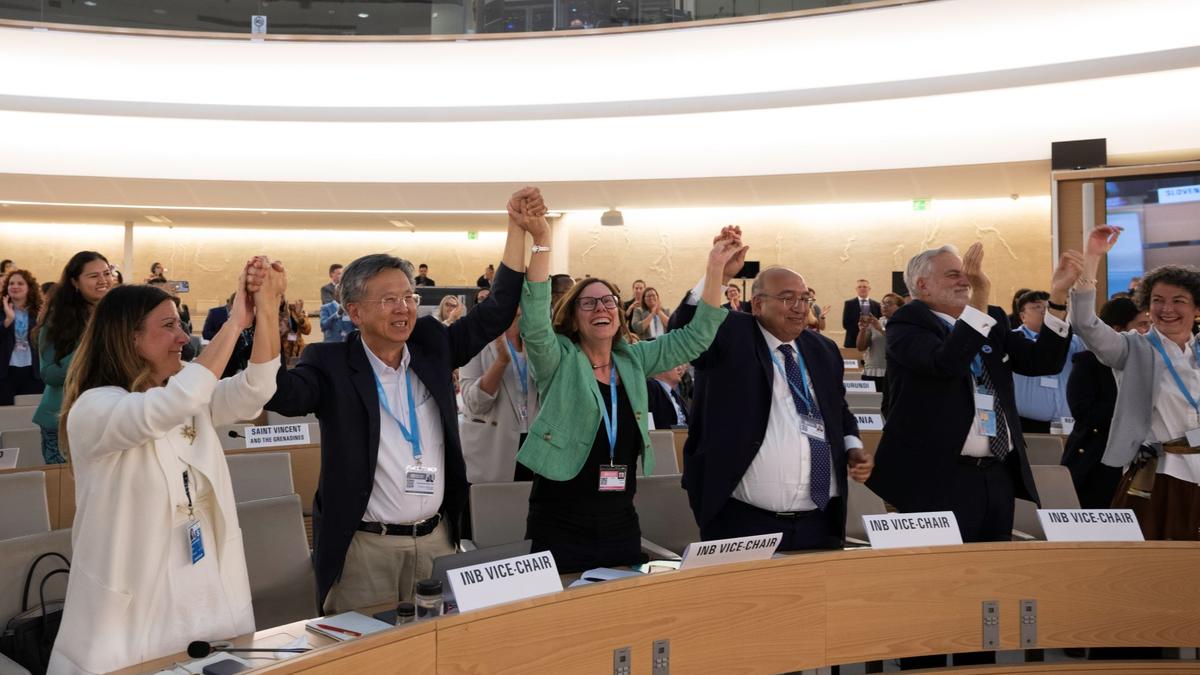
The World Health Organisation (WHO) Pandemic Agreement was adopted by the World Health Assembly on May 20, 2025. Photo: who.int
Ahead of a crucial meeting of countries in Geneva this month where they must agree on a rule book, accompanying the so-called ‘Pandemic Agreement,’ India has found common cause with a coalition of developing countries — called the Group for Equity — that says developing countries that share pathogen materials and genetic sequence data must receive fair, concrete, and legally enforceable benefits in return.
The World Health Organisation (WHO) Pandemic Agreement was adopted by the World Health Assembly on May 20, 2025, and was developed in response to the COVID-19 pandemic, which revealed significant gaps and inequality in the world’s ability to prevent and respond to health emergencies, prompting nations to take action.

The aim of the body was to draft and negotiate a WHO convention, agreement or other international instrument on pandemic prevention, preparedness and response, that would culminate in a legally binding international instrument. Once adopted, the next step was for an Intergovernmental Working Group (IGWG) on the Pandemic Agreement to negotiate the details of the Pathogen Access and Benefit-Sharing (PABS) system, which will form an ‘annex’ to the Agreement. Once adopted by the World Health Assembly, expected to be May 2026, the full agreement will be open for countries to sign and ratify according to their own constitutional processes. The agreement will officially enter into force 30 days after 60 countries have ratified it.
A major point being discussed is how biological samples of viruses and bacteria, among other life forms, that may be linked to epidemics or public health emergencies ought to be shared with international networks of laboratories. These need not only be the physical samples but also the genetic sequence of these life forms. Developing countries say a system of standard legally binding contracts must govern every stage of pathogen and sequence data sharing. Every entity that touches PABS materials or sequence information — whether a laboratory within the WHO Coordinated Laboratory Network or a private pharmaceutical company outside it — must sign enforceable agreements that include benefit-sharing obligations. However, what defines networks and whether there is an exhaustive list governing them is a moot point, said Nithin Ramakrishnan of the Third World Network. a group that has been following negotiations.
Landmark agreement: On the draft WHO Pandemic Agreement
These benefits can mean that those who commercialise products derived from PABS materials, pay a percentage of annual revenue back into the system. Non-monetary benefits include requirements that manufacturers reserve a percentage of real-time production of pandemic products for WHO (with at least 10% donated), grant non-exclusive licences to developing country manufacturers during emergencies, and make products available at affordable or not-for-profit prices. The ‘equity group’ insists — their submissions show — that physical materials and digital sequence information ought to be traceable back to the originating country, and access to PABS materials require prior informed consent from the providing party.
A submission by the European Union suggests a preference for a more “voluntary” nature to such agreements. Manufacturers are encouraged, rather than compelled, to enter into legally binding contracts with WHO. The architecture depends on attracting sufficient manufacturer participation through incentives rather than mandating it through regulation. The EU agrees with a 10% donation floor during a pandemic emergency, which aligns with the Group for Equity’s numbers. “Currently the system works as one-way traffic. Because there is no legally binding system, countries supplying biological material or sequences are getting very little benefit. The World Health Organisation is not transparent and seems to want to continue to protect this extractive system,” said K.M. Gopakumar, Senior Researcher and Legal Adviser, Third World Network (TWN). India is represented by officers in the Health Ministry as well as Geneva-based diplomats, where the negotiations are underway.
Published – March 14, 2026 06:45 am IST



