


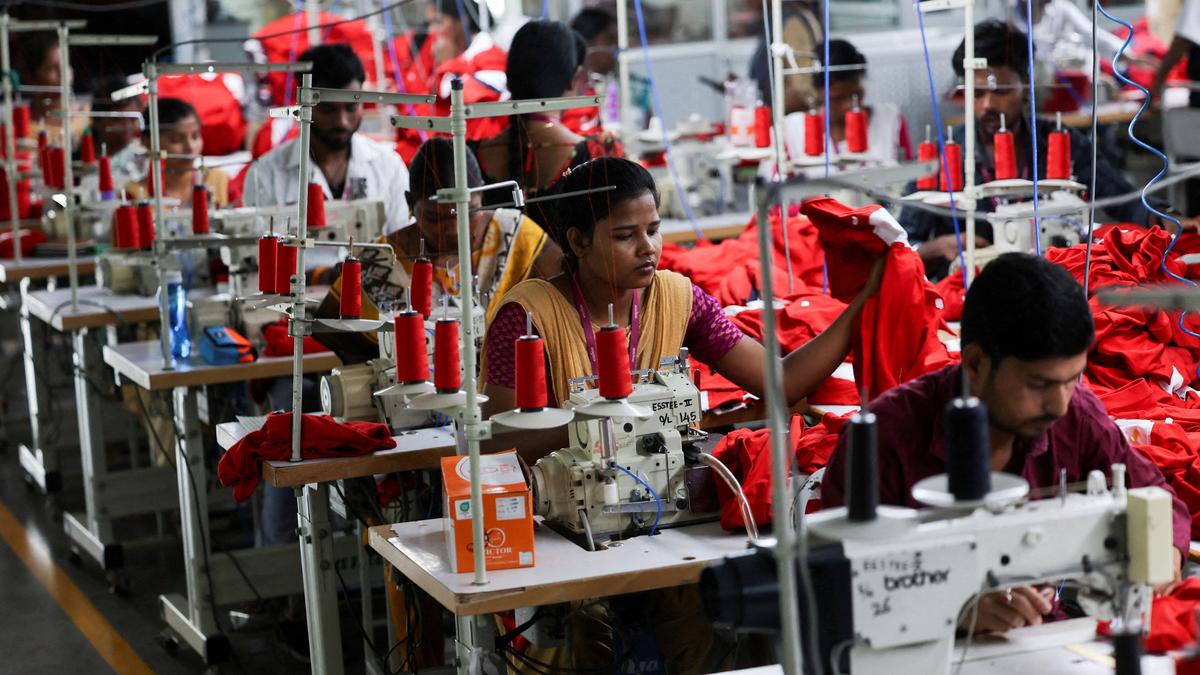
Following concerns in the Indian textile and garment industry, which is the largest employment generator after agriculture, Indian Minister for Commerce and Industry Piyush Goyal said that India is to have the same facility as Bangladesh, and that Indian garment and textile exporters will also benefit. File picture used for representation only.
| Photo Credit: Reuters
The story so far: In the U.S.-Bangladesh Agreement on Reciprocal Trade, signed on February 9, the U.S. has committed to “establish a mechanism that will allow for certain textile and apparel goods from Bangladesh to receive a zero reciprocal tariff rate”. A statement from the White House said this mechanism will provide for a to-be-specified volume of apparel and textile imports from Bangladesh to enter the U.S. at this reduced tariff rate, but that the volume shall be determined based on the use of U.S. produced cotton and MMF (man-made fibre) textile inputs. Following concerns in the Indian textile and garment industry, which is the largest employment generator after agriculture, Indian Minister for Commerce and Industry Piyush Goyal said that India is to have the same facility as Bangladesh, and that Indian garment and textile exporters will also benefit.
Also Read | India’s textile exports to U.S. will get same benefits as Bangladesh: Piyush Goyal
What does data of the countries indicate?
Of the total imports of $16.1 billion of textile inputs by Bangladesh in 2024, $3.1 billion went from India. Bangladesh imports approximately 85 lakh bales of cotton annually, mainly from Brazil, India, and African countries for its nearly 500 spinning mills. India exported 12-14 lakh bales of cotton to Bangladesh in 2024-25, of its total production of about 300 lakh bales. It also shipped $1.47 billion worth of cotton yarn (570 million kg) to Bangladesh, which was the biggest destination for Indian yarn, in 2024-25. Bangladesh buys more yarn and fabric from other countries than the basic raw material — fibre, according to a report by the Global Trade Research Initiative (GTRI). Bangladesh exported $50.9 billion in garments globally in 2024, and of it, $7.4 billion went to the U.S.
Of the annual garment exports of $16 billion from India, almost one-third goes to the U.S. At present, international cotton prices (landed cost) have a 2% to 8% price difference, depending on the country of origin and the buying country.
Also Read | Indo-U.S. trade deal will destroy India’s textile industry: Rahul
Will trade dynamics tilt towards Bangladesh?
Indian textile and garment exporters feel things will not change immediately or much because of the U.S.-Bangladesh deal. A GTRI report notes that over 63%, or $32.3 billion, of Bangladesh’s garment exports went to the European Union, duty-free. Since the EU is Bangladesh’s main market, its garment supply chains are built to serve European buyers.
Bangladesh’s garment industry depends heavily on imported textile inputs, especially yarn and fabric, for making garments. To qualify for zero tariffs of the U.S., Bangladesh should replace long-established suppliers and invest heavily in new spinning and fabric-processing capacity, which it currently lacks. According to the Cotton Textiles Export Promotion Council, the Bangladesh textile industry should change its product mix and realign its raw material supply chains to benefit from the use of American cotton. Its textile mills are already in a crisis, say Indian yarn exporters.
Also Read | U.S.-Bangladesh trade agreement a cause of concern for Indian apparel exporters
What is the extent of India-U.S. cotton trade?
India imports close to five lakh bales of U.S. cotton annually, of which 2.5 lakh bales are of extra long staple (ELS) cotton and the other 2.5 lakh bales are non-ELS cotton. India is one of the leading users of American PIMA cotton, which is a premium ELS variety. Several Indian textile mills are already nominated by American brands to supply yarn made of American cotton for garments. India currently levies 11% import duty on cotton, except for ELS cotton. Indian garment exporters will get similar access to the U.S. market as Bangladesh exporters, Mr. Goyal has said.
Also Read | Bangladesh plans to shift from Indian to U.S. cotton
What are the concerns?
While Indian goods will attract 18% reciprocal tariff in the U.S., goods from Bangladesh will attract 19% from the earlier 20%. Thus, the U.S. tariff difference between India and Bangladesh has halved with the U.S.-Bangladesh agreement. Bangladesh is already among the leading exporters of textiles and apparel to the U.S., alongside China, Vietnam, and India. Both, India and Bangladesh make predominantly cotton-based apparel.
Shafiqul Alam, information adviser to Chief Adviser Mohammed Yunus, told The Hindu that Bangladesh has traditionally imported cotton from India and Central Asia as it does not produce the cotton or yarns necessary for its textile sector. It will replace Indian cotton with U.S.-produced cotton as a result of the U.S.-Bangladesh trade deal, he said. The immediate impact is likely to be on Indian cotton and yarn exporters. However, Indian exporters still have a lot of unanswered questions, such as if the U.S.-India agreement does give Indian garment exporters a similar facility to the U.S. market, will the Indian government waive the import duty on U.S. cotton? Will it allow specific quantities to be imported by India duty-free?
Also Read | Export of technical textiles see a dip in April – October 2025
Will there be benefits for garment exporters buying American cotton?
There is every possibility of U.S. cotton prices firming up when demand increases. If cotton is available from any other country at a lower cost, will U.S. customers find it cost competitive to buy garments made from U.S. cotton? There is also no clarity on how the U.S. will determine the quantity of U.S. cotton in a garment or textile product. Both India and Bangladesh garment exporters will get relief only from the reciprocal tariff if they use U.S. cotton and not the basic duty. While waiving of tariff by the U.S. for products made from U.S. cotton or MMF will certainly benefit Indian garment exporters, they are hoping the Indian government will evolve a system that will take into consideration all the practical implications and necessities for the effective operation of such a facility.
Published – February 15, 2026 02:36 am IST



