


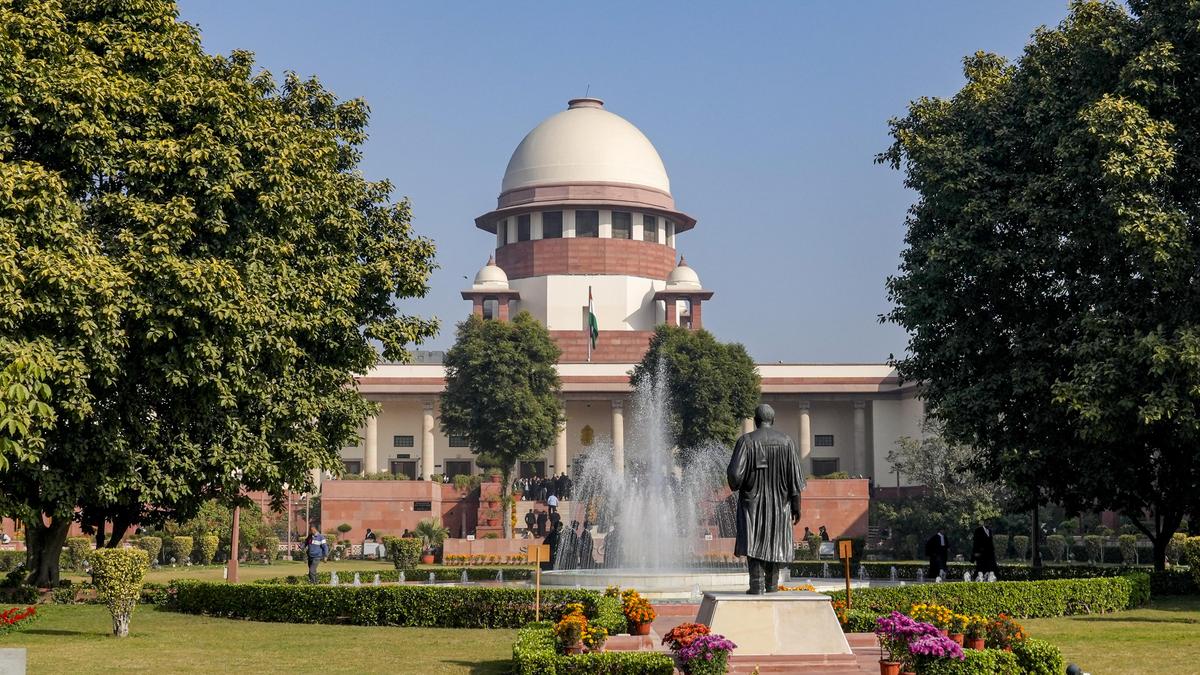
Chief Justice Surya Kant said that the party failed in the elections, only to now use the judicial platform.
| Photo Credit: PTI
The Supreme Court on Friday (February 6, 2026) chastised former poll strategist Prashant Kishor’s Jan Suraaj Party, which sought the setting aside of the 2025 Bihar Assembly elections, that political parties cannot use the judicial platform as an avenue to gain popularity after facing defeat at the ballot box.
The party has accused the Nitish Kumar-led NDA government in Bihar of splurging ₹15,600 crore as “dole” in violation of the Model Code of Conduct, creating a serious dent in the coffers of a State whose finances are already stretched tight.
“How many votes did your political party get in the election? People reject you, and now you use the judicial platform to get popularity,” Chief Justice of India Surya Kant, heading a Bench with Justice Joymalya Bagchi, addressed senior advocate C.U. Singh, for Jan Suraaj Party.

The petitioner-party alleged corruption on the part of the State government for transferring ₹10,000 each to women under the Mukhyamantri Mahila Rojgar Yojana immediately after the announcement of the 2025 Assembly poll schedule.
Chief Justice Kant said the court was meaning to “seriously examine” the distribution of irrational freebies, but it did not want to be seen to do so at the behest of a political party which has lost the elections. A political party, on garnering power, may do the very same thing to retain power.
“There are other cases which we are examining. We are examining previous elections very seriously. But not at the behest of a political party which has just lost an election. If this political party gets power, it would do the same thing,” Chief Justice Kant said.
The court allowed the party to withdraw the petition and gave it liberty to approach the Patna High Court, saying the issue pertained to only one State, that is, Bihar.
Mr. Singh submitted that the distribution of money, camouflaged as a welfare scheme, to crores of women in the State shortly after the coming into effect of the Model Code “tore asunder the level playing field” and squarely came under the definition of a ‘corrupt practice’ under Section 123 of the Representation of the People Act, 1951.
“In a fiscal deficit State… A State which is one the first five most indebted States in the country paid Rs.15,600 crore in an immediate pre-election dole, adding to future debt of the State with no budgetary support or allocation. It had completely upset the playing field,” Mr. Singh submitted.
He alleged that nearly 30 lakh people were added to the Chief Minister’s scheme after the Model Code.
Justice Bagchi said there was a difference between agitating a legal or Constitutional question and challenging the wisdom of the government in pursuing a certain fiscal policy.
Mr. Singh said the distribution of “largesse” to about 1.5 crore women in the State without any prior scrutiny had “absolutely no rationale”.
“Then it is for the people to vote out that party… We cannot issue notice on this petition. This is nothing but a composite election petition, and you want an omnibus order to set aside all elections… Let us assume that your allegation is completely correct, but it has to be proved in the election petition that the candidate benefitted from the corrupt practice,” Chief Justice Kant reasoned.
Mr. Singh responded that he was not on a particular individual’s pre-poll corrupt practice, but on the “complete breakdown of the Model Code across a State”.
Chief Justice Kant asked why the party did not challenge the legality of the scheme itself then. The Bench advised Mr. Singh to raise his arguments in the High Court, allowing him to withdraw the petition from the apex court.
Published – February 06, 2026 11:59 am IST



