


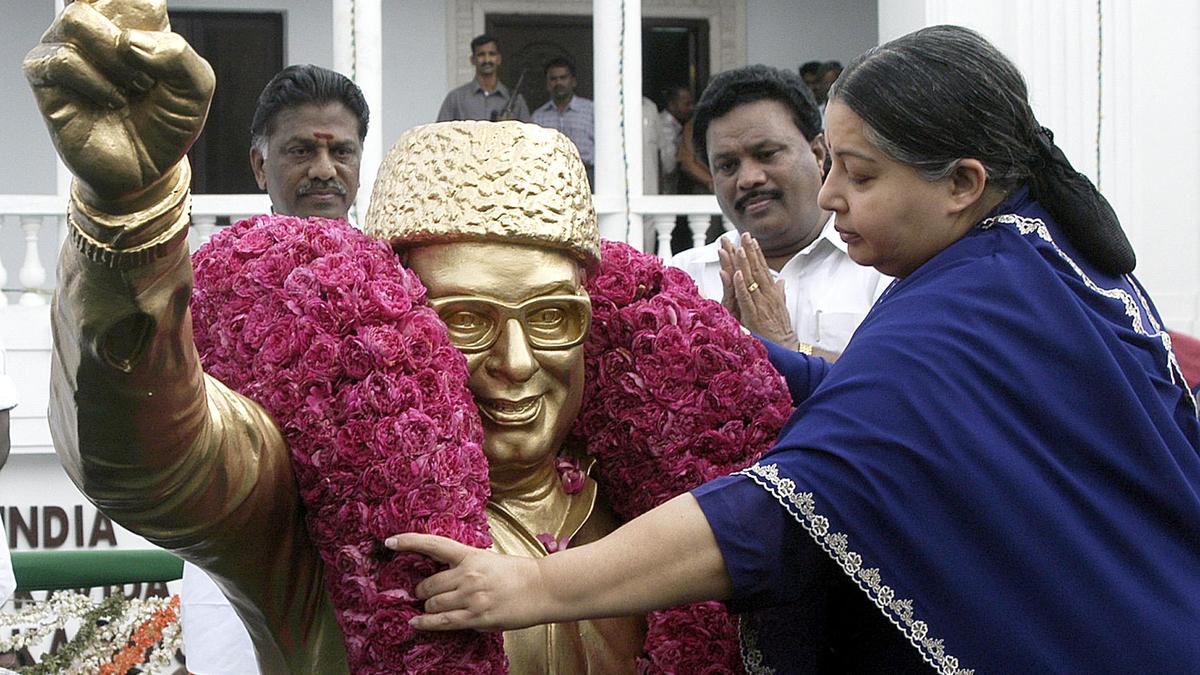
M.G. Ramachandran and Jayalalithaa neutralised the BJP’s appeal by occupying the space of “soft Hindutva” within a Dravidian political framework. File
| Photo Credit: The Hindu
In theory, Tamil Nadu should have been fertile ground for the BJP and the Sangh Parivar to take root. The State’s cultural landscape includes the Bhakti movement, temples, a vast body of devotional literature, and Sangam poetry that praises several deities. Despite the rationalist movement, a majority of the people are believers. Even several politicians who benefited from ‘Periyar’ E.V. Ramasamy’s Dravidian movement continue to practise faith in their personal lives. In fact, the few leaders who remain committed to Periyar’s hard-core ideology have been unable to persuade their own families to follow it fully.
Yet, the BJP has failed to convert religious Hindus into political Hindus in Tamil Nadu. This is because the socio-religious tradition of the region — from the Bhakti movement to the Self-Respect Movement — has been deeply anti-Brahmin and hostile to Brahminical rituals and Sanskritic modes of worship.
There has also long been resistance among Tamils to viewing themselves primarily through the homogenising category of ‘Hindu’. Internal sectarian identities have often been stronger than any pan-Hindu consciousness. The Supreme Court’s decision to appoint a retired judge to mediate the Vadakalai-Tenkalai dispute among Vaishnavites at the Varadaraja Perumal Temple in Kanchipuram underlines this fragmentation. The antagonism between Shaivites and Vaishnavites has been no less intense.
The Dravidian movement itself has its roots in the historical conflict between Brahmins and Vellalas. The Vellalas, a land-holding community with expertise in agriculture, were predominantly Shaivites. The intellectual foundation of the Dravidian movement was laid largely by educated Vellalas who were anti-Brahmin.
The historian, A. R. Venkatachalapathy, in Dravida Iyakkamum Vellalarum, notes that while several Vellala scholars supported the Self-Respect Movement, they were furious when the magazine Kudi Arasu, run by Periyar, published a series of articles ridiculing the Periyapuranam, the poetic hagiography of the 63 Shaivite saints. This episode reveals the limits of Vellala support for radical rationalism when it encroached upon Shaivite devotional tradition. In its early years, the DMK itself was derisively referred to as the Dravida Mudaliar Kazhagam — a criticism of the strong presence of Mudaliars, a community ranked just below Brahmins in the traditional social hierarchy, in the party.
Alongside these developments, a distinct intellectual tradition emerged among the Scheduled Castes (SCs) in Tamil Nadu. Pandit Iyothee Thass was a formidable scholar who articulated a radical critique of caste and religion. Another prominent SC leader, Swami Sahajananda, while aware that the core structure of Hinduism rested on the varna system, nevertheless remained a practising Hindu and even spoke against the consumption of beef. These examples complicate any simplistic narrative that equates anti-caste politics with a rejection of religious belief.
What then worked against the BJP — and continues to keep it at a distance in Tamil Nadu — was the emergence of the AIADMK as a major political force. M.G. Ramachandran (MGR), the founder of the AIADMK, was a devoted follower of the goddess, Mookambika, and popularised the deity across Tamil Nadu. Jayalalithaa even sent bricks to Ayodhya for the construction of the Ram temple. In effect, they neutralised the BJP’s appeal by occupying the space of “soft Hindutva” within a Dravidian political framework.
Had MGR remained within the DMK, the absence of the AIADMK from the political landscape might have enabled the Congress to function as a viable opposition and even capture power. In such a scenario, the BJP could have more easily displaced the Congress and occupied that space. Instead, the AIADMK foreclosed this possibility, leaving the BJP without a clear ideological or electoral opening.
By preferring a status quo approach to the caste system, the BJP has failed to reflect the ethos of Tamil Nadu. When there were demands for performing pujas in Tamil and for the appointment of non-Brahmins as priests, BJP leaders opposed them.
The BJP-led Central government has also failed to proactively implement major development schemes in the State. It has been unable to turn the tables on the Dravidian parties, which have a strong organisational base and deep cultural legitimacy.
Published – February 04, 2026 12:45 am IST



