


For most of the year, there is no work in the villages. Work comes briefly, during sowing or harvesting, and then it’s a dry season. “All of us, nearly 15 people in my family, get work only for a few months in a year. The rest of the time, there is nothing. What kept us going was the guarantee,” said Mahantappa K., a seasonal agricultural worker from Ananthapur, Belagavi, who travelled to Bengaluru to join a protest on Monday against proposed changes to the Mahatma Gandhi National Rural Employment Guarantee Act (MGNREGA).
Under the MGNREGA, rural households can demand work, and the government is legally bound to provide it within 15 days or pay compensation. “Now they are saying work will be given only if a requirement is identified, approved and funded. If there is no approved project or the budget is exhausted, there is no work. That means it is no longer a guarantee. For people like us, that uncertainty decides whether we stay in the village or migrate,” Mr. Mahantappa said.
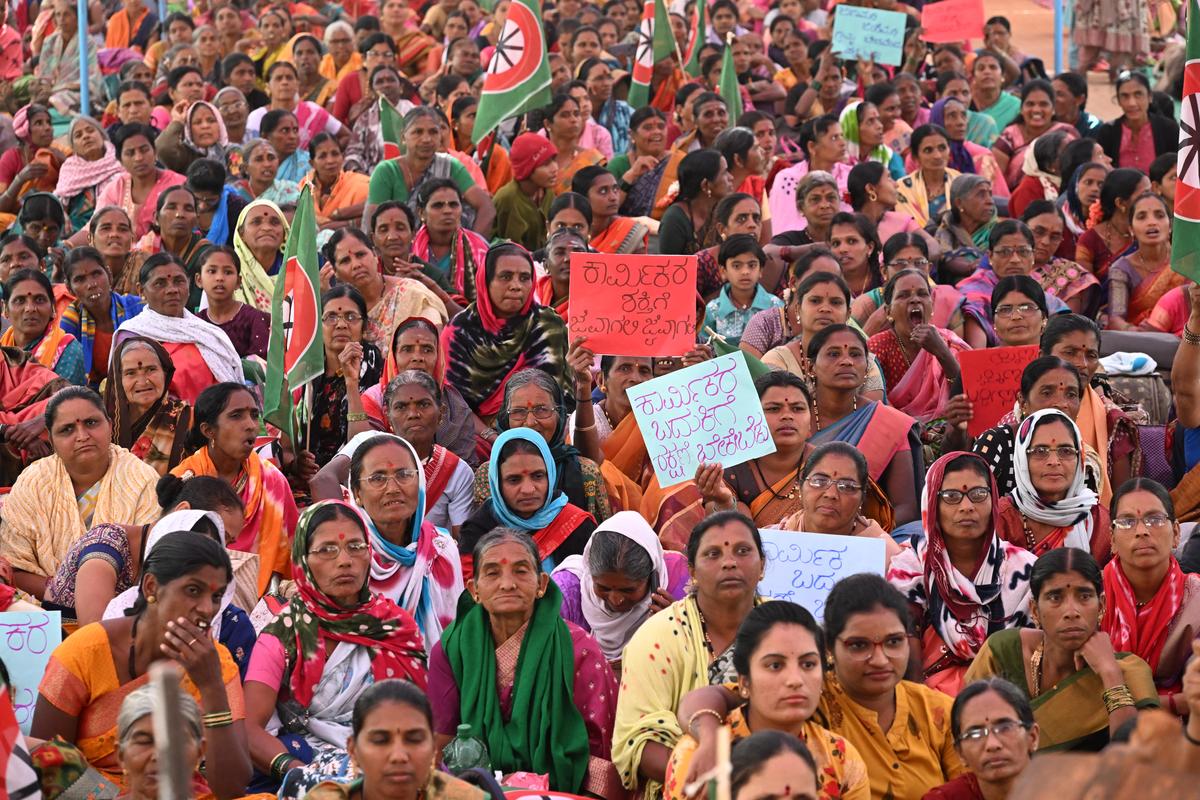
MGNREGA workers staging a protest against the VB-G RAM G Act at Freedom park in Bengaluru on Monday.
| Photo Credit:
ALLEN EGENUSE J.
February 2 marks the 20th anniversary of the Act. More than 10,000 rural workers from across Karnataka gathered at Freedom Park for a State-level mobilisation, opposing what they described as the dilution and effective replacement of the MGNREGA through the proposed Viksit Bharat-Guarantee for Rozgar and Ajeevika Mission (Gramin) (VB-G-RAM G) framework.
The workers argued that the new framework weakens the demand-driven, rights-based nature of the law that has sustained rural households for nearly two decades, especially during lean agricultural seasons.
The mobilisation, held as a Mahapanchayat, reflected the MGNREGA’s impact over the past 20 years and highlighted its role in strengthening women’s livelihoods, providing labour security, improving the socio-economic conditions of Dalit communities, and deepening local governance through Panchayat Raj institutions.
Dalit workers recall life before the Act
For many Dalit workers, the issue went beyond wages. They spoke of how access to work before the MGNREGA was shaped by humiliation, coercion and caste control. Vinayak P., a worker from Bagalkot, recalled how Dalit families were forced to accept whatever work and wages were offered, often under degrading conditions.
That changed, he argued, with the MGNREGA. The Dalit workers organised themselves, learned their rights, and were able to demand work and fair wages. Many workers recalled earning as little as ₹5 to ₹10 for hard labour before the law came into force, pointing at how the MGNREGA ensured fair wages and dignity.
What changed for women?
Women workers described the MGNREGA as a turning point not just economically, but socially. Several women workers said they, who once hesitated to step outside their homes, gained confidence through collective work and organisation, and later learned how panchayats functioned, demanded equal wages, and began participating in village-level decision-making. Many recalled working alongside men on physically demanding tasks and being paid the same wages.
Widows, single women and survivors of domestic violence said the scheme enabled them to earn livelihoods in their own villages with dignity, without depending on exploitative labour or migration.
Gayathri Anjappa, a worker from Hubballi, pointed out that people who earlier survived by begging were absorbed into panchayat work under the MGNREGA and now lived with respect.
Flagging the new restrictions under the proposed framework, workers said that while the MGNREGA allows rural households to seek work throughout the year, the new law bars employment during two months of peak agricultural activity. This effectively limits access to work for at least 60 days annually. This, the workers, described as a direct erosion of the right to livelihood, particularly for households that depend on wage work when farm incomes are uncertain.
The government’s claim that the new law will provide 125 days of work per year was described as misleading. Shantappa Kumar, a farmer from Chitradurga, pointed out that even under the legally guaranteed 100 days of MGNREGA, the average employment generated per household was only around 45 days due to inadequate funding. “Scrapping the law entirely is unnecessary and unjustified,” he said, highlighting MGNREGA’s importance not just to labourers but also to farmers. Works such as land levelling for smallholders, desilting of tanks, improved irrigation and the creation of farm ponds, he said, had directly supported agriculture.
Excessive digitisation was flagged as another major concern. Workers said wages were often denied despite completion of work, while large numbers of job cards had been deleted. Even with these challenges, they stressed, MGNREGA continues to function as a lifeline for lakhs of rural families in Karnataka.
The demonstrators argue that, the VB–GRAMG Act imposes a 60-day restriction during sowing and harvesting seasons, barring workers from seeking employment at times when rural incomes are most vulnerable.
From demand-driven to command-driven employment
Rajendran Narayanan of the MGNREGA Sangharsh Morcha said the proposed law was fundamentally unfair because it concentrates power with the Central government. Under the MGNREGA, he said, the right to demand work rested at the village and panchayat level.
Funds to States, he added, would be released based on what the Centre calls “objective parameters”, with fixed normative allocations. “This transforms the programme from demand-driven to command-driven,” he said. Tracing the evolution of the scheme, Mr. Narayanan argued that MGNREGA began as a demand-driven, gradually became supply-driven over the past decade, and is now entering a phase where employment will be dictated entirely by central command.
He also raised concerns about the revised Centre-State funding ratio of 60:40, warning that it would disproportionately affect poorer States. Combined with greater central control, he said, the shift could lead to political favouritism towards some states and the victimisation of others.
Published – February 02, 2026 08:29 pm IST



