


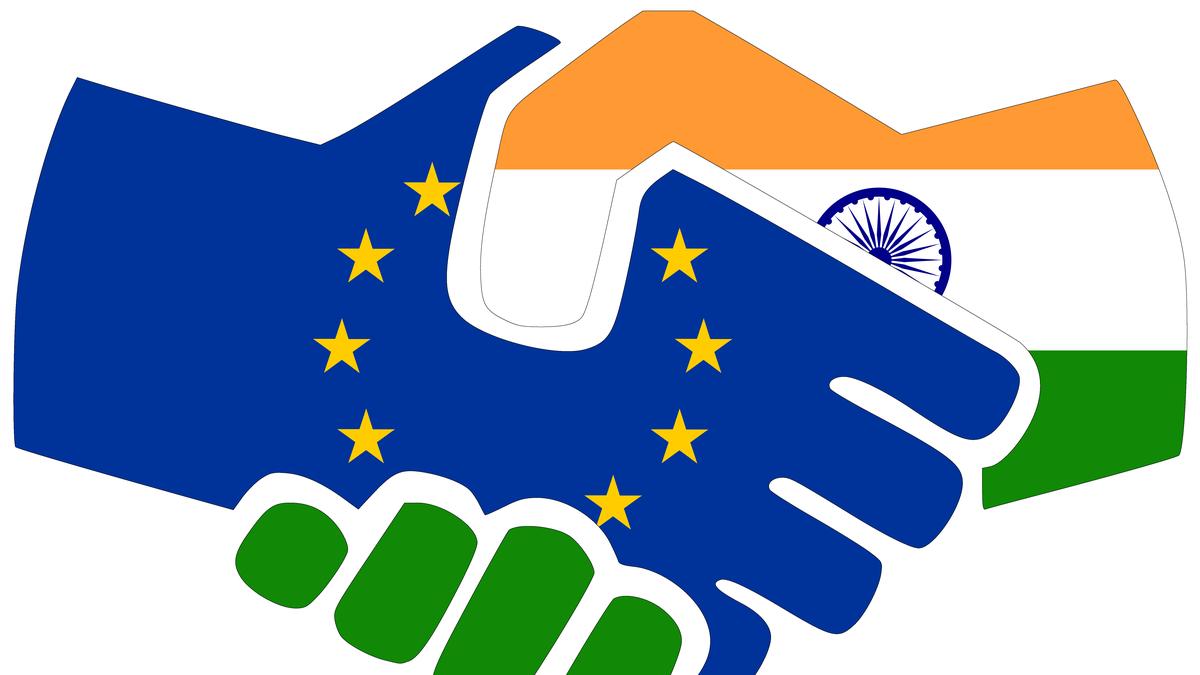
‘The EU-India partnership could be a model for other nations’
| Photo Credit: Getty Images/iStockphoto
In geopolitics, clarity is rare. But when it arrives, it demands action. Both are now embodied within the deepening relationship between the European Union (EU) and India as the two sides prepare for the upcoming visit of the President of the European Commission, Ursula von der Leyen, and the President of the European Council, António Luís Santos da Costa, New Delhi. As chief guests at India’s 77th Republic Day on January 26, 2026, and co-chairs of the 16th India–EU Summit on January 27, their presence is more than ceremonial. It is an alignment of intent. The optics of EU leaders standing alongside Prime Minister Narendra Modi at India’s most symbolic national celebration will underscore the urgency of this moment.
India, once confident of its rapport with United States President Donald Trump, now finds itself in the crosshairs of America — hit with punitive tariffs and disparaging rhetoric, including being accused with the farcical charge of ‘Modi’s War’ in Ukraine over Indian purchases of Russian oil. New Delhi has rejected this inflammatory rhetoric as “inaccurate and misleading”, cautioning against “double standards”, even as it insists that the partnership has survived many challenging transitions and will press forward on the basis of mutual respect and shared interests. Europe understands this rupture all too well. Today, the message is clear: alliances no longer guarantee protection, and strategic autonomy must take precedence over strategic patience.
A relationship with potential
For too long, the India-EU relationship has simmered with unrealised potential. The two sides have committed to strengthening the relationship but progress has remained episodic. It is often derailed by narrative wars over Russia and China, and by the simple reality that the two sides were more focused on their respective relationships with the U.S. But the new urgency behind this specific visit means that it could now result in relationship-defining outcomes.
What the FTA can deliver
First, India and the EU are in the final stages of negotiating a Free Trade Agreement (FTA) that has been sputtering along since 2007. It should be viewed as a geopolitical insurance policy. If realised to its full potential, the agreement could unlock major opportunities in textiles and apparel, where India seeks tariff reductions to boost exports to Europe; pharmaceuticals and chemicals, sectors where India’s competitive edge can meet EU demand; automobiles and machinery, where Europe wants greater access to India’s growing market; and digital and services trade, where India’s IT sector could gain from regulatory harmonisation.
For India, the FTA is also about climate equity. One sticking point continues to be the EU’s Carbon Border Adjustment Mechanism (CBAM), which levies a 20%-35% effective carbon charge on materials such as steel, aluminium, cement and fertilizers from India. India sees it as a non-tariff barrier that has the potential to erase the gains an FTA would provide. In the interest of both sides, Europe should be able to offer some relief to India on this front, while still ensuring that climate remains a top policy priority.
Second, while maximising cooperation in issues of trade and technology remains vital, perhaps the hardest and most necessary conversations lie in defence. Ms. Von der Leyen has called for a Security and Defence Partnership with India, on a par with Japan and South Korea. And while it is not headline-grabbing like the FTA, it is almost just as important. For the EU, it would offer access to India’s defence market, and the opportunity for co-production of defence equipment.
For India, it compliments Mr. Modi’s ‘Make in India’ initiative, which aims to transform India into a global manufacturing hub. It would also offer access to European technology and a framework for more joint exercises and coordination in the Indian Ocean.
As a template for the world
Finally, on a strategic level, the EU-India partnership could be a model for other nations as they recalibrate and search for new partners. With America’s unpredictability and China’s continued assertiveness, India and the EU could offer a model of relationship building that respects internal domestic sensitivities, while recognising the need for flexibility and pragmatism. At the heart of this alignment is a shared belief that sovereign choices must remain sovereign, and that neither Beijing, Moscow nor Washington should hold veto power over India or Europe’s strategic decisions. India and the EU have paid the price of over-dependence — whether on Russian gas, Chinese markets or American security guarantees. Both also recognise the need for strategic autonomy, which is about enhancing flexibility, reducing over-exposure to or over-dependence on certain countries, and amplifying each other’s voices on the global stage.
| Video Credit:
How can the EU defend itself from “economic coercion”? | The Hindu Explains
India and the EU have the credibility, the capability and the capital to co-create a new chapter in multilateralism. If they choose to seize this moment and avoid the trappings of internal bureaucracy, the two sides could help realise a multipolar order that is resilient, equitable and sovereign.
Shruti Pandalai is a Fellow at the M.P. Institute for Defense Studies and Analyses based in New Delhi. Rachel Rizzo is a Senior Fellow in the Strategic Studies Programme at the Observer Research Foundation based in New Delhi. The views expressed are personal
Published – January 24, 2026 12:08 am IST



