


- Seasonal return
- The seasonal aggregation of whale sharks, the gentle giants of the ocean along India’s eastern seaboard typically begins in October and continues until March.
- Despite their immense size, whale sharks are slow-moving, plankton feeders and bear little resemblance to the fearsome image commonly associated with sharks.
- Along the Andhra Pradesh coastline, areas such as Visakhapatnam, Kakinada and Machilipatnam have historically emerged as major shark landing zones.
- Globally, whale sharks face mounting threats from climate change, ship strikes, plastic pollution, irresponsible tourism and accidental capture in large purse-seine nets
The brief appearance of a whale shark, the world’s largest fish species, off the Chinna Rushikonda coast earlier this week has stirred excitement among scuba divers. For divers, marine researchers and conservationists working along the Andhra Pradesh coast, the sighting has opened up conversation on what lies beneath these waters and what still remains undocumented.
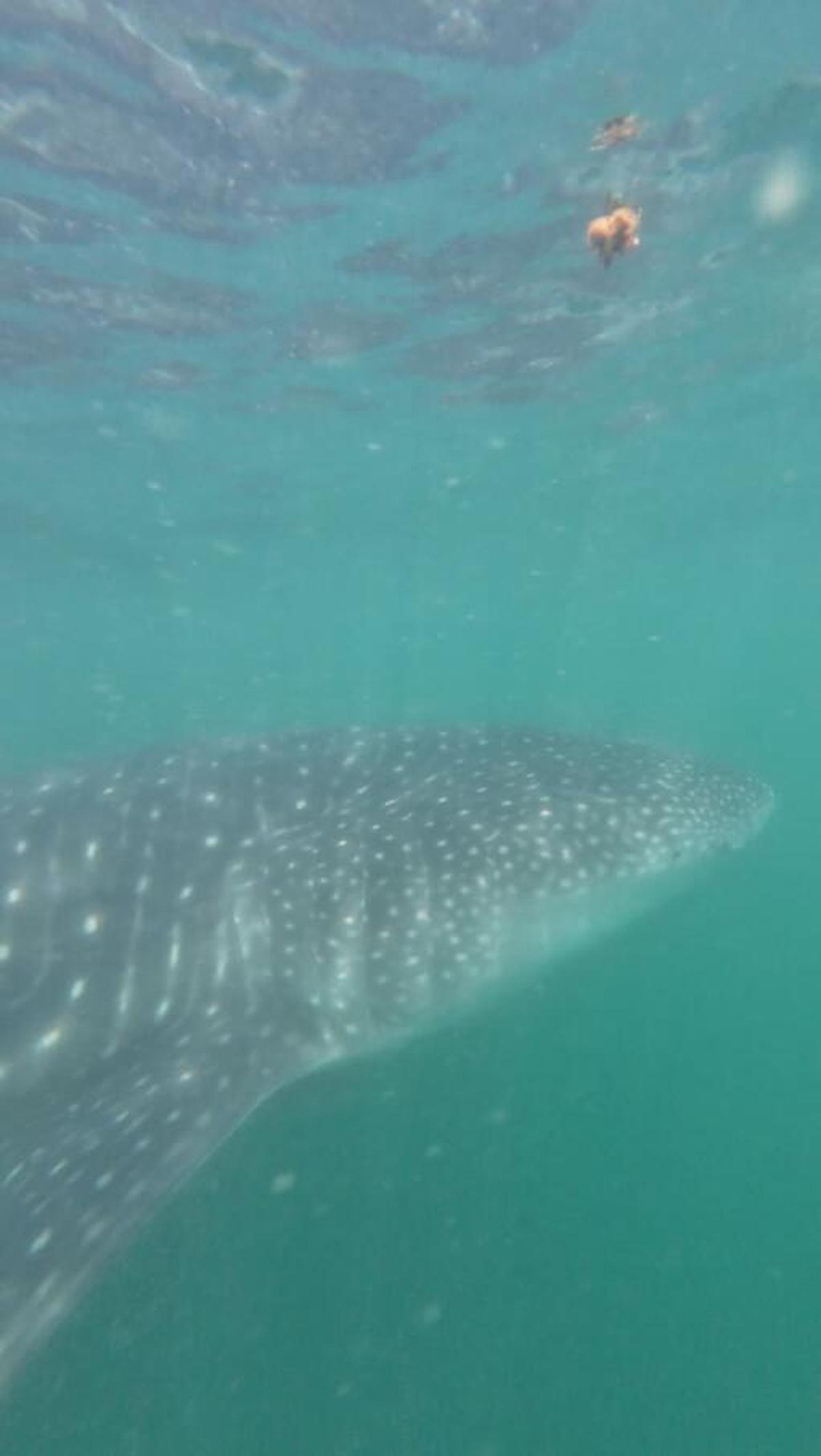
The whale shark that was spotted by scuba divers off Visakhapatnam coast.
| Photo Credit:
SPECIAL ARRANGEMENT
For scuba instructors who spend much of the year exploring nearshore dive sites, encounters with large pelagic species are rare. Vysakh Sivarajan, an instructor with Scuba Schools International-certified centre Dive Adda, describes the moment as one that redefined his understanding of the local seascape.
After eight years of diving across Indian waters, this was his first whale shark encounter. “You don’t expect to see an animal of that scale often,” he says. “We often talk about limited coral cover along this coast, but the marine diversity is remarkable — from nudibranchs and sea slugs to shoaling fish. This sighting proves that these waters are far more alive than we assume.”
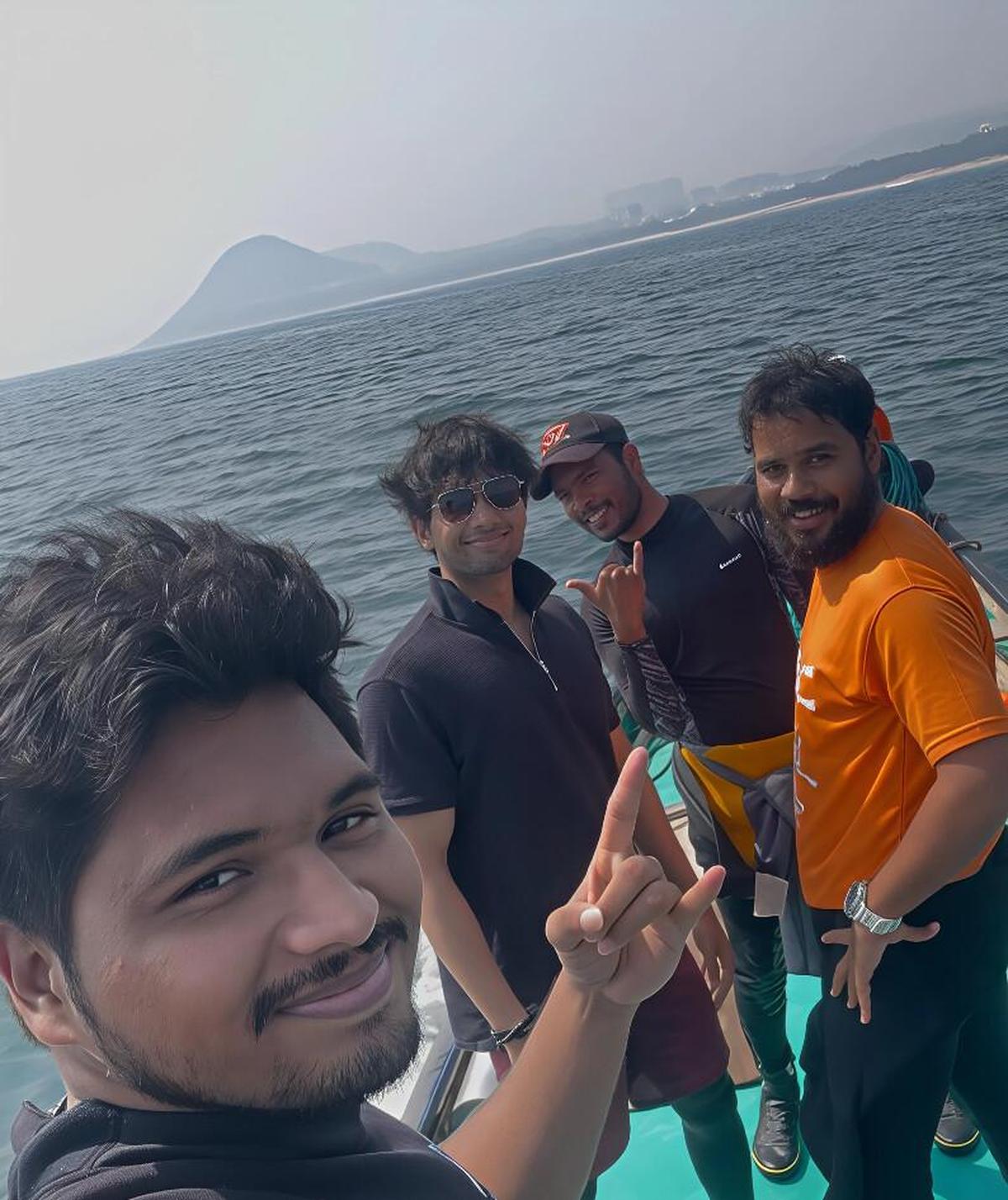
Dive Adda scuba diving team in Visakhapatnam.
| Photo Credit:
SPECIAL ARRANGEMENT
The whale shark, estimated to be around 10 metres long, was seen calmly trailing a school of fish, unbothered by the divers’ presence. According to the team, it was the first such close encounter reported by the scuba diving community along the Andhra coast, a detail that makes the sighting particularly significant. While whale sharks are known to migrate along India’s coastline, live sightings in the Bay of Bengal are relatively sparse, with most public attention drawn instead to distressing reports of strandings.
Seasonal oceanographic patterns may hold the key to understanding both phenomena. Priyanka Vedula of the East Coast Conservation Team (ECCT), which has been documenting marine life along the region, explains that winter currents play an important role. “At this time of year, colder currents move closer to shore, bringing plankton blooms and shoaling fish,” she says. “Whale sharks, being filter feeders, are naturally drawn to these food-rich zones. That’s why sightings, and unfortunately stranding, are more frequent during this season.”
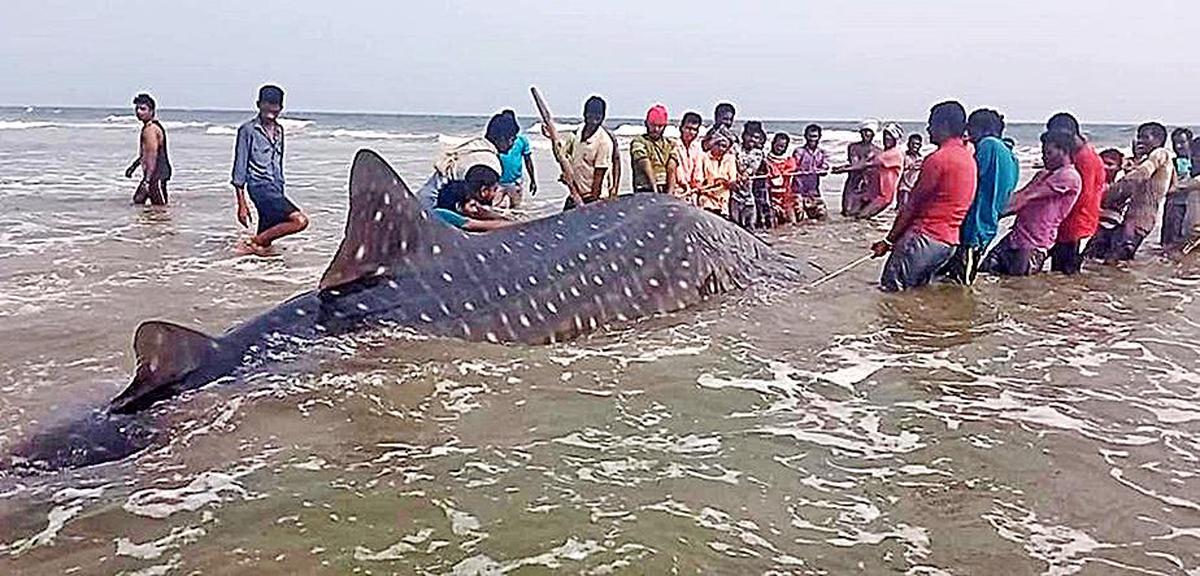
A file photo of local fishermen and forest officials guiding back a beached whale shark into the sea at Tantadi beach.
| Photo Credit:
Special Arrangement
In recent months, there have been two instances of whale sharks getting stranded at Yarada and once at Pudimadaka beach. Only one animal could be successfully guided back to deeper waters. The rest succumbed, underscoring the logistical challenge involved in rescuing an animal that can weigh between four and five tonnes. “Most strandings are not deliberate,” Priyanka notes. “They happen as a result of by-catch, especially during beach seine fishing in winter. Once a whale shark is dragged close to shore, returning it to the sea becomes extremely difficult.”
The successful rescue at Yarada, she recalls, was possible only because of a naturally deeper stretch of water close to the beach. “The fishermen could push the animal back before it became completely exhausted,” she says. Such outcomes, however, remain exceptions.
Awareness has improved over the years. Fishing communities along the Visakhapatnam coast are now familiar with the whale shark’s protected status, following sustained outreach by the Andhra Pradesh Forest Department and conservation groups. The species is listed as endangered on the International Union for Conservation of Nature Red List and is protected under Schedule I of the Wildlife (Protection) Act, offering it the highest level of legal protection in India.
Seasonal return
The seasonal aggregation of whale sharks, the gentle giants of the ocean along India’s eastern seaboard typically begins in October and continues until March.
Despite their immense size, whale sharks are slow-moving, plankton feeders and bear little resemblance to the fearsome image commonly associated with sharks.
Along the Andhra Pradesh coastline, areas such as Visakhapatnam, Kakinada and Machilipatnam have historically emerged as major shark landing zones.
Globally, whale sharks face mounting threats from climate change, ship strikes, plastic pollution, irresponsible tourism and accidental capture in large purse-seine nets
Yet newer challenges persist. The rise of mechanised fishing boats and the widespread use of nylon nets have increased the risk of accidental entanglement. “When a stranding is reported, the Forest Department responds along with a veterinarian,” Priyanka explains. “Our role at ECCT is to bridge the gap. We work closely with fishing communities and coordinate rescue efforts on the ground.” To strengthen this response, ECCT is currently running the Marine Megafauna Stranding Response programme across Visakhapatnam and Anakapalle districts. The initiative focuses on training coastal communities to identify distress situations early, report them quickly and avoid actions that could worsen the animal’s condition. Documentation is another key component. Each stranding or sighting adds a data point to a region that remains compartively poorly studied compared to India’s western coast.
For the scuba diving community, the recent sighting has renewed interest in citizen-led marine documentation. Divers are increasingly recognising their potential role as observers, capable of recording rare species without disturbing them. “This changes how we look at our dives,” says Bhadram Rasamsetty, an ex-naval officer and founder of Dive Adda. “It’s not simply about recreation any more. Every dive can contribute to understanding and protecting the diversity we have in our oceans,” he adds.
Published – January 23, 2026 10:40 am IST



