


As the BJP-Shiv Sena combine inched closer to the winning figure in the BMC election on Friday (January 16, 2026) night, it became clear that Uddhav Thackeray had lost control of the municipal corporation for the first time, having ruled it continuously for over 25 years.
From 84 seats in the 2017 elections, his party Shiv Sena (UBT), formed three years ago, won 64 seats this time. Eknath Shinde, who is the claimant of the Shiv Sena now, got only 27 seats in Mumbai. The results show a consolidation of the Marathi vote bank, after the Thackerays trumped Eknath Shinde in the core Marathi voter belts of Mumbai.

“This shows that in Mumbai, the Shiv Sena belongs to Thackerays,” a senior political leader said.
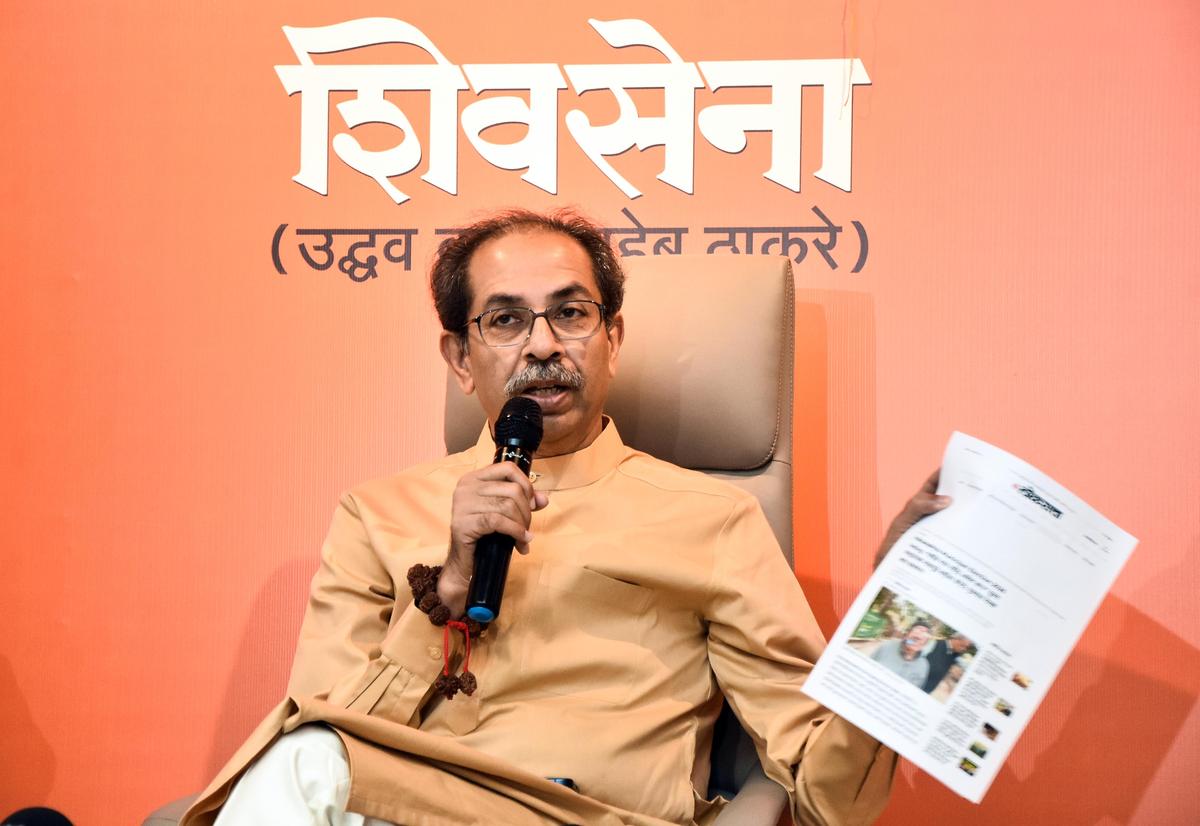
File picture of Shiv Sena (UBT) chief Uddhav Thackeray addressing a press conference at Shivsena Bhavan, in Mumbai
| Photo Credit:
ANI
Shiv Sena (UBT) blamed Eknath Shinde for the defeat, claiming that the BJP would have never been able to see its mayor in Mumbai, had it not been for Mr. Shinde.
“The Marathi population will remember Eknath Shinde as ‘Jaichand’,” posted Shiv Sena UBT MP Sanjay Raut on Friday night. The post references the 12th-century king of the Gahadavala dynasty, ruling Kannauj and Varanasi, infamous in legend as a traitor for allegedly helping Muhammad of Ghor defeat his rival, Prithviraj Chauhan.
Eknath Shinde had demanded that his party contest in 100 of the 227 seats in the BMC when discussing sharing of seats with the BJP. After tough negotiations that lasted for a week, the party got to contest 90 seats.
Thackeray not routed
Though Uddhav Thackeray lost BMC, the results indicated that he was not routed. If anything, he proved to be the contender for the Marathi vote bank, and got the second highest number of seats after the BJP.

Trends on Friday showed that the BJP got 87 seats after fighting on 137. Uddhav Mr. Thackeray’s party won 64.
When asked if the outcome would have been different, had the BJP given fewer seats to Eknath Shinde, a senior BJP leader said, “It is difficult to predict that. It would have led to a narrative that the BJP was unjust to a Marathi party, the Marathi manoos. Shinde’s party would not have taken kindly to it. And it would have hit our poll prospects. Had we given them fewer seats, it would have flared a sentiment that the BJP works against Marathis, and wants to hand over the city to outsiders.”
He said that the consolidation of Konkani Muslims and lower-middle-class Marathis had benefited Uddhav Thackeray. “Anyway, the Marathi vote bank got consolidated in favour of the Thackerays. That is why they could get so many seats in Mumbai. The fear that BJP was anti-Marathi, was successfully instigated to some extent in the Marathi population,” he said.

In the 2017 elections, the BJP had got 82 seats, its best performance in BMC by leaps and bounds till then. The party had traditionally stayed away from BMC till then, in a tacit understanding with the Shiv Sena that the latter would look after Mumbai, while the BJP will look after the rest of the State.
The power equations changed rapidly in Maharashtra after 2019, leading to a split in the Shiv Sena and pitching Uddhav Thackeray in staunch opposition of the BJP.
This time, the BJP has bettered its best performance in BMC, with an eye on ‘Shat Pratishat BJP’ in the 2029 elections. Of the 36 MLAs in Mumbai, the BJP has 15.
But the Shiv Sena’s poor strike rate in Mumbai, compared to that of the Shiv Sena (UBT), showed who the city thought was the true Shiv Sena.
A senior BJP leader said that although the Marathi vote bank had consolidated in favour of the Thackerays, the BJP also did not lose its core Marathi vote bank. “So the non-Marathi vote bank got consolidated in favour of the BJP. And our core Marathi voters too voted for us. This showed us victory,” a leader analysed.
BMC POLLS
BMC POLLS
| Video Credit:
The Hindu
Published – January 17, 2026 12:14 am IST



