

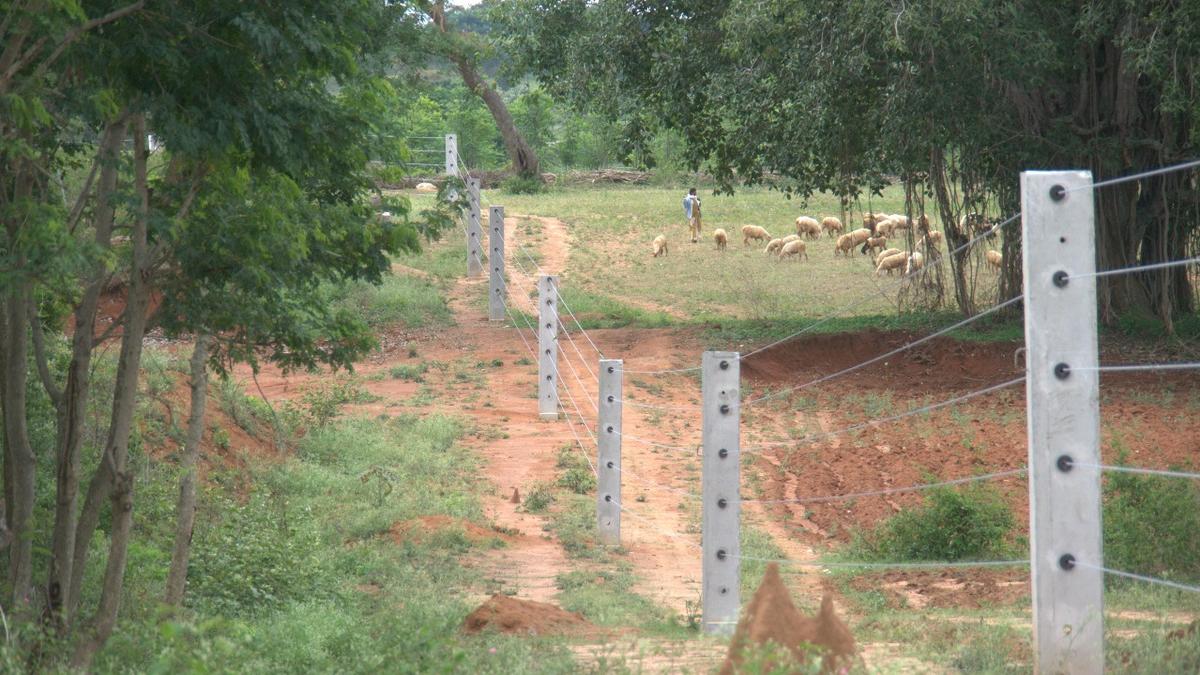

Stretch of steel wire fence erected by the Tamil Nadu Forest Department at Hosur in Krishnagiri district. File
| Photo Credit: Special Arrangement
The Madras High Court, on Friday (September 12, 2025), vacated its status quo order and permitted the forest department to go ahead with its pilot project to erect a steel wire rope fence for a distance of 10 km in Coimbatore district forests to prevent Human-Elephant Conflicts (HEC).
A special Division Bench of Justices N. Sathish Kumar and D. Bharatha Chakravarthy took the decision after inspecting the entire stretch in person and hearing the views of all stakeholders including amici curiae T. Mohan, Chevanan Mohan, Rahul Balaji and M. Santhanaraman.
The judges said, they had granted the interim order pursuant to a petition filed by activist S. Muralidharan who had objected to the erection of the fence for the 10-km distance from Thondamuthur in Boluvampatti Forest Range and Thadagam in Coimbatore Forest Range at an outlay of ₹5 crore. The petitioner had feared that any kind of fencing might prove fatal to the elephants.
Focus Tamil Nadu: The fight over elephant fencing in Coimbatore forests
| Video Credit:
Thamodharan B.
However, after interacting with the farmers in the region who had expressed grave concern over frequent crop raiding by the pachyderms and the death of many people pursuant to their encounter with the animals, as well as the forest department officials, the judges were convinced that the project could be allowed.
The Bench said the forest department had demonstrated that enough research was carried out by it before deciding to erect the steel wire rope fence and that it was the best among all other options such as erection of eight feet tall V-shaped tower fence which would increase the cost manifold.
The judges took note that the forest department officials had earmarked enough space around the proposed fencing for the elephants to manoeuvre and tread along their traditional pathways without straying into human habitations and that a similar fence put up in Hosur forest range was working well.
After watching videos of how the elephants reach the steel wire rope fencing and then retract without suffering any injuries, the judges said: “It would be a win-win situation both for safeguarding the reserve forests as well as the animals and also the farmers, their crops and human lives.”
Bio-fencing
Nevertheless, sounding a word of caution that the fence to be erected in Thondamuthur was only a pilot project which would be monitored continuously by the court to gauge its success, the judges said that it would issue appropriate directions if the elephants suffer any harm.
They directed the forest department to come up with a proposal by next month for creating a bio-fence on both sides of the steel wire rope fence so that the elephants could be completely discouraged from reaching the steel fence over a period of time.
Installation of surveillance equipment
The Bench further said thermal/artificial intelligence cameras could be installed along the entire 10-km stretch in order to analyse the behaviour of the elephants near the steel wire rope fence, document those videos and use them for research purposes in the future.
The judges also made it clear the steel wire rope fence should not be extended beyond the 10-km stretch without obtaining the express approval of the court.
Published – September 12, 2025 07:49 pm IST



