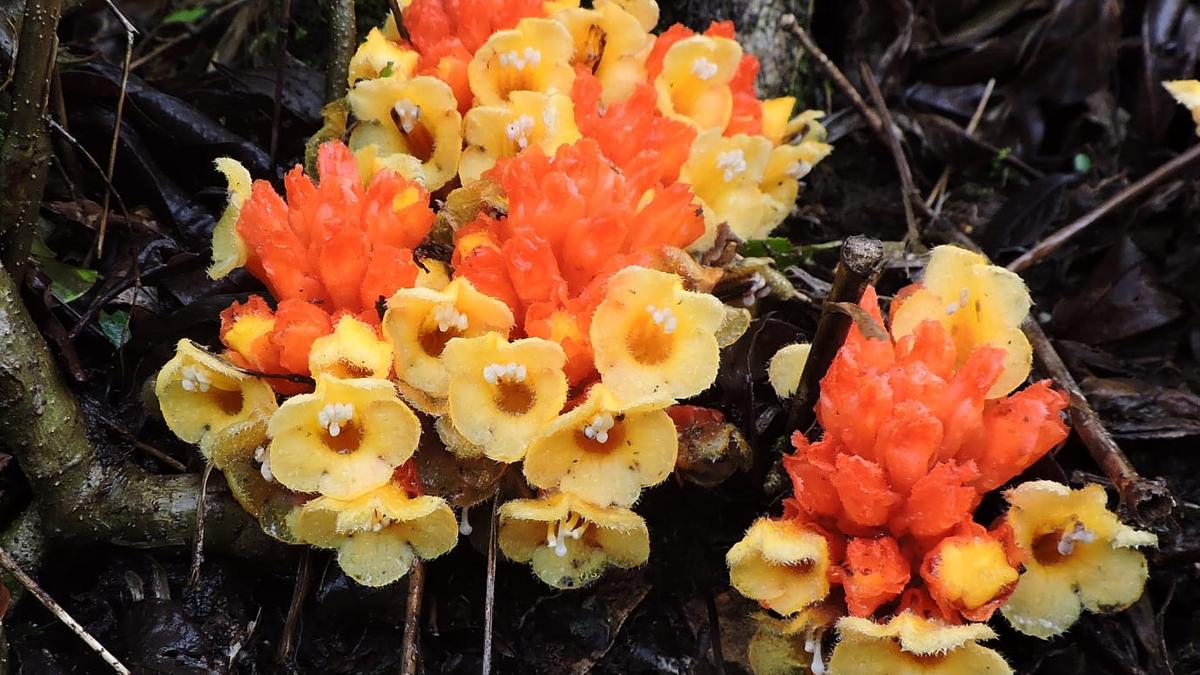
Campbellia aurantiaca
| Photo Credit: Special arrangement
A parasitic plant with vibrant orange and yellow flowers that was long thought extinct in the wild has been rediscovered after around 175 years from Kerala’s Wayanad district.
Researchers have identified the plant, first collected and described in 1849 from Naduvattam in Tamil Nadu by the Scottish Botanist Robert Wight, as Campbellia aurantiaca (family Orobanchaceae). The plant has now been rediscovered from a forest region that lies less than five km from Chooralmala and Mundakkai, the sites of the deadly landslides of July 30, 2024.
A paper on its rediscovery by Salim Pichan of the M.S. Swaminathan Research Foundation; Jose Mathew, P.T. Arunraj and V.N. Sanjai from the Department of Botany, Sanatana Dharma College, Alappuzha, and B. Gopallawa from the University of Peradeniya, Sri Lanka, has been published in Kew Bulletin, the official journal of the Royal Botanic Gardens, Kew, England.
Although Wight had established the genus Campbellia with C. aurantiaca as its type species, its taxonomic status had become entangled in uncertainty due to divergent interpretations by subsequent taxonomists. The big challenge before the present-day researchers was verifying beyond any doubt that plant specimens collected in 2022-23 from the Thollayiram forest region in Wayanad was indeed the one described by Wight.
Complex task
What made their task a complex one was the absence of credible sightings or collections since Wight’s description. For over a century and a half, this had led to widespread misinterpretation of the plant’s characteristics. “It was frequently assumed to be synonymous with Christisonia bicolor, a species found in the Western Ghats and Sri Lanka. The resulting ambiguity — including whether Wight’s genus Campbellia was merely a misdescription of the genus Christisonia – precluded a clear understanding of the plant,” Dr. Jose Mathew said.
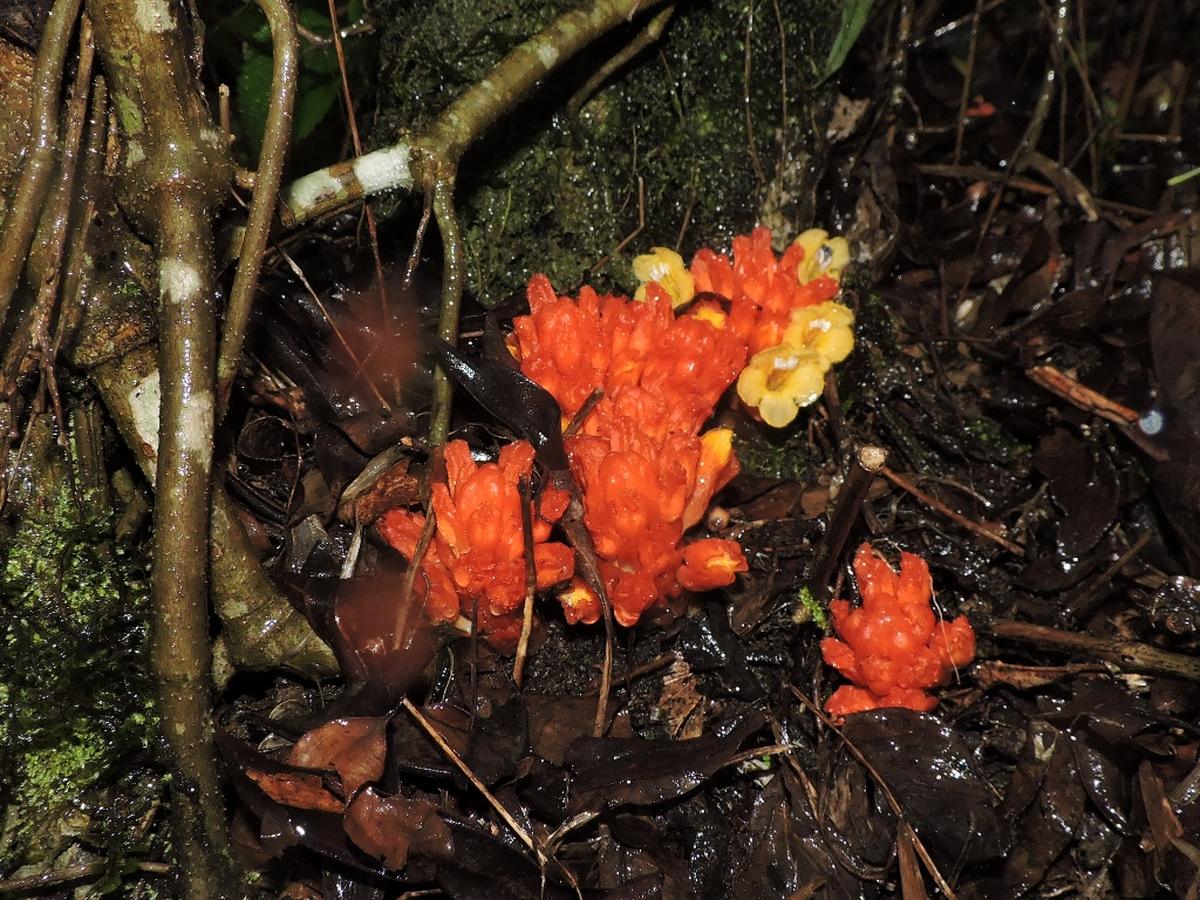
Campbellia aurantiaca in its habitat.
| Photo Credit:
Special arrangement
Wight’s 1849 citation had read thus: “Neilgherries (Nilgiris), in a small clump of jungle by the roadside near Nedawuttim (Naduvattam), flowering in August and September. As seen growing, this is a peculiar looking plant, the deep orange coloured tops only appearing above ground.”
A few years ago, Mr. Salim had chanced upon a “few vibrant orange clumps of a holoparasitic species thriving in humus-rich, moist, shady soil,” according to the research paper.
Holoparasitic plants are incapable of photosynthesis and are dependent on the host plants for nutrients. Careful examination of its characteristics, supported by an extensive survey of literature, had helped them establish it as Campbellia aurantiaca.
Physically, the plant grows to a length of 13-17 cm long. The paper in the Kew Bulletin has noted that the present specimens have been collected from an eco-sensitive area vulnerable to landslides, and therefore “encounters severe natural threats in the locality.”
Published – December 03, 2025 01:34 pm IST