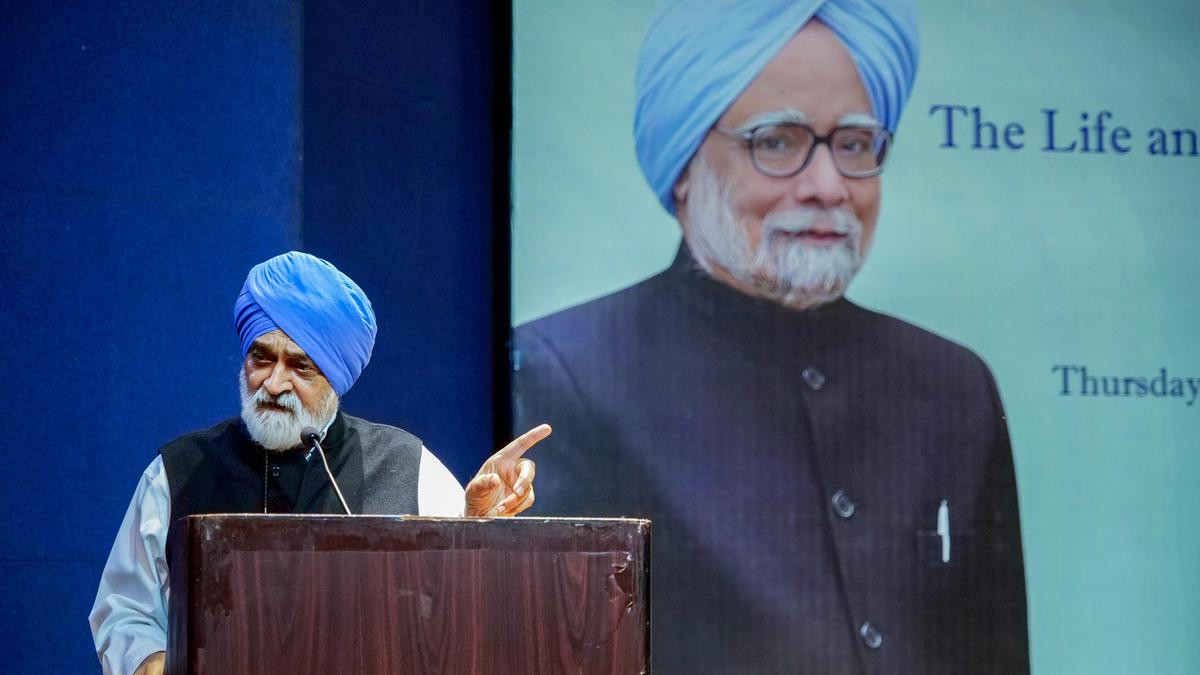
Economist Montek Singh Ahluwalia delivers a lecture on ‘The Life and Legacy of Dr. Manmohan Singh’, as part of the Prime Minister’s Lecture Series at the Prime Ministers’ Museum and Library (PMML), in New Delhi on November 13, 2025.
| Photo Credit: ANI
One of the late Manmohan Singh’s important achievements during his 10 years as Prime Minister was retaining the focus on economic growth, eminent economist and former Deputy Chairperson of what was then the Planning Commission, Montek Singh Ahluwalia, said on Thursday (November 13, 2025).
Mr. Ahluwalia was delivering a lecture on the ‘Life and legacy of Dr. Manmohan Singh’ at the Prime Minister’s Museum and Library in New Delhi.
He categorised Dr. Singh’s long and highly distinguished career into three parts — an economist-bureaucrat, 1970-1991; Finance Minister of India, 1991-1996; and as the Prime Minister, 2004-2014.
Transformative role
He said that Dr. Singh’s tenure as the Finance Minister was the high point of his career, as it was transformative for the nation.
The former Planning Commission Deputy Chairperson said that as prime minister, Dr. Singh made many important contributions: the MGNREGA programme, the Indo-U.S. Civil Nuclear Deal, and ensuring that economic reforms launched in 1991 under Prime Minister Narasimha Rao and continued by Prime Minister Atal Bihari Vajpayee, were not rolled back despite significant opposition from within his party.
“Within the system, there was this division between the Prime Minister and Mrs. (Sonia) Gandhi. That was also unavoidable because he was not the leader of the Congress party. She led the Congress party, so that was some arrangement. One could argue if it was a good or not good arrangement, but it was clearly a khichdi type government, and it was quite a miracle that they stayed together for five years.”
Multiple constraints
Mr. Ahluwalia said that he (Dr. Singh) was very aware that there were multiple constraints on him. And it was much more than the constraints of coalition politics. “That was an understatement.”
He noted that all this contributed to high economic growth in the range of 8-9% between 2004 and 2010.
“If you take the 10 years together, one important thing was retaining the focus on economic growth.”
Mr. Ahluwalia said that since former PM, the late Atal Bihari Vajpayee, had lost the election despite the “India Shining” campaign, the Left and NGOs felt it should be played down. “Manmohan Singh was aware that this was not the right thing to do,” he said.
He said that the late former PM was able to convince people of the need for change using his personal integrity and austerity.
“In democracy, you cannot expect consensus, but what you can expect is a softening of the stance by the opposition,” he said.
Published – November 14, 2025 12:43 am IST