


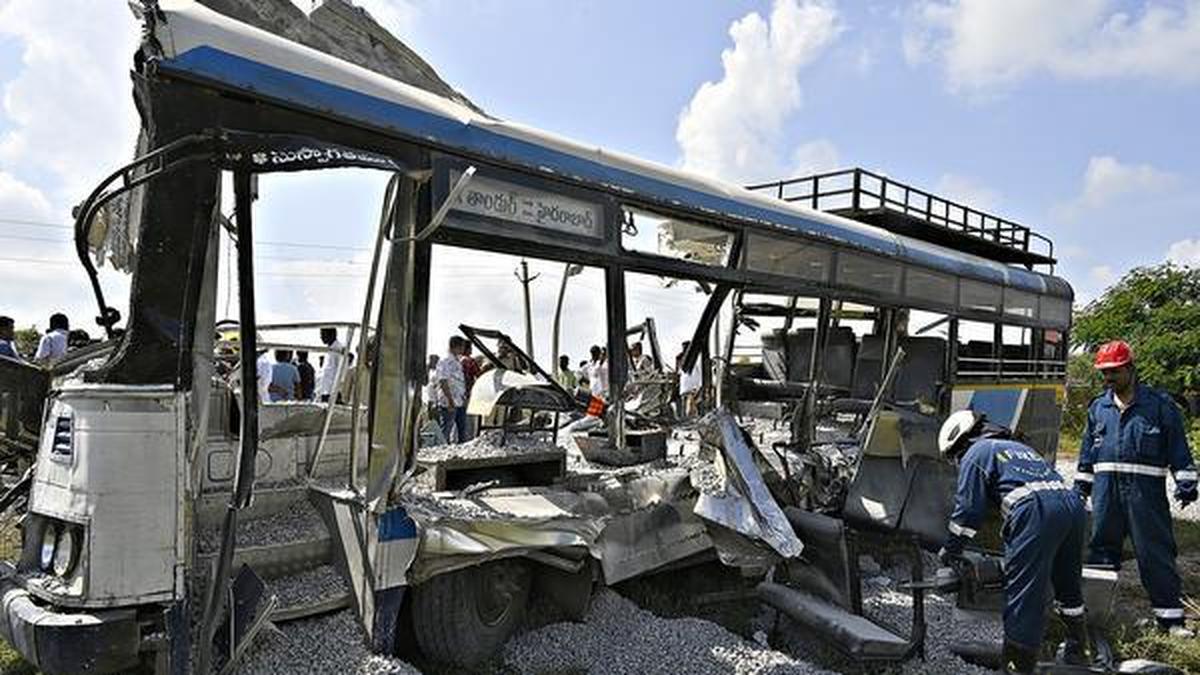
Police and firefighters at the crash site where a tipper lorry collided head-on with the Telangana State Road Transport Corporation (TGSRTC) public transport bus near Chevella in Rangareddy district on November 3.
| Photo Credit: NAGARA GOPAL
The story so far: On November 10, the Supreme Court took cognisance of two mass-casualty road crashes in Phalodi, Rajasthan (14 killed) and NH 163, Telangana (19 killed). More than 1.7 lakh lives were lost in 2023 alone due to road crashes.
What are the problems in licensing?
Licensing and training need to be the first line of defence against crashes, not just an administrative formality. The driver licensing system is meant to be a filtration process, determining who is fit to operate a vehicle and who is not. But, across much of India, driving licences can be obtained without formal training. Driving tests are often reduced to perfunctory turns on small test tracks. For commercial drivers, whose vehicles can weigh more than 15 tonnes and carry dozens of passengers, there is no structured, standardised safety training. And once a licence is issued, few checks are carried out to assess a driver’s continuing skill, physical fitness, or mental alertness. Heavily fatigued drivers — some with compromised vision or chronic illness — routinely operate heavy vehicles carrying unsuspecting passengers, with no mechanism to detect or restrict them.
What is the role of enforcement?
Speeding, overloading, lane violations, and driving under the influence remain among the top causes of fatal crashes. Enforcement against these, however, continue to rely heavily on resource-constrained and unskilled manual policing, making it inconsistent and susceptible to both human error and discretion. Even where technology exists — such as automated cameras and digital challan systems — coverage is limited, data integration is weak, and penalties are often not recovered. The Supreme Court has repeatedly emphasised the need for electronic enforcement standards and technology-based deterrence. But adoption remains patchy across States.
What about weak infrastructure?
From poorly banked curves and no crash barriers to inadequate illumination and missing rest areas that force heavy vehicles to park on the highways, the physical environment of India’s highways and urban roads often turns minor mistakes into fatal outcomes. Many State and national highways were designed decades ago for speed and throughput, not safety. The result has given way to ‘unforgiving roads’ — corridors where a moment’s lapse can mean disaster. Maintenance gaps such as broken dividers, exposed concrete structures, unmarked construction zones, and encroachments are common. In urban areas, pedestrian infrastructure remains minimal or absent, leaving those on foot to compete with heavy vehicles for space.
Evidence from pilot projects show that design-led interventions can reverse this trend. On the Mumbai-Pune Expressway, for instance, evidence-based engineering and enforcement changes under the Zero Fatality Corridor programme have cut crash deaths by more than half.
How can trauma care be improved?
For many victims of road crashes in India, survival depends not on the impact itself, but on what happens in the critical hour that follows. Ambulance networks vary widely in availability and efficiency across the country. In rural areas, delays in decisive care can stretch beyond an hour; even in cities, victims are often extracted by bystanders or the police without proper equipment and little to no medical support. Facilities closest to crash sites often lack trauma specialists, blood banks, or basic resuscitation facilities. A proposed Right to Trauma Care law could mandate time-bound emergency response standards and a coordinated trauma network.
Moreover, licensing, infrastructure, and trauma care are treated as separate silos managed by different departments. Safety can only be achieved when they function as one, reinforced by accountability and coordination.
Piyush Tewari is the Founder and CEO of SaveLIFE Foundation.
Published – November 13, 2025 08:30 am IST



