


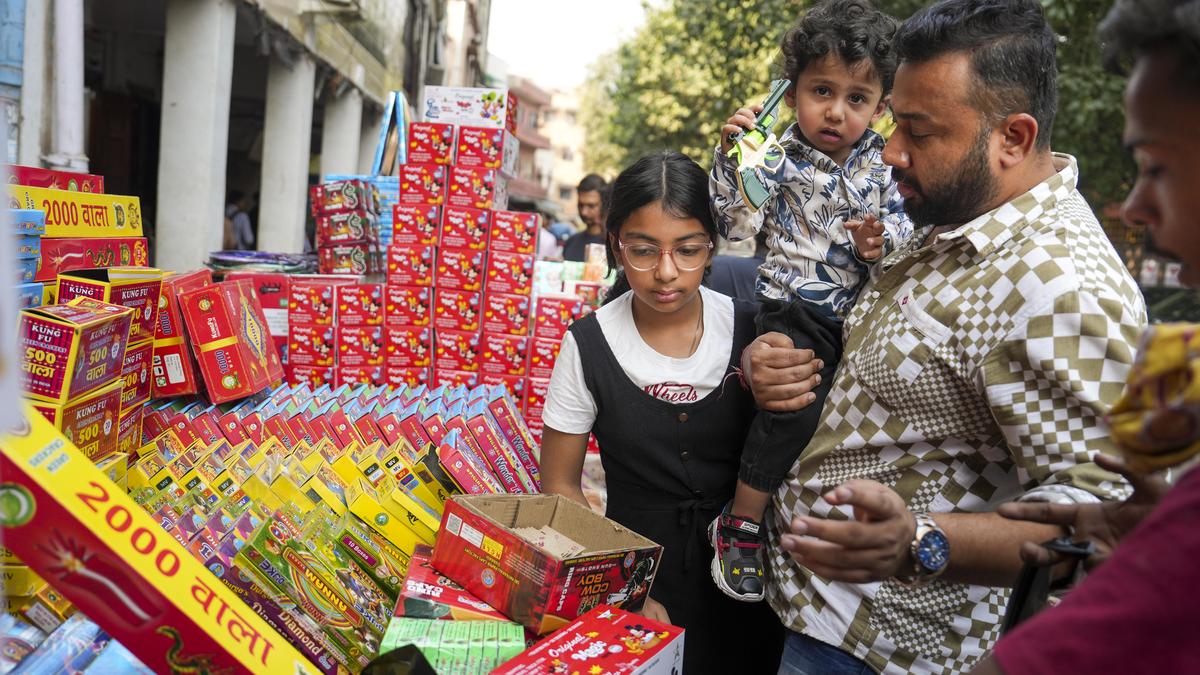
People shop for green firecrackers ahead of the ‘Diwali’ festival, near Jama Masjid in New Delhi, Thursday, Oct. 16, 2025.
| Photo Credit: PTI
The story so far: In the run-up to Deepavali, the Supreme Court legalised the sale of “green” crackers, in a bid to balance three competing interests: the “sentiments” of the people during the festive season; the pollution caused due to the burning of firecrackers; and livelihood concerns of those employed in the firecracker industry. The largely small-scale informal sector has been hit by the cracker ban in the National Capital Region since 2018.
How are ‘green’ crackers made?
In 2018, the Nagpur-based CSIR-National Environmental and Engineering Research Institute (NEERI) initiated the development of “green” crackers that reportedly cut particulate emissions by a minimum of 30%, and sometimes up to 80%, while maintaining brightness, safety, and shelf-life. This was largely achieved by three major chemical-formulation changes: the use of additives such as ‘zeolite’; water-releasing molecules such as boron-based reagents to act as dust suppressants; and the addition of metallic composites to enhance combustion temperature and improve combustion efficiency. Traditionally, firecrackers have been made with barium nitrate, antimony and a range of metals that, over the years, have been linked to respiratory diseases and even cancer.
The green avatar of the ‘flower pot’, one of the most popular fireworks, has a mixture of water and lime that is chemically stored in the cracker. When lit, the effulgence also triggers water, and the moisture, its makers contend, wets the dust-and-smoke particles making it settle rather than becoming airborne. NEERI claims that tests in its labs have seen a reduction of nearly 30% in particulate matter and also reduced the release of sulphur dioxide as well as nitrous oxide emissions when these flower pots are burnt. Green sparklers use 32% potassium nitrate, 40% aluminium powder, 11% aluminium chips, and 17% “proprietary additives” to reduce PM10 and PM2.5 to 30%.
Similarly, a new formulation of a ‘bomb’ named ‘SWAS’ uses 72% of a “proprietary additive,” 16% potassium nitrate oxidiser, 9% aluminium powder, and 3% sulphur to reduce PM10 and PM2.5. Since these crackers were developed, there have been demonstrations by NEERI at major fireworks manufacturing units such as Sivakasi in Tamil Nadu.
What has been the uptake?
NEERI, according to the Commission for Air Quality Management (Delhi-NCR), had also developed a Standard Operating Procedure (SOP) to register green cracker manufacturers and to provide technology transfer of the formulations for manufacturing such crackers. The list of green crackers have been put on the website of NEERI for registration and grant for individual products. It would require the manufacturer to get multiple registrations from NEERI based on the number of products. Only manufacturers with an explosive licence from the Petroleum and Explosives Safety Organisation (PESO) would be granted registration by NEERI. This year, there were nearly 1,500 applicants who procured a licence to manufacture these crackers with the vast majority of them from Tamil Nadu, followed by West Bengal. The term “green” cracker, strictly speaking, is a misnomer as green usually refers to zero-emission-or-smoke products. An electric vehicle, for instance is ‘green,’ as it is powered by a battery with no carbon emissions. In an academic article from 2023, scientists from NEERI when evaluating the results from such crackers referred to them as ‘Reduced Emission Fireworks,’ a more accurate term. However, the SC order refers to these products as “green”.

Are green crackers less polluting?
The stated claim of the makers is that they reduce particulate matter pollution by 30%. However, these are numbers computed by the lab themselves and have not been verified in real-world conditions. The Supreme Court in its order noted that relative to 2018 and 2024, there was “not much improvement” in the overall air quality. However, it used this to conclude that, therefore, permitting green crackers for Deepavali, though with restrictions on their use, could not make the deteriorating air quality much worse than it already was. On October 20 and 21, air quality deteriorated to ‘very poor’, according to readings from sensors through the NCR. In the days leading up to the festival, the air quality was already on a decline. This is not unusual in mid-October, given dipping temperatures and a drop in wind speed. Several sensors recorded particulate matter concentrations well over 1,000 microgram/cubic metre. A contributor to this was also stubble burning in Punjab but there is no official or independent scientific measurement available yet of their relative contribution.
Published – October 26, 2025 12:25 am IST



