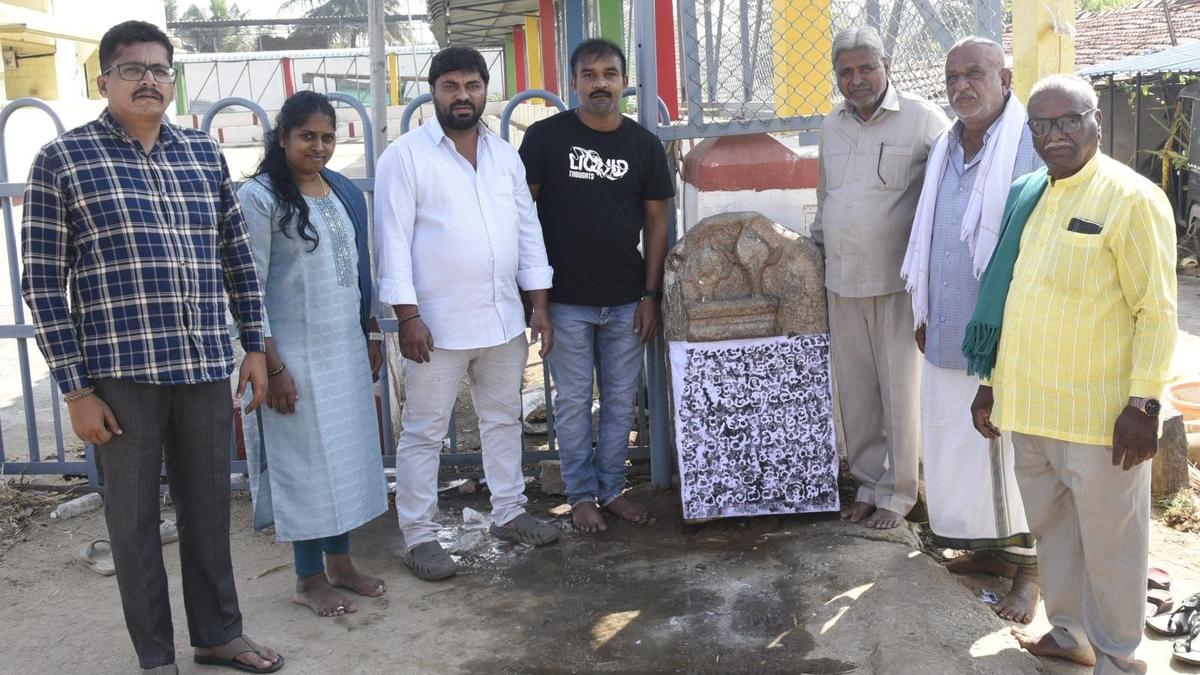
Archaeologist from Centre of Excellence for Studies in Classical Kannada in Mysuru Dr. Shashidhara C. A. (4th from left) posing with the inscription and other members of the team, in the Mahalakshmi temple at K. Bettahalli village in Pandavapura taluk of Mandya district in Karnataka..
| Photo Credit: Special Arrangement
A rare multi-lingual stone inscription dating to the 12th century reign of Hoysala king Narasimha I has been discovered outside the Mahalakshmi temple at K. Bettahalli village in Pandavapura taluk of Mandya district in Karnataka.
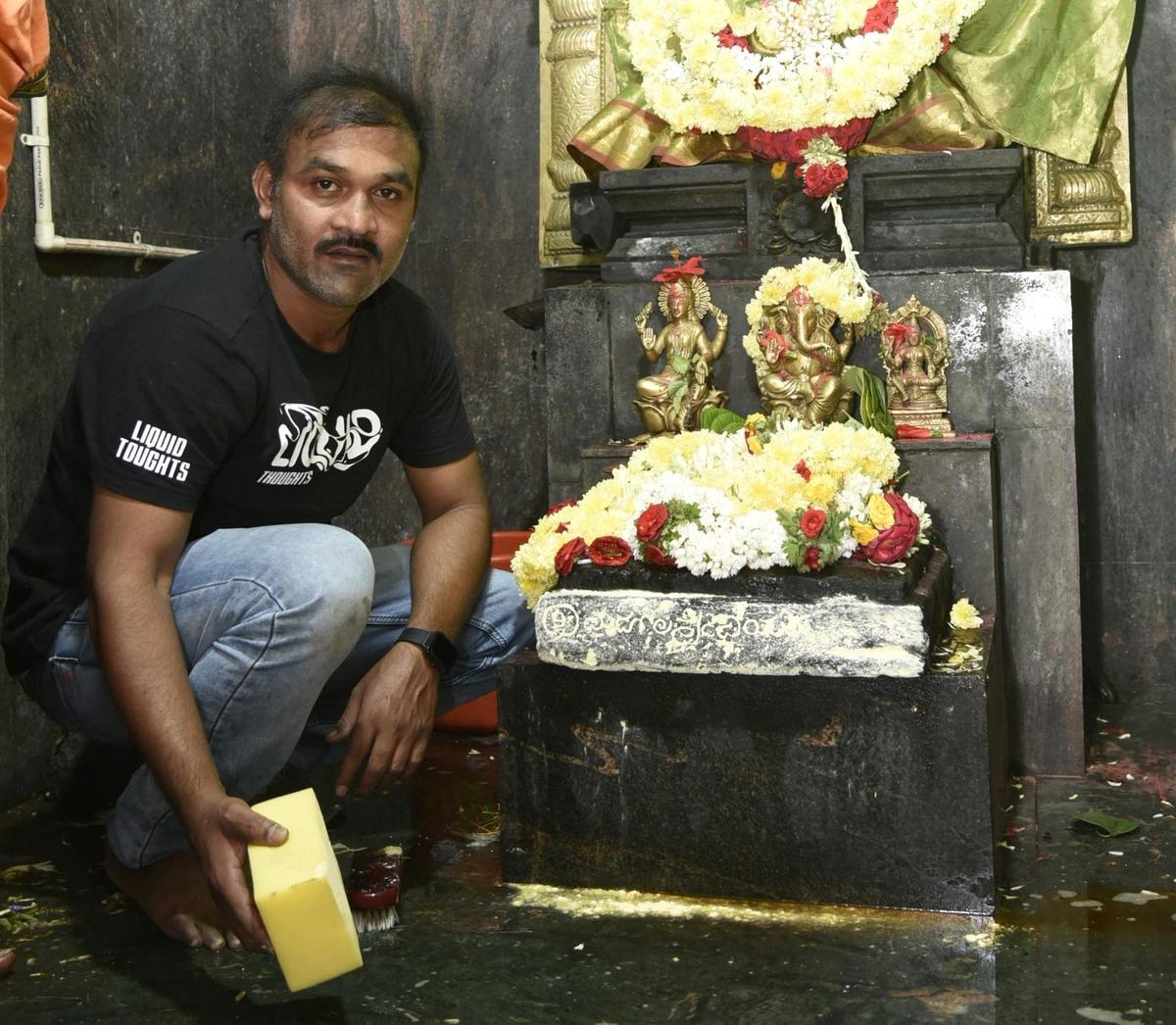
Archaeologist Dr. Shashidhara posing near the inscription found on the pedestal beneath the sculpture of the goddess inside the sanctum sanctorum of the Mahalakshmi temple in K Bettahalli village in Mandya district of Karnataka.
| Photo Credit:
Special Arrangement
The inscription is carved on white granite that measures about two feet in width and two-and-a-half feet in height. It consists of nine lines of text.
“Estimated to be around 850 years old, it is a multi-lingual inscription written in Kannada script employing Kannada, Tamil and Sanskrit languages,” said Dr. Shashidhara C. A., an archaeologist, who undertook a field exploration after being alerted by K. S. Mahadevagowda, a retired teacher residing in the area.
The Mahalakshmi temple outside which the inscription was found was originally constructed during the Hoysala period, and later renovated.
The inscription opens with the auspicious invocation ‘Svastishri’ and bears embossed carvings of Vishnu’s emblems – the conch (sankha) and discus (chakra). It records that during the reign of Hoysala king Narasimha I, Karikundi Tillai Koottandi, who served as dandanayaka (military commander), donated the territory of Mudana Battahalli (present day K. Bettahalli) for the purpose of conducting temple festivals and rituals at the Vittirunda (Krishna) temple at Sri Yadava Narayana Chaturvedi Mangala (modern-day Kere Tonnuru).
“It is likely that this land grant was executed by Karikudi Tillai Koottandi. This inference is supported by other inscriptions from the reign of Narasimha I associated with the same Krishna temple, which record additional donations of villages by Karikudi Tillai Koottandi for maintaining the Nandadipa”, according to a statement.
Inside the sanctum of the Mahalakshmi Temple at K. Bettahalli, an inscription carved on the pedestal beneath the sculpted feet of the goddess reads ‘Sri Mahalakshmi Deviyaru’ executed in the Hoysala period script.
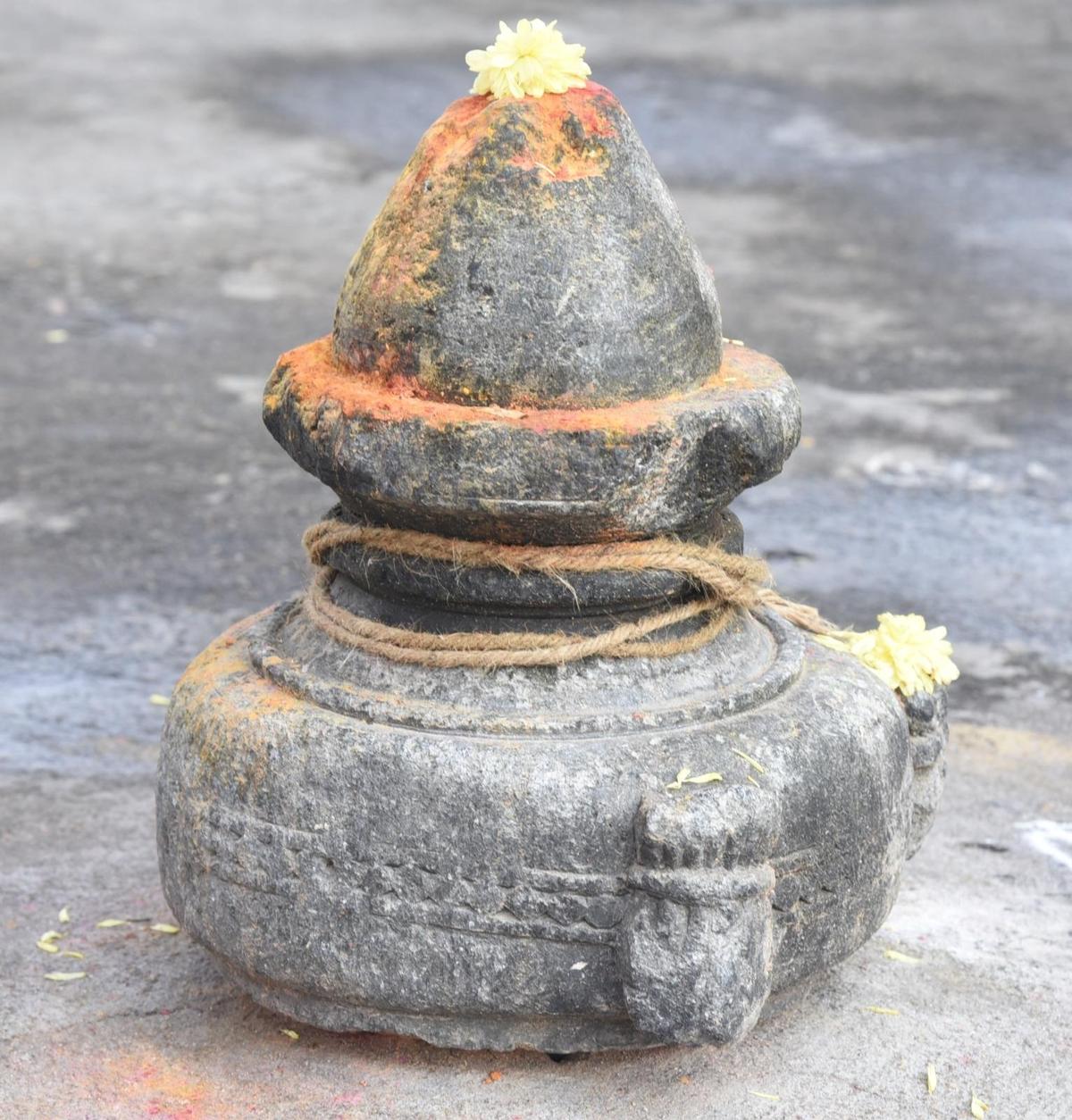
The broken soapstone kalasha in the temple at K .Bettahalli village.
| Photo Credit:
Special Arrangement
Also, near the Balipitha (sacrificial altar) within the temple complex, a soapstone kalasha sculpture is preserved. “This sculpture was originally installed atop the temple’s sikhara (tower) during the Hoysala period, but is now in a broken condition”, according to the statement.
“At present, the kalasha stone and the inscribed pedestal beneath Mahalakshmi’s feet constitute the only surviving architectural and epigraphical evidence confirming the temple’s Hoysala origin. Additionally, two hero stones (viragallu) depicting scenes related to warfare, cattle raids, and penbuyyal (erected in memory of the men who laid down their lives protecting the modesty of women) are found on both sides outside the temple compound wall”, according to the statement.
Professor M. N. Talwar, Project Director, Centre of Excellence for Studies in Classical Kannada, Mysuru, under whose leadership the exploration work was carried out, stated, “…From this discovery, one may infer the close relationship that existed between Kannada and Tamil languages, and between Kannadigas and the Tamil commander Karikudi Tillai Kootandi. It stands as clear evidence that Tamilians also served as military commanders in the armies of the Hoysala kings in the Kannada region”.
Senior archaeologist, Mysuru, Professor N. S. Rangaraju said other inscriptions from Tonnur show that Dandanayaka Karikudi Thillai Kuttandi made more land donations to the same deity — lord Krishna. “One of the record states that he bought land for 80 gadyanas from a man named Keshava Dikshita, and then donated that land to the deity. The inscription also notes that members of the village assemblies of Tailur and Maduru were witness to the donation,” he added.
Published – January 08, 2026 03:30 pm IST