


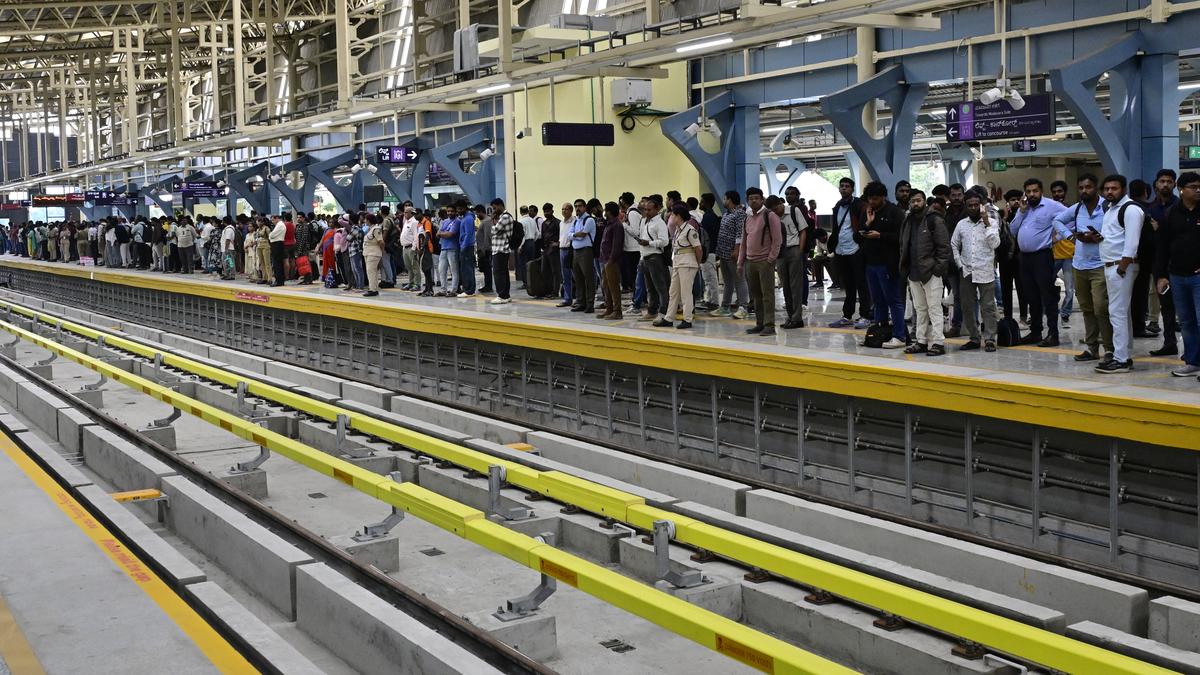
Passengers wait to board trains on the Namma Metro Yellow Line in Bengaluru.
| Photo Credit: The Hindu
The inauguration of Namma Metro’s Yellow Line in August 2025 was expected to be a moment of celebration for Bengaluru. Instead, an incomplete line operating at one-fifth of its planned capacity has delivered overcrowded trains, packed stations, and a suboptimal commuter experience.
By 2023, Bengaluru had a finished metro line, but no trains to run on them. The delay in procuring trains is linked with geopolitics. In 2019, the Bangalore Metro Rail Corporation Limited (BMRCL) invited bids for the train sets that would be used on Phase-2 of Bengaluru’s metro system. Eventually, Chinese state-owned rail manufacturer, CRRC, secured a ₹1,578-crore contract for 36 train sets of six coaches each. The cost per coach for this contract (₹7.3 crore) was significantly cheaper than other competitors. The bidding process was done under the L1 system, by which the lowest cost bidder always wins as long as they meet certain basic, baseline criteria.
The contract mandated that 75% of the production take place in India. As a result, CRRC decided to build a new plant at Sri City in Andhra Pradesh. It agreed to supply the first set of 12 coaches from China within 87 weeks, then ramp up to deliver the remaining 204 coaches from India.
The 2020 Galwan incident heightened tensions between China and India. It also slowed many large Chinese-related infrastructure ventures: any direct investments from Chinese firms needed Cabinet permission and approval from the Home and External Affairs Ministries. This meant that the FDI and component inflow that had to happen for CRRC to set up its Sri City factory was now in limbo. CRRC technical staff were denied visas.
The land transfer for the Sri City factory also faced barriers. Customs seized imported parts for inspection for long stretches; those parts had to be released eventually by a special clearance from the Union Cabinet. By mid-2021, BMRCL tried to cancel the contract with CRRC altogether. CRRC responded that between the policy shifts and COVID-19, it was exposed to force majeure events. The legal proceedings involved both the Delhi and Karnataka High Courts and were slow.
Once the courts ordered the contract to stand, CRRC accepted a workaround. It formed a joint venture with the Indian rail firm, Titagarh Rail Systems Ltd (TRSL). CRRC shifted local manufacturing to TRSL’s plant in West Bengal. But the transition took time as any items or visitors from China faced scrutiny. It was only at the start of 2024 that a prototype six-coach train arrived in Bengaluru from Shanghai. The second and third trains, assembled locally, arrived in early 2025. By August 2025, the line was opened at a limited capacity. It was decided that more trains would be added later, when they were manufactured by TRSL.
As a result of this delay, the total outlay rose by 32%, adding ₹1,866 crore to the project. Since the original difference between CRRC’s bid and an Indian competitor was around ₹410 crore, the extended delay cost far more than what was saved by choosing the cheaper Chinese bid. Additionally, the total final cost that taxpayers had to pay for the Yellow Line evened out to about ₹7,610 crore, giving it a ₹400 per kilometre cost, which is higher than usual for elevated metro lines in India.
The policy lesson from this saga is that critical infrastructure procurement must align with long-term strategic posture. The essential calculation is whether the price advantage offered by a Chinese supplier is worth the risk of geopolitical uncertainty. Regardless, once a decision is taken to allow Chinese capital, there must not be any ex-post reversals. Also, instead of banning Chinese investment altogether, it would be more practical for India to adopt a graduated investment-review mechanism. Low-security-risk items could be sourced globally to leverage cost benefits, while the highest risk segments might require deeper scrutiny. Once a firm passes these requirements, it should be free to complete its project without policy reversals. Finally, instead of relying on a L1 approach, India should adopt the Quality-cum-Cost Based Selection method for infrastructure procurement. This combines a technical evaluation with a financial evaluation to award a contract to the highest composite scorer. It allows decision-makers to consider reliability and strategic concerns alongside raw cost, reducing the chance of sudden disruptions.
The authors are with the high-tech geopolitics programme at the Takshashila Institution
Published – October 08, 2025 01:30 am IST




