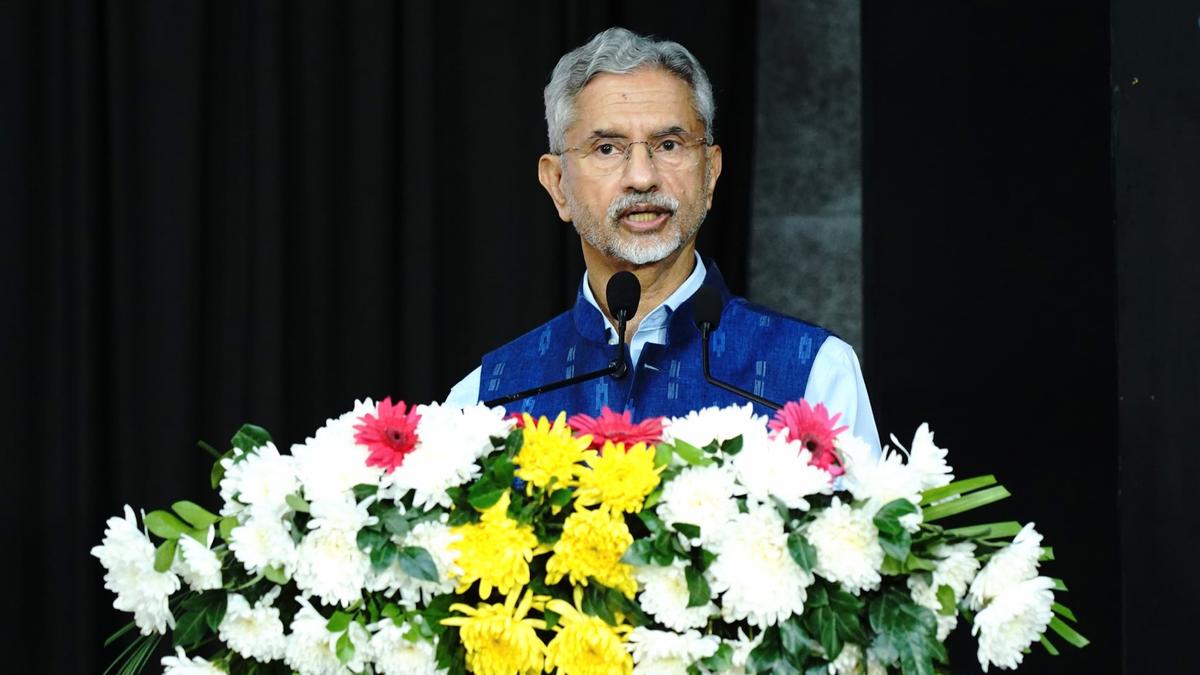
External Affairs Minister S. Jaishankar at the launch of the Aravalli Summit, organised by the Jawaharlal Nehru University’s School of International Studies on Monday, October 6, 2025. Photo credit: X/DrSJaishankar
India has always exerted its strategic autonomy, External Affairs Minister S. Jaishankar said, referring to India’s decision to sign a friendship pact with the Soviet Union in 1971, as a “necessary” choice, given the triangular threats India faced from the other big powers, the United States and China. Speaking at the launch of the Aravalli Summit, organised by the Jawaharlal Nehru University’s (JNU) School of International Studies, marking its 70th anniversary, Mr. Jaishankar, an alumnus of the school himself, said that it was necessary for students of foreign policy to factor a future of multi-alignment and multipolarity. Mr. Jaishankar said recent global volatility, including the imposition of tariffs by the U.S., had made the case for multi-alignment, more than allying with any one power, much stronger.

“Imagine if [India were] not today adopting strategic autonomy. Please tell me, which country in the world would you like to join up with and put [India’s] future in their hands?” he asked. “I can’t think of anybody. [India’s] interest is best secured by maximising its options, maintaining [its] freedom of choices,” he said. Mr. Jaishankar’s comments came a day after he said that trade negotiations with the U.S. would have to respect India’s “red-lines”.

The government has also been facing increased pressure from the U.S. over the issue of Russian oil imports. While Mr. Jaishankar did not refer directly to India’s position, amidst reports that Russian oil imports in September have been considerably reduced, he praised India’s stand during the 1971 war with Pakistan and Liberation of Bangladesh, when India signed a Friendship Treaty with the Soviet Union.

“What we did was in our national interest — we were dealing with a U.S.-China triangle and we had to find a way out of this,” Mr. Jaishankar said, answering questions from students at the event, which was co-hosted by the Ministry of External Affairs, and the newly launched, Delhi-based, Adani Group-owned think tank Chintan Research Foundation. “So, the decision we took in the midst of an acute national security crisis, was necessary,” he added, addressing the audience, which included a number of diplomats, including, significantly, the Ambassador of Russia to India Denis Alipov, and Bangladesh High Commissioner Riaz Hamidullah.

When asked about India’s neighbourhood first policy amidst signs of strains with a number of neighbours including Bangladesh, and protest-led regime changes in Sri Lanka and Nepal, Mr. Jaishankar said India has to be prepared to unilaterally “underwrite the infrastructure for cooperation” with countries in the region, and should become the “go-to option” for neighbouring countries when in need.
“Every country has problematic neighbours, and every big country has more problematic neighbours,” the External Affairs Minister said, stressing that the purpose of India’s policy was not merely to solve problems, but to “manage relationships to national advantage”. Without directly naming Pakistan, he said that barring one country, India has effected “transformational change” in projects with neighbouring countries, in the areas of energy, roads, railway lines, and the movement of people.
To a question about the “re-hyphenation” of India with Pakistan, post Operation Sindoor, and a reference to recent developments where the U.S., Saudi Arabia, China, Turkiye, and other countries have forged closer ties with Islamabad, Mr. Jaishankar said that India “cannot wish away a difficult neighbour”, as that is a “reality”. But he said that other countries no longer draw an equivalence between India and Pakistan.
Published – October 06, 2025 10:01 pm IST