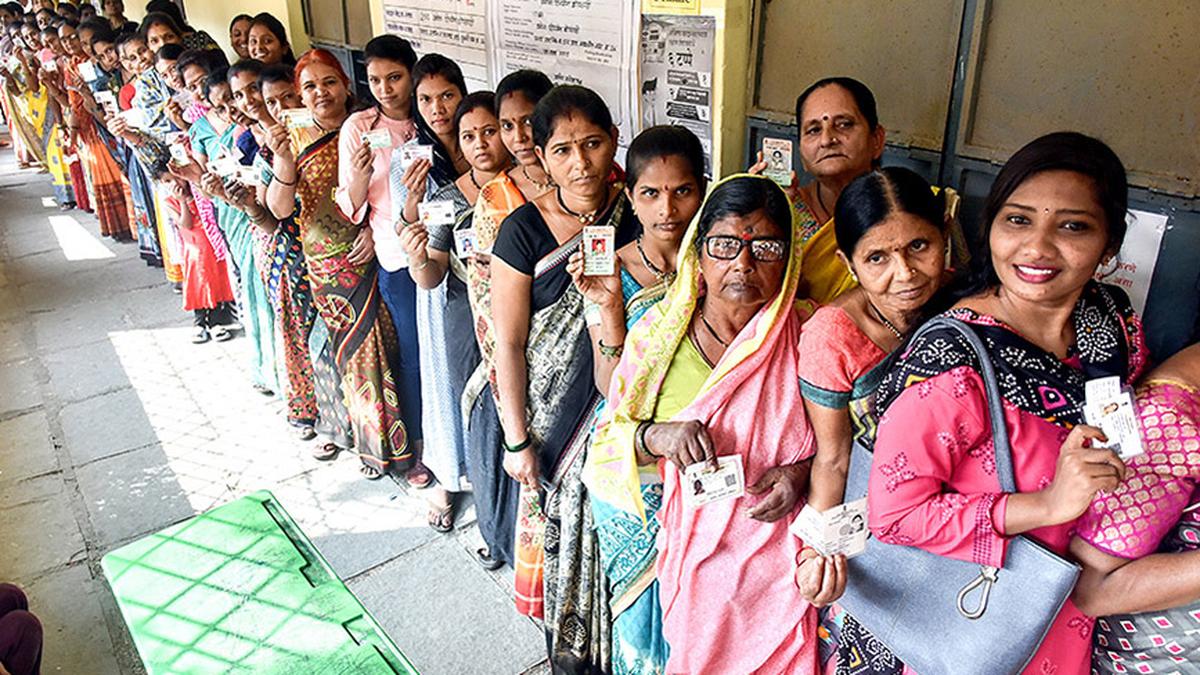
The State Commission cited insufficient EVM machines, the school education board’s examination, and an insufficient number of officers to justify the non-compliance with the Court’s order
| Photo Credit: ANI
The story so far:
The Supreme Court recently directed the Maharashtra State Election Commission to conduct elections of all local bodies by January 31, 2026. It also pulled up the Commission for not complying with its earlier order of May 6, directing it to notify the elections by September 6.
What are the reasons for the delay?
The continuous delay in conducting these elections is attributable not only to the pendency of the OBC (Other Backward Classes) reservation issue, but also the judicial delays, inconsistency, and lack of political will.
Today in Maharashtra, 29 Municipal Corporations, 248 Municipal Councils, along with hundreds of Nagar Panchayats, 32 out of 34 Zilla Parishads, 336 out of 351 Panchayat Samitis are run by administrators. While the biggest municipal corporation in India, the Brihanmumbai Municipal Corporation (BMC), with an annual budget of over ₹74,000 crore, has been functioning without corporators since March 2022, the newly formed Municipal Corporations in the State, at Jalna and Ichalkaranji, await their corporators since their inception.
What is the issue around OBC reservation?
In 2010, the Supreme Court left it to the States to carry out a ‘rigorous investigation’ to decide which communities are ‘politically backward’ and should benefit from OBC reservation in local bodies. In March 2021, the apex court laid down a three-fold test to provide these reservations. As the State of Maharashtra failed to fulfil this test, in March 2022, the Banthia Commission was set up. It submitted its report in July 2022, which is currently under challenge before the Supreme Court. Meanwhile, the court ordered that States should carry out elections without the OBC quota if they fail to fulfil the criteria. Thus, the Commission conducted elections in 106 municipalities after relocating the OBC quota seats to the general category.
On May 6 this year, the apex court directed the State Election Commission to conduct elections with OBC reservation as existed prior to the 2022 Banthia Commission report. It reminded the Commission how local body elections are necessary for keeping democracy alive at the grassroots. While the Court’s sentiment for conducting elections is commendable, it does not absolve the Court from the delay it caused. It will also lead to inconsistent outcomes as the election of 106 municipalities has already taken place without the OBC reservation. Additionally, the current elections are also subject to the outcome of pending litigation, which can potentially disqualify the elected representatives.
Despite the above orders, the State Commission took no steps to conduct elections. It cited insufficient EVM machines, the school education board’s examination and an insufficient number of officers to justify the non-compliance with the Court’s order. The State government also seemed in no hurry for all past years to push timely elections.
Is the delay impacting work?
Some may argue that the lack of having elected representatives at local bodies hasn’t really harmed anyone, given that bureaucrats are anyway running them. However, in reality, the developmental engine in both urban and rural areas has taken a hit due to democratic damage of weakened local bodies. People do not have a political avenue to voice their concerns. The burden automatically falls on local MPs or MLAs or guardian ministers of the district who are not readily available.
On the other hand, the bureaucracy is not really designed to ‘make’ decisions, but rather to ‘execute’ them. It is an undue burden on administrators to care for political issues, which fundamentally is the mandate of elected leaders. Political accountability of bureaucracy is clearly missing.
Running the local bodies through bureaucrats is no different from running a State through its Governor. This reality ultimately results in ignorance of people’s demands, pendency of larger policy issues, lack of local economic development, undue burden on bureaucrats and weakening of democratic institutions.
Recently, Maharashtra Chief Minister Devendra Fadnavis announced that all 29 Municipal Corporations shall be headed by IAS officers, owing to allegations of corruption and political interference. This move itself suggests that urban local bodies are difficult to handle, especially when there is a democratic void. The issue is not just about the absence of elected representatives for a few years in local bodies; rather, it is intentional ignorance of the words and mandate of the Constitution. Having a strong self-governance system at the local level, especially in villages, is a part of the law, after the 73rd and 74th constitutional amendments. An independent election commission and smooth transfer of power are hallmarks of constitutional liberal democracy. While the New York Mayoral election gains worldwide attention, we should inquire into why the lack of having an elected local body for Mumbai is not causing a noteworthy discontent.
Girija Bhosale is a law graduate from NLSIU and worked as a law clerk at the Supreme Court
Published – October 06, 2025 08:30 am IST