

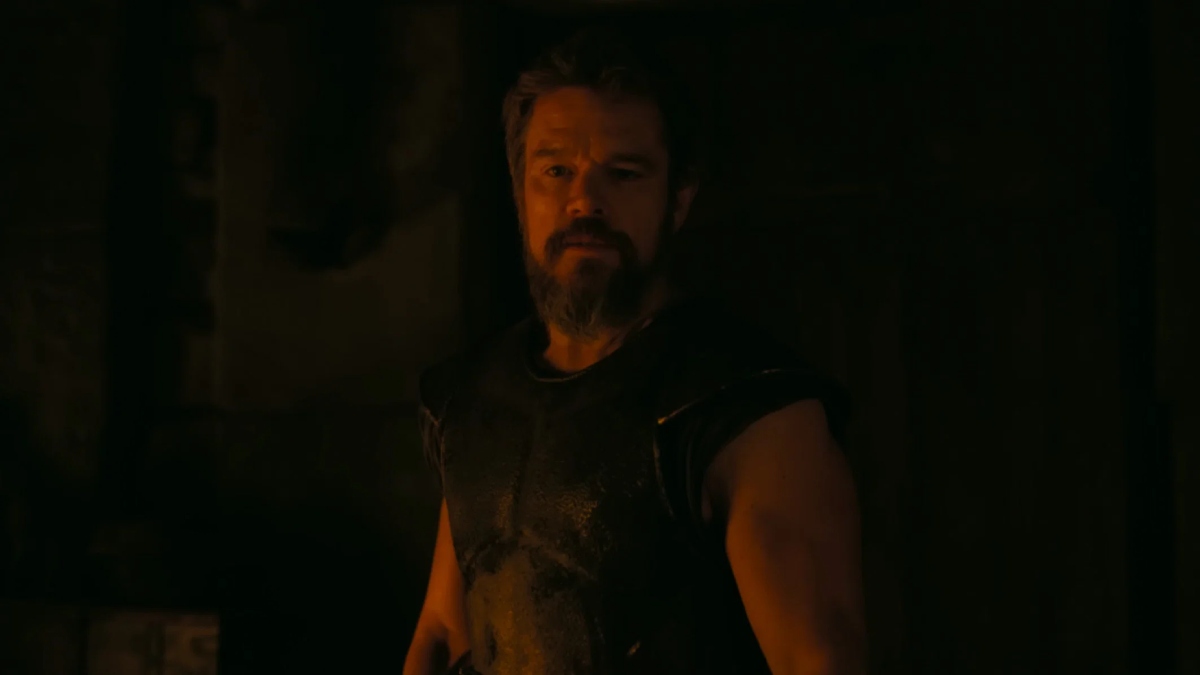

Despite being filled with sea monsters, gods and battles, Christopher Nolan’s The Odyssey focuses on a much more subtle concept, Zeus’ Law. This concept is not just another element of Greek mythology used in the film; rather, it becomes the moral compass of the story and the reason Odysseus’ journey home turns into years of suffering.
Whereas Homer’s work has always explored fate and the will of the gods, Nolan takes a much more human approach, raising the question of whether trust can ever truly be rebuilt once it has been broken in the pursuit of victory.
What exactly is Zeus’ Law?
Zeus’ Law comes from the ancient Greek idea of xenia, often described as sacred hospitality. In those times, travellers relied entirely on strangers for food, shelter and protection, so welcoming a guest was considered a sacred duty. The belief was simple: any stranger could be Zeus, or another god, disguised as an ordinary person.
That responsibility worked both ways. Hosts were expected to offer kindness and safety, while guests were expected to behave with respect and never exploit the generosity shown to them. Breaking that trust was not simply seen as bad manners; it was considered an offence against the gods themselves.
Nolan has spoken about this idea as one of the foundations of civilisation. In a world where survival often depended on the kindness of strangers, hospitality was not just a virtue, it was essential.
Why does it matter in The Odyssey?
The film’s biggest twist on Homer’s story is the way it looks at the Trojan Horse. History remembers it as one of the cleverest military strategies ever devised, but Nolan asks audiences to see it from another perspective.
The horse was offered as a gesture of goodwill, a symbol of kindness. But it actually hid soldiers who would destroy Troy from within. According to Nolan, this was not just a brilliant strategy, it was a direct violation of Zeus’ Law. A symbol of trust became a deadly weapon.
From then on, Odysseus is no longer simply searching for his way home. All the dangers that befall him are portrayed as punishment for breaking a sacred code rather than as accidents of fate.
What is the meaning behind the film?
By the time Odysseus finally arrives in Ithaca, he is far from the celebrated hero who departed to fight in Troy. Through Zeus’ Law, Nolan demonstrates that societies are built on trust, respect and honesty. Once these values are betrayed, the consequences extend far beyond the individual or the battle itself.
This is why The Odyssey carries such emotional significance. Behind all the spectacle, Nolan has crafted a story about guilt, responsibility and how fragile civilisation can be. It is a lesson drawn from an ancient tale, yet one that remains remarkably relevant today.



