

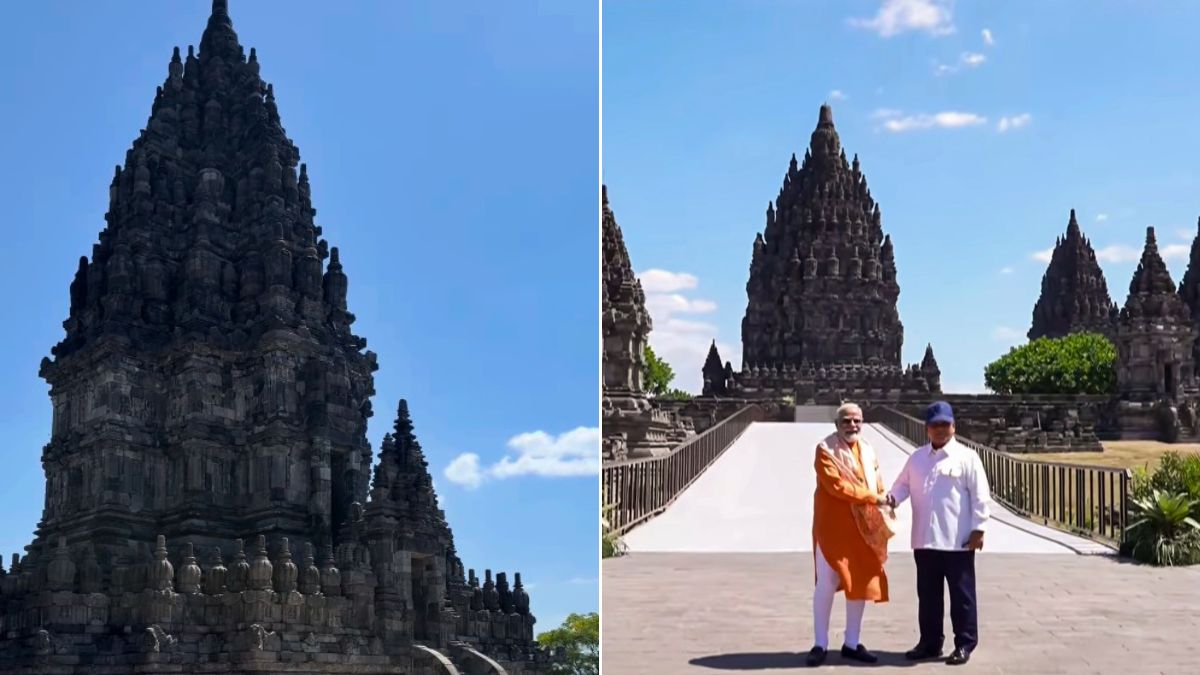

Prambanan Temple has once again entered the global spotlight after Prime Minister Narendra Modi and Indonesian President Prabowo Subianto jointly inaugurated its restoration project in Yogyakarta. The visit has renewed interest in one of Southeast Asia’s most remarkable Hindu monuments and the centuries-old connection it represents between India and Indonesia.
While Indonesia is today the world’s largest Muslim-majority nation, Prambanan stands as a remarkable reminder of the country’s rich Hindu past. Built more than a thousand years ago in Central Java, the temple complex continues to draw pilgrims, historians, architects and travellers from around the world. Its soaring towers, intricate stone carvings and religious significance have made it one of Indonesia’s most celebrated cultural landmarks and a UNESCO World Heritage Site.
How Prambanan Temple reflects India and Indonesia’s shared heritage
Prambanan is more than a historic monument. It tells the story of a civilisational relationship that has linked India and Indonesia for well over a millennium through religion, trade, language, literature and art.
Built in the 9th century during the Mataram Kingdom, the temple reflects the spread of Hinduism across Southeast Asia and the way those ideas took root in Java. Rather than simply replicating Indian traditions, the people of ancient Java adapted them into their own artistic and cultural expression, creating a monument that is distinctly Indonesian while remaining deeply connected to Hindu civilisation.
That shared heritage can be seen throughout the complex. The temple is dedicated to the Hindu Trimurti of Lord Shiva, Lord Vishnu and Lord Brahma, while many of its beautifully carved relief panels depict scenes from the Ramayana. Although based on one of India’s greatest epics, the carvings present the story through the Javanese tradition, highlighting how shared cultural influences evolved across regions while retaining their core identity.
India’s role in the restoration project, jointly inaugurated by Prime Minister Modi and President Prabowo, adds a new chapter to this centuries-old relationship. It also reflects a shared commitment by both countries to preserve a monument that continues to symbolise their historical and cultural ties.
One of the world’s most important Hindu temple complexes
Located near Yogyakarta on the island of Java, Prambanan is the largest Hindu temple complex in Indonesia. According to UNESCO, the original temple compound consisted of 240 temples, arranged in a carefully planned layout inspired by Hindu cosmology.
At the centre of the complex stand three principal temples dedicated to the Hindu Trimurti of Lord Shiva, Lord Vishnu and Lord Brahma. They are accompanied by three smaller temples dedicated to the deities’ respective vahanas or divine mounts.
The Shiva temple dominates the complex. Rising about 47 metres, it is the tallest and most prominent structure at Prambanan and is recognised by UNESCO as the largest temple in the compound. Built during the 9th century, the complex is widely regarded as one of the finest surviving examples of Hindu architecture in Southeast Asia, celebrated for its towering spires, balanced design and exceptional stone craftsmanship.
A UNESCO World Heritage Site with the Ramayana carved into its walls
UNESCO inscribed the Prambanan Temple Compounds on the World Heritage List in 1991, recognising their outstanding universal value as one of Southeast Asia’s greatest cultural monuments.
Among the site’s most celebrated features are the detailed bas-reliefs carved into the temple walls. These narrate episodes from the Ramayana and remain some of the finest examples of narrative stone carving in the region. They also illustrate how an Indian epic was interpreted and preserved within Javanese culture, further reinforcing the temple’s role as a bridge between two ancient civilisations.
Prambanan has endured earthquakes, volcanic activity and centuries of deterioration. Conservation work has been carried out for decades to protect the monument while preserving its historical authenticity. The restoration project inaugurated this week forms part of those continuing efforts, helping ensure that one of the world’s most significant Hindu temple complexes can be preserved for future generations.
ALSO CHECK OUT: Onboard shower to transparent windows: A look inside Vande Bharat Sleeper First AC



