


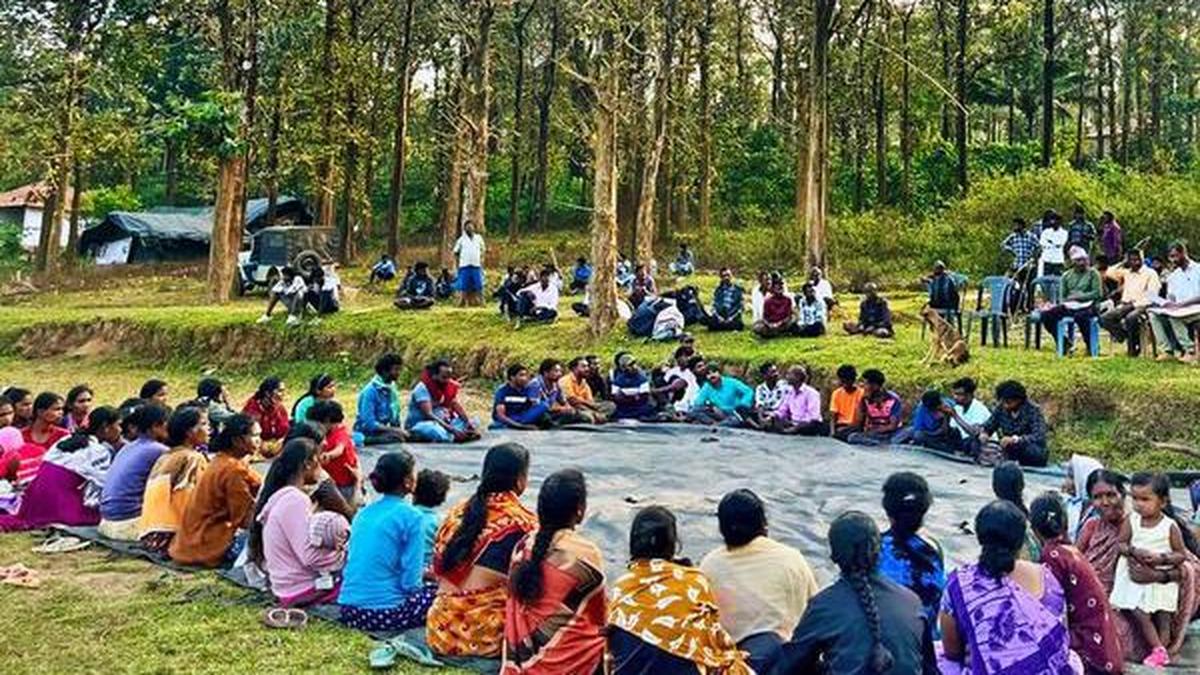
Representative image.
| Photo Credit: Special arrangement
The constitution of a task force in Chhattisgarh this May to fast-track the implementation of laws such as the Forest Rights Act, 2006 and the Panchayats (Extension to the Scheduled Areas) Act, 1996, has led to fresh controversy. Forest and tribal rights activists and the Opposition Congress allege that this undermines statutory bodies set up under these laws and institutionalises the role of Sangh Parivar-linked outfits in the implementation of these laws in tribal-dominated areas.

The Chhattisgarh government, on May 6, notified the task force, comprising an 18-member apex body headed by the Chief Minister and a 12-member implementation body headed by the Chief Secretary of the State. This task force is meant to map potential areas for community forest resource rights claims under the FRA, review pending claims, design strategies for PESA-related matters, and assist district authorities with implementation of the FRA.
The Campaign for Survival and Dignity (CSD), a forest rights civil society collective, has noted in a statement that the Chhattisgarh government’s notification of a task force appeared to be modelled on a similar structure established by the Madhya Pradesh government in November 2024, meant to help with the implementation of the PESA and the FRA in the State. The CSD also flagged that a similar task force structure is likely to be constituted in Odisha as well.

The CSD has asserted that these task forces are a way to include representatives of Sangh Parivar-linked organisations such as the Janjati Suraksha Manch (JSM) and the Akhil Bharatiya Vanvasi Kalyan Parishad (ABVKA) in the process for implementing these laws. Chhattisgarh Forest Minister Kedar Kashyap was unavailable for a comment on the matter.
‘Gold standard’
Interestingly, on May 24, Union Home Minister Amit Shah had addressed a public meeting organised by the ABVKA and the JSM in New Delhi and hailed Madhya Pradesh’s “model of PESA implementation” as the gold standard, adding that BJP-led State governments across the country are preparing to follow in its footsteps. One of the key demands of the JSM and the ABVKA leaderships at this event was to ensure that Gram Sabhas under the PESA include only tribal villagers “who had not converted” to any other religion.
Chhattisgarh-based forest rights activist Alok Shukla told The Hindu that such a task force structure was violative of the very laws they were meant to implement. “The idea of laws like the PESA and the FRA is to strengthen tribal governance at the village level. There are statutory bodies under these laws, like the Gram Sabhas, Forest Rights Committees, Sub-divisional and District level committees and State-level monitoring committees. Instead of strengthening these bodies and ensuring they work as they are supposed to, this is the creation of a parallel structure outside of the statute.”
On Tuesday (June 2, 2026), Congress leader Jairam Ramesh said these task forces “subvert the basic democratic structure of implementation of these two laws”, adding that the ABVKA was the “driving force” behind this move. “Their essential character in letter and spirit is being deliberately sabotaged by such task forces which have executive responsibilities as well. It is not a coincidence that one impact of the task forces will be felt in the exploitation of rich natural resources with little regard to ecological considerations in forest areas by mining companies of whom the most prominent will be the Modani empire,” he said in a statement posted on social media.
Vijaybhai, another rights activist with the CSD in Madhya Pradesh, added that laws such as the PESA and the FRA are “governance” provisions. “By creating such a structure, they are trying to make these laws look like schemes with individual beneficiaries and targets that are to be saturated.” He explained that the task force in Madhya Pradesh, over the last 1.5 years, has not been able to fix any of the systemic issues with the implementation of the FRA.
Similar allegations had been levelled by forest and tribal rights activists last year when the Union Tribal Affairs Ministry had tried to fund the establishment of “FRA Cells” in each State under its larger DAJGUA programme (a scheme saturation programme). At that time too, activists raised the issue of the FRA cells being extra-statutory bodies, following which the Union government had decided to scrap the plans for it and constitute more general supervisory bodies.
Mr. Vijaybhai said, “There are examples of bodies being set up to help with the implementation of these laws, like the cells operating in Chhattisgarh. But these are constituted as recommending bodies and not implementation bodies.”
Published – June 02, 2026 04:45 pm IST



