


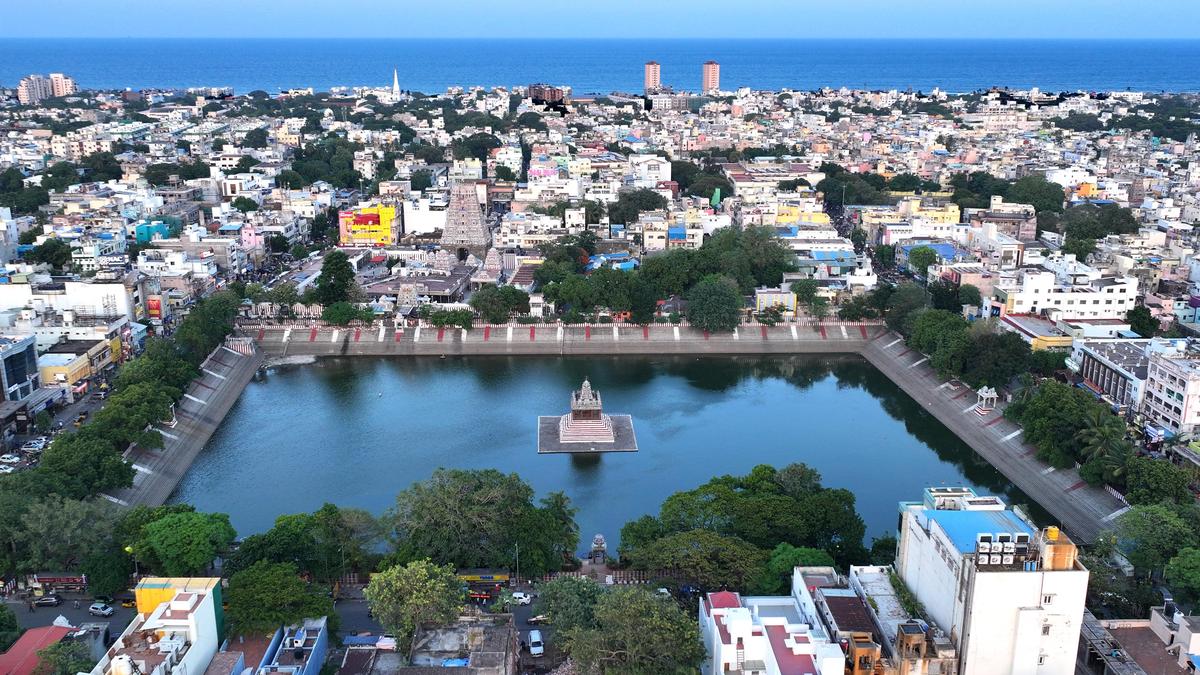
Aerial view of Kapaleeswarar Karpagambal temple tank at Mylapore, Chennai
| Photo Credit: B. Jothi Ramalingam
Come summer and thoughts automatically turn towards water. If you are of the age group that lived through the terrible water scarcities of the 1970s and 1980s in Chennai city, you can be scarred for life. Thereafter, the scarring has been because of floods. The Madras to Chennai transformation is reflected even in our water history.
These days, whenever it floods, we see articles on how many of the natural reservoirs of the city have vanished. Such lists usually begin with the Long Tank of Mylapore, and most of those details are well known. K.N. Kesari, in his memoir Chinnanati Muccatlu, reminisces about how in the 1880s many of the well-to-do in the city got potable water from the Villivakkam tank supplied via carts to their households. Once spread over 219 acres, it is now one tenth that size. Not so well known or documented are tanks – smaller waterbodies, several manmade. The ones attached to temples have survived but not so the others.
It is in this context that it is interesting to read that when the Corporation of Madras, as per the JA Jones scheme, began supplying piped water to localities (and not houses, which happened later), they, apart from building cisterns for storage in various places, also made use of available tanks. Such a list survives in the Administration Report of the Madras Municipality 1875-1876. A digital version is available for download if you type that title. Before I go on to the list, I must add that the Corporation had a tradition of administration reports from the 1800s till the 1990s. These are excellent records of the municipal body’s year by year performance and many of the later ones are available at the Ripon Building archives. A few of the older ones survive as digital copies on the internet.
But to get back to the list – there are 21 tanks in it. Of these, the ones attached to temples are easily identfied, though their condition is hugely variable. Thus the ones at Kapaliswarar, Parthasarathy and Gangadiswarar temples are all well maintained but the same cannot be said of those at Kachaliswarar, Ekambareswarar or the Thiruvateeswarar temple and Chithra Kulam. What however needs closer study are the others listed. The Krishnappa Naicken Tank, located in a square of the same name at George Town has just about survived. It was news to me that the mosque on Angappa Naicken Street had a tank next to it of which there is not a trace now. But there it is in the list, as the Pallivasal Cistern, Ungappa Naick Street.
The army clearly needed its water supply and so we had two regimental tanks, one in Perambur at the Left Wing Lines (how interesting in today’s context) and another at Rundall’s Road, Vepery. They cannot be found now. The Marshall’s Road Tank brought a smile of recognition. It became the Police Lines and then early in the 1920s the sports facility for the force. In the 1970s, this site was converted into the Rajarathinam Stadium. Likewise, the Museum Tank was filled in to build I forget which, either the Connemara Public Library or the Victoria Memorial Hall (now the Art Gallery). The Chepauk Tank, in Chepauk Compound was no doubt the pond that the Government handed out to the Madras Cricket Club when it returned after a sojourn elsewhere following its older site being taken over for the Buckingham Canal. If so, the Chepauk Stadium now stands on it. That the present pitch was once a pond is documented in S. Muthiah’s The Spirit of Chepauk.
The Peddu Naicken Tank on the eponymous street is where Sivagnanam Park, the first to be named after an Indian came up in the late 1800s. It is named after Dewan Bahadur PM Sivagnana Mudaliar, Justice Party member and a Councillor of the Corporation for decades. Recognisable by way of name is Elephant Tank in Triplicane but it is now a thriving residential area with not a waterbody in it. The remaining tanks seem to have vanished leaving not a wrack behind. For example, what do we know of Avadhanam Paupier Tank on the eponymous road in Purasawalkam. Or for that matter the Balakrishnapathy Street Tank in Chintadripet?
Which brings us to the end of the list. There are a few inferences to be made – first, even in the 1800s, the aquifers feeding these tanks did not have the capacity to fill them. The Corporation was thus able to use the volume available for its piped water. Second, the civic body had clearly worked on a system of networking these reservoirs, a scheme that was sadly abandoned later. Lastly, getting rid of waterbodies and utilising the space for real estate is an age-old practice in our city.
(Sriram V. is a writer and historian)
Published – May 20, 2026 07:00 am IST



